

For six years, those of us who questioned the official COVID story were told to wait, defer, trust, and stop noticing what the data was already suggesting.
We watched it with the lab leak. We watched it with masks. We watched it with school closures. We watched it with natural immunity. We watched it with myocarditis. We watched it with vaccine injury reporting. We watched it with DNA contamination.
The frustrating part was never just that institutions got things wrong. Everyone gets things wrong in a crisis. The deeper wound was that the people asking reasonable questions — parents, physicians, data analysts, small-business owners, vaccine-injured patients, and dissenting scientists — were treated as if their questions were a threat.
But something important has changed.
Some of the people who stood with us through the madness — Jay Bhattacharya, Marty Makary, and others who understood early that COVID policy had become cruel, unscientific, and destructive — are now in positions of real influence. They know what it was like to be on the receiving end of the smear machine. They know what questions were suppressed. They know where the bodies are buried, figuratively and, in some cases, literally.
And because of that, we are finally getting results.
That is the spirit in which I want to look at the newest cancer-signal literature. Not panic. Not a victory lap. Not a simplistic claim that one paper proves everything. Biology is messier than that, and cancer is never a one-variable story.
The better question is: do we now see enough signal to investigate honestly, with people in charge who actually want the answer?
The answer is yes.
And for the first time in a long time, there is reason to be grateful that the question might actually be allowed.
This is not one study. It is a convergence.
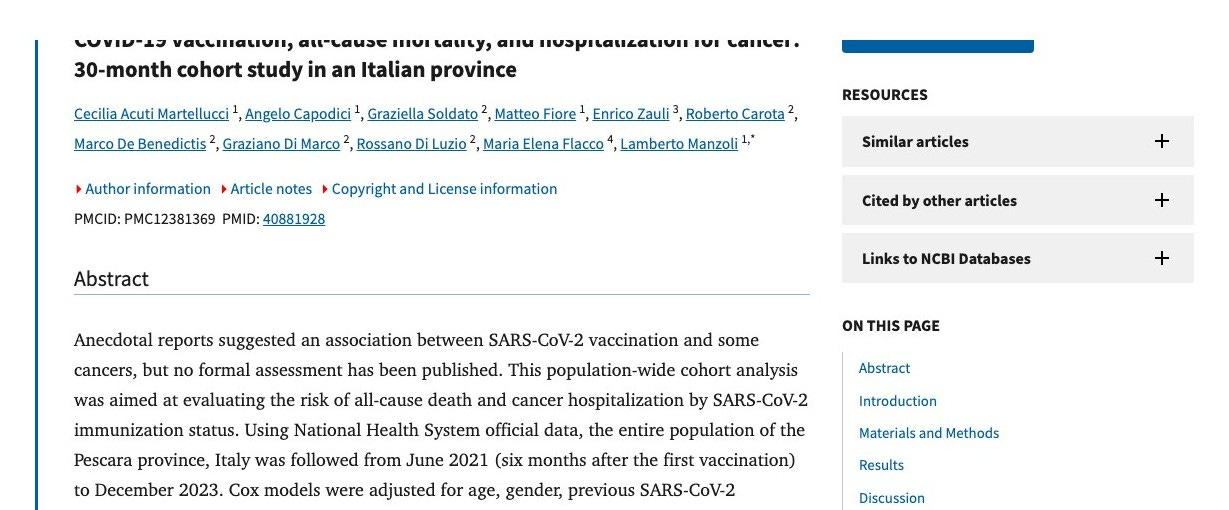
A new Italian population-wide cohort study followed nearly 300,000 residents in Pescara province from 2021 through 2023. The vaccinated group showed lower all-cause mortality — an important caveat — but also a higher likelihood of hospitalization for cancer compared with the unvaccinated group: HR 1.23, 95% CI 1.11–1.37. The authors were cautious, noting healthy-vaccinee bias and unmeasured confounders. Good. That is how honest science should sound. But the signal was there. (Italian cohort study)
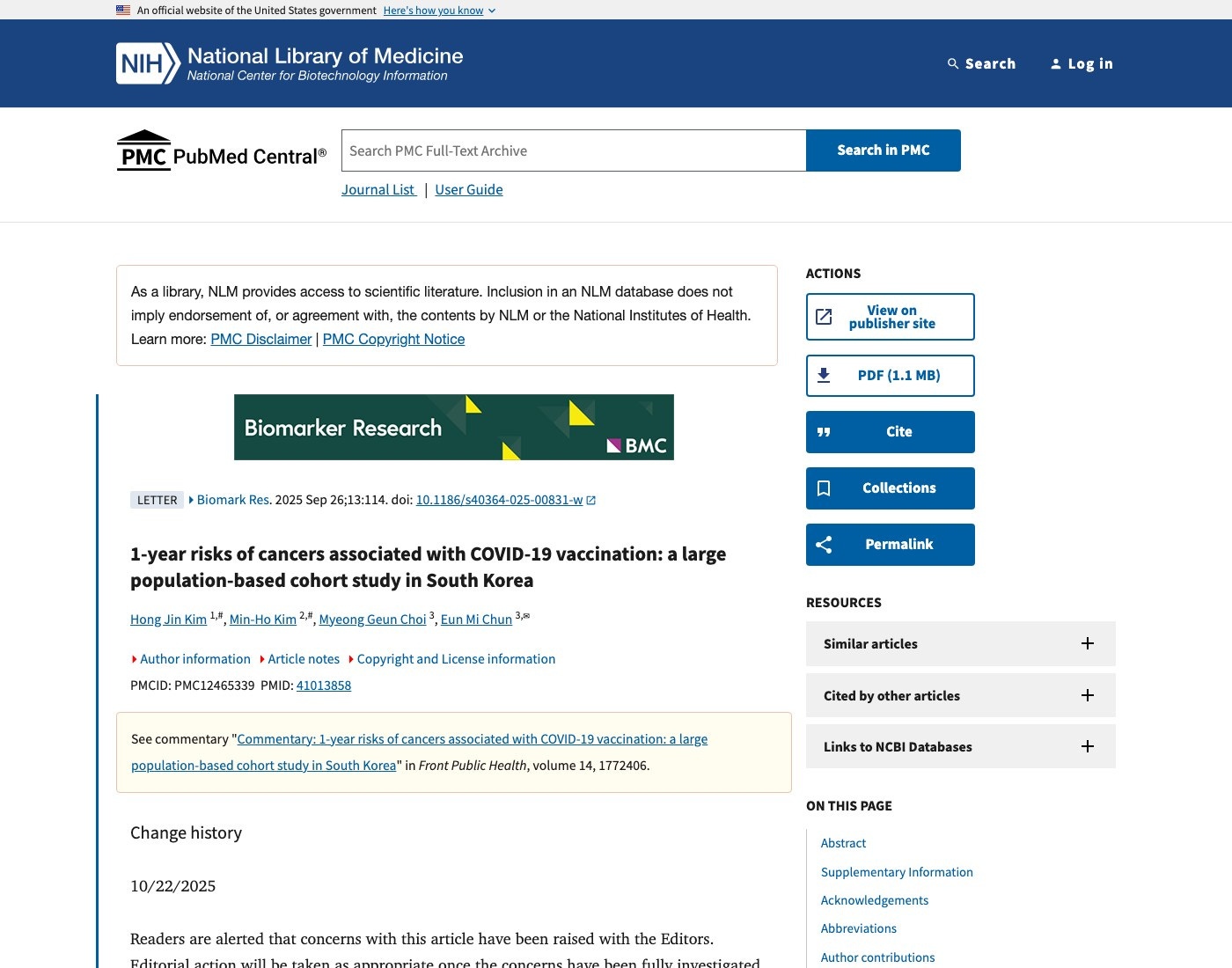
Then came an even larger South Korean study using Seoul National Health Insurance data on 8.4 million people. It reported increased one-year risks after COVID vaccination for multiple cancers: thyroid, gastric, colorectal, lung, breast, and prostate. The pattern varied by vaccine type. Again, the authors did not declare the matter settled. They called for more research. But the finding is not a rumor on Telegram. It is a large population-based cohort study in the peer-reviewed literature. (South Korea cohort study)
A systematic review indexed at PubMed found 69 publications meeting inclusion criteria, including 66 article-level reports describing 333 patients across 27 countries. The authors identified recurrent themes: unusually rapid progression, recurrence or reactivation of previously controlled disease, atypical pathology involving injection sites or regional lymph nodes, and plausible immune mechanisms involving tumor dormancy and immune escape. Their conclusion was not “case closed.” It was that this is an early safety-signal detection phase demanding rigorous epidemiologic, histopathological, forensic, and mechanistic follow-up. (Systematic review / PubMed)
That is exactly the posture public health should have taken from the beginning.
What is encouraging now is that the posture is changing. The reflexive dismissal is weaker. The data is more available. The people asking these questions are harder to exile. And some of the officials now in the room understand, from personal experience, why “trust us” is not enough.
The mechanism question is no longer theoretical.
For years, the public was assured that the shots stayed in the arm, that the mRNA disappeared quickly, and that anyone worried about longer-term biological effects simply did not understand the technology.
That story has not aged well.
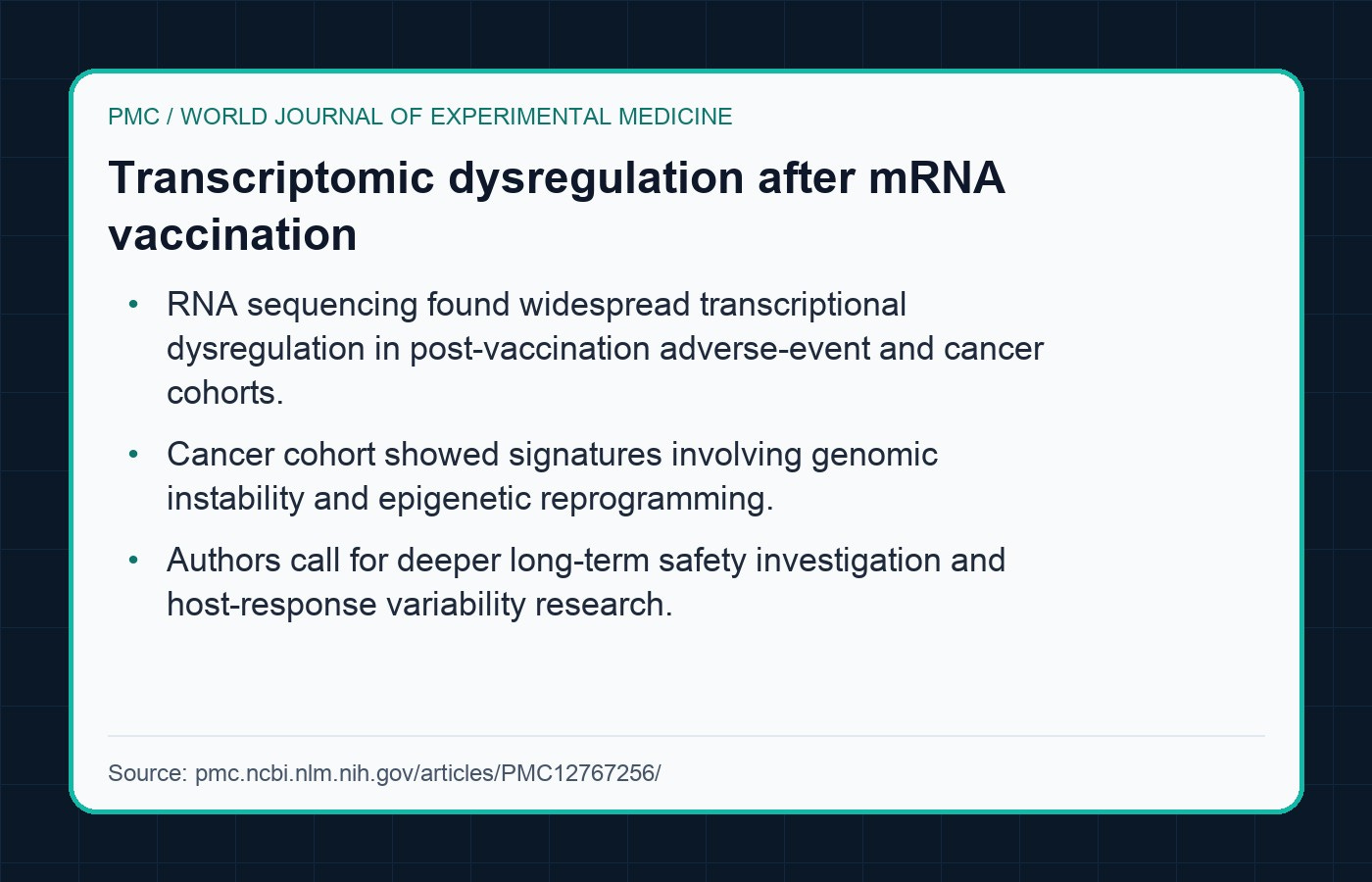
A 2025 transcriptomic study looked at people with new-onset adverse events or cancers after mRNA vaccination and found widespread transcriptional dysregulation. In the cancer group, the authors reported signals involving genomic instability, epigenetic reprogramming, immune signaling, mitochondrial dysfunction, and other stress pathways. The authors concluded that these molecular signatures may help explain post-vaccine complications, including oncogenesis or progression of malignant disease in susceptible individuals. (Transcriptomic dysregulation study)
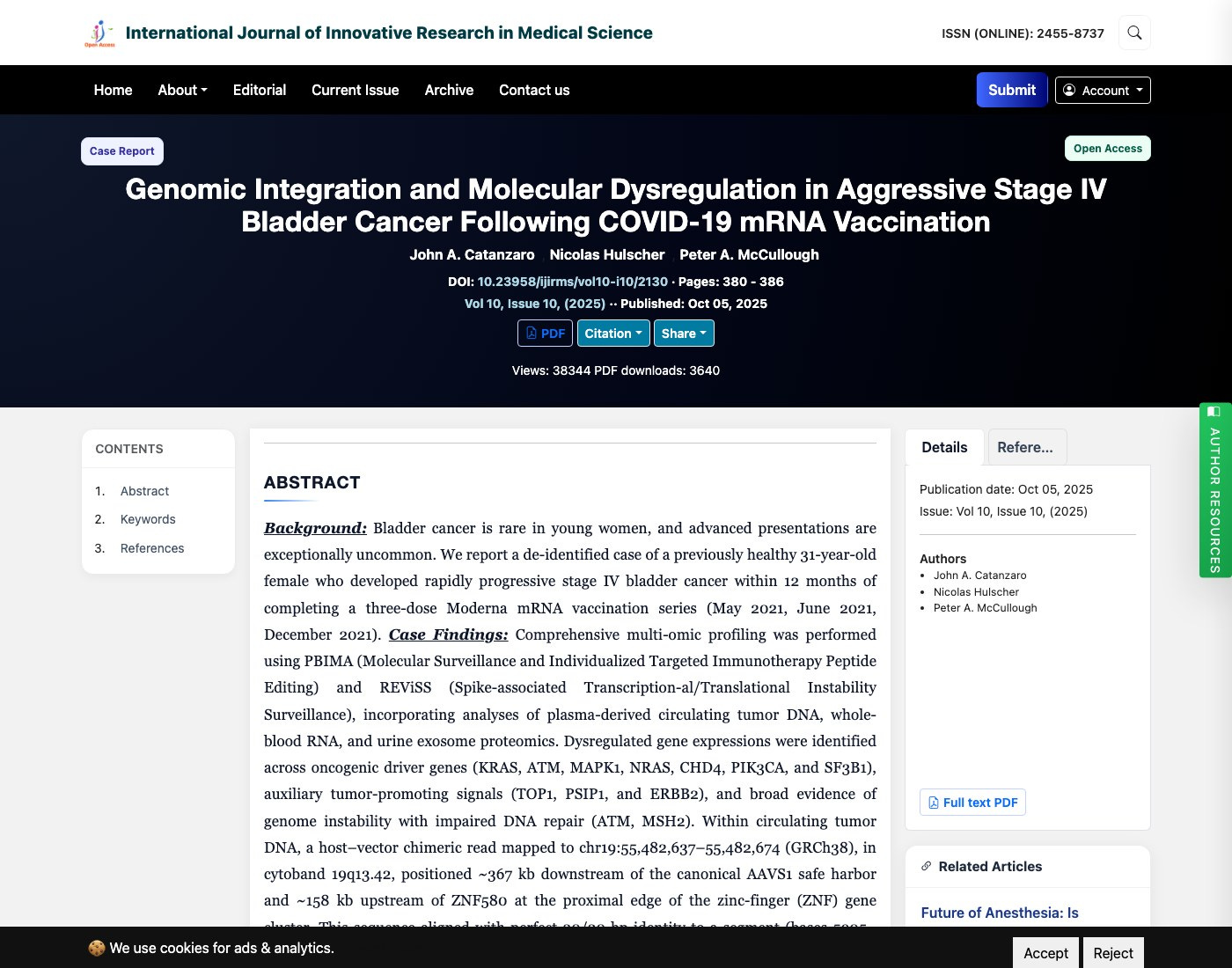
A case report described spike protein detected in metastatic breast carcinoma cells, possibly derived from mRNA vaccination. (PubMed case report) Another report described genomic integration and molecular dysregulation in a young woman with aggressive stage IV bladder cancer after a Moderna series. (IJRIMS case report)
Are case reports proof of population-level causation? No.
Are they exactly the kind of biological smoke that a serious safety system is supposed to investigate? Obviously.
And when you place them beside the DNA contamination story, the picture gets harder to dismiss.
Back in November, I wrote How DNA Ended Up in the COVID Vials (and How Regulators Chose Not to See It). The basic point was simple: these products were sold to the public as clean, short-lived mRNA instructions, but independent researchers were finding residual plasmid DNA in the vials — and, worse, evidence that the official testing methods may have been structured in a way that missed much of it.
Then in January, I covered the follow-up: BREAKING: New Study Reveals WHY Regulators Missed the DNA Contamination in mRNA Vaccines. Kevin McKernan, Charles Rixey, and Jessica Rose showed that RNA:DNA hybrids could survive the standard DNase cleanup process, creating a greater than 100-fold discrepancy depending on what assay was used.
That matters because lipid nanoparticles are not decorative packaging. They are delivery systems. Their job is to move genetic material into cells.
So when critics asked whether residual DNA, spike expression, immune dysregulation, and oncogenic pathways deserved a hard look, the honest answer should have been: yes, immediately.
Thankfully, that question is no longer confined to the margins. It is moving into the literature, into public debate, and — at last — into the world of people with the authority to do something about it.
“Turbo cancer” is not a magic phrase. It is a warning label.
The term “turbo cancer” is not a formal oncology classification. It is clinical shorthand — sometimes imprecise, sometimes overused — for a pattern physicians and patients began reporting: unusually rapid cancers, relapses after remission, and aggressive disease appearing close in time to vaccination or infection.
A review in the Journal of Independent Medicine attempts to define and organize that phenomenon. It argues that reports of advanced-stage, fast-moving, or relapsing cancers after COVID mRNA vaccination warrant scientific inquiry rather than dismissal. (JIM review)
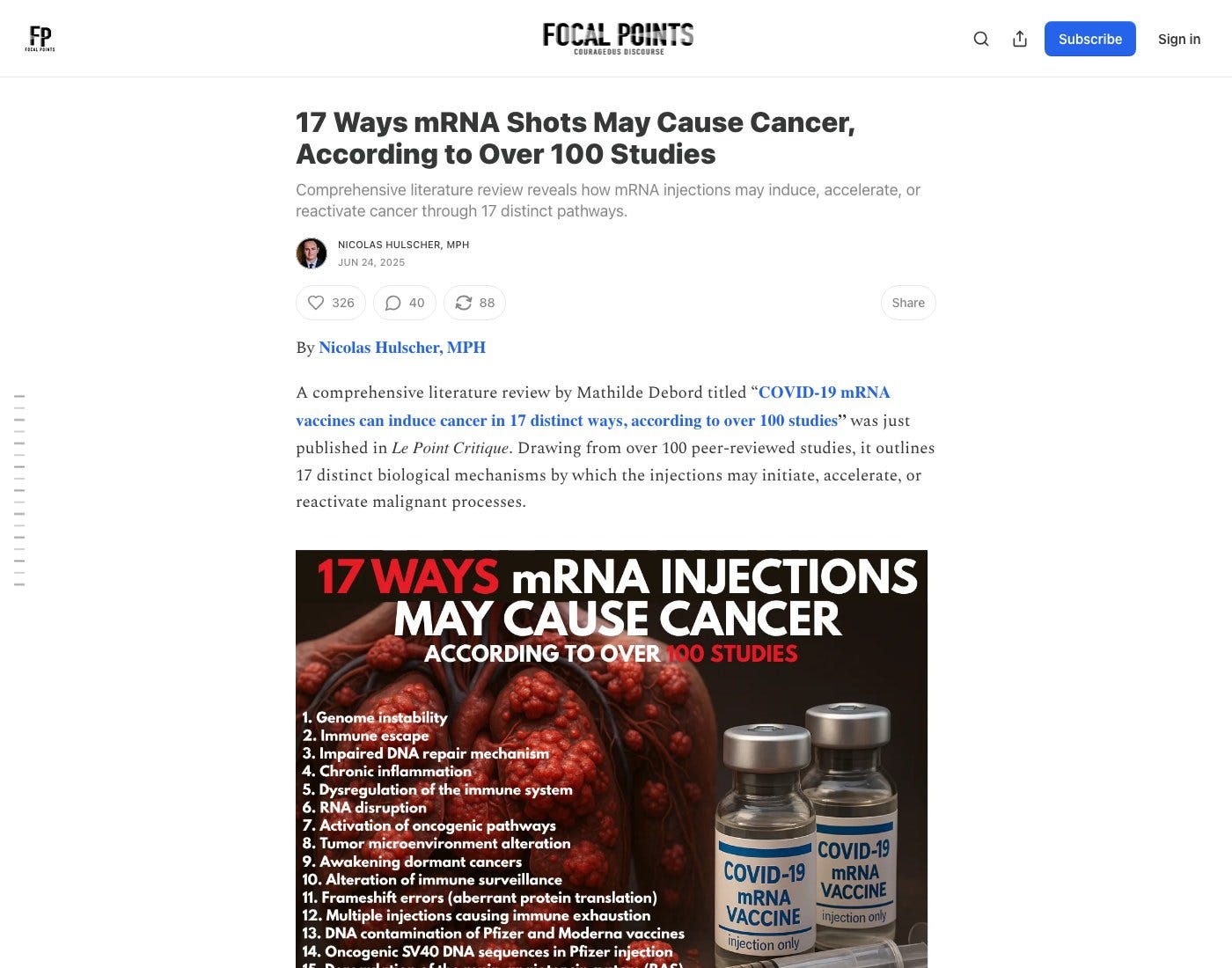
Another literature review summarized at The Focal Points identifies 17 proposed mechanisms by which mRNA shots may initiate, accelerate, or reactivate cancer, including genome instability, immune escape, impaired DNA repair, chronic inflammation, immune dysregulation, and RNA disruption. (17 mechanisms summary)
You can dispute mechanisms. You can argue about strength of evidence. You can say some of the case reports are weak, some are stronger, and some are confounded by prior infection, prior disease, age, screening disruption, or other variables.
Fine.
That is what science is supposed to do.
But what you cannot honestly say anymore is that there is nothing to investigate.
The excess mortality backdrop makes the question urgent.
One of the most provocative pieces in this stack is The Ethical Skeptic’s long-running excess mortality analysis, which claims that since the mass mRNA rollout, the United States has seen more than 900,000 excess non-COVID, non-unnatural deaths and more than 138,000 excess cancer deaths. (The State of Things Pandemic)
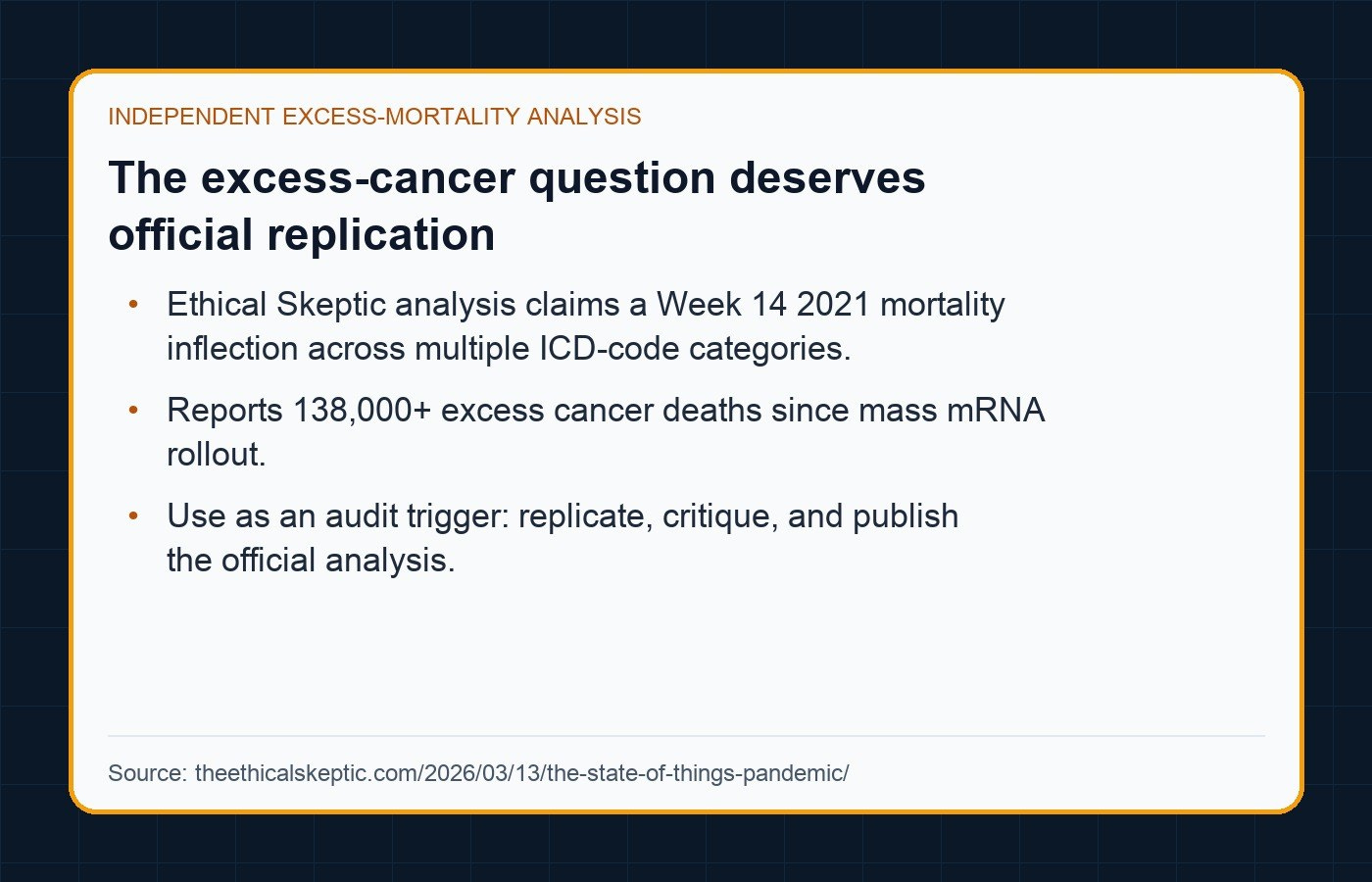
This is not a peer-reviewed paper. It is an independent analysis, and it should be treated as something that needs replication, critique, and official engagement.
But that is precisely the point.
If a private analyst can produce a detailed ICD-code mortality signal suggesting a massive cancer excess, and if large population studies in Italy and Korea are simultaneously reporting cancer associations, and if case reports and mechanistic papers are simultaneously describing plausible biological pathways, then the right response is serious replication.
This is where the current moment is different.
For years, the plea was: release the data.
Now, increasingly, the data is being released, the old gatekeeping is losing power, and the people who know why these questions matter are in a position to demand better answers.
That deserves gratitude.
It also creates responsibility. The next step is not just to celebrate that better people are in the room. The next step is to use this opening well:
Where possible, build CDC and FDA matched cohort analyses.
Study lot-level cancer outcomes.
Support autopsy and tissue programs.
Compare long-term outcomes by dose, product, age, sex, prior infection, and baseline risk.
Link cancer registries to vaccination, infection, and mortality data with appropriate privacy protections.
Create public dashboards that let independent analysts test, replicate, and challenge the findings.
That is how trust starts to come back: not by demanding blind faith, but by letting the evidence breathe.
This is why the new leadership matters.
In Why We Lost Trust, I wrote that public trust did not collapse because Americans suddenly became anti-science. It collapsed because institutions got major questions wrong, enforced their errors with power, punished dissent, and then refused to account for the damage.
That is why the presence of people like Bhattacharya, Makary, and others matters so much. They are not abstract technocrats parachuting into a controversy they never understood. They lived through the same institutional failure. They saw what happened to families, schools, churches, children, businesses, and honest scientists when COVID policy became a crusade instead of a discipline.
This new cancer literature belongs inside that broader reckoning — but the tone of this moment should not only be anger. It should also be gratitude that the questions are no longer orphaned.
When we said lockdowns would cause medical harms, including missed cancer screenings, we were told that the emergency justified it. Now the delayed-care damage is documented, and I compiled much of it in The Complete Reckoning: 150+ Studies on the Devastating Harms of COVID Lockdown Policies.
When people said the unvaccinated had rational reasons to hesitate, they were treated as defective citizens. Later, in How the “Unvaccinated” Got It Right, we revisited the actual risk calculus: low absolute COVID risk for many people, no long-term safety data, changing efficacy claims, and a public-health regime that replaced informed consent with coercion.
When myocarditis signals appeared, the early posture was denial and minimization. Then the literature grew. We covered it in The Truth About Vaccine-Induced Myocarditis, Video: 388 Studies of Post-Vaccine Myocarditis, and Ignoring the Heart of the Matter.
When vaccine-injury reports accumulated, patients were told they were anxious, confused, or politically contaminated. Then even the FDA had to acknowledge serious pediatric safety questions, as I covered in Breaking! FDA Finally Admits It: At Least 10 Healthy Kids Likely Died from COVID Vaccines.
When the lab leak was obvious enough to investigate, it was branded racist conspiracy theory. Years later, former CDC Director Robert Redfield was saying out loud what many of us had argued from the beginning, which I covered in Former CDC Director Drops Bombshells: Lab Leak, Vaccine Warnings, and the Cover-Up.
This is not a record of paranoia.
It is a record of delayed admissions.
The standard now should be: follow the signal wherever it leads.
A real safety culture treats uncertainty as a reason to investigate, not as a reason to sneer.
The mRNA rollout was the largest pharmacovigilance challenge in history. Billions of doses. Novel platform. Compressed trials. Legal immunity. Mandates. Massive variation by age and risk. A public told, often aggressively, that hesitation was not merely wrong but immoral.
That history cannot be undone. The families and businesses that were submarined by ridiculous policies cannot get those years back. The children who lost school years cannot simply be made whole. The people injured or bereaved cannot be repaired by a new dashboard.
But we can be grateful that the next chapter is different.
The cancer signal now deserves what myocarditis deserved, what excess deaths deserved, what DNA contamination deserved, and what the public deserved from the start:
lot-level analysis
dose-response analysis
product-specific comparisons
prior-infection stratification
age- and sex-specific risk tables
cancer registry linkage
autopsy and tissue studies
independent replication
full disclosure of manufacturer data where legally possible
and protection for physicians and researchers who report adverse events.
This is not about revenge.

It is about repair.
It is about making sure the people who were right to ask hard questions are finally joined by institutions willing to answer them.
What we can say now
We can say that multiple peer-reviewed papers and case reports now describe cancer signals temporally associated with COVID vaccination or infection.
We can say that two large population-level studies — Italy and South Korea — report cancer associations after vaccination, while acknowledging confounding and the need for further research.
We can say that the literature now includes mechanistic claims involving immune dysregulation, genomic instability, spike persistence, DNA contamination, transcriptomic disruption, and impaired cancer surveillance.
We can say that independent mortality analysis is raising a large excess-cancer-death question that deserves official replication.
We can say that the old public-health posture — “there is nothing to see here” — is no longer defensible.
And we can say one more thing.
The people who asked these questions early were not the problem.
They were the early-warning system.
The reckoning keeps widening
Six years ago, Rational Ground existed because the official narrative was diverging from the data in real time.
That was true on schools.
It was true on masks.
It was true on lockdowns.
It was true on natural immunity.
It was true on censorship.
It was true on myocarditis.
It was true on DNA contamination.
Now the cancer question has entered a new phase: early reports, accumulating literature, better access to data, and the possibility — finally — of honest institutional follow-through.
The people demanding answers were not crazy.
They were early.
The correct response is not panic. It is not simplistic certainty. It is not pretending every cancer diagnosis has one cause.
The correct response is honest investigation — with the full power of agencies now influenced by people who understand why the investigation matters.
If the signal is wrong, transparency will show it.
If the signal is real, transparency will help us quantify it, understand it, and protect people.
Either way, this is what we asked for: not blind vindication, but the chance to let evidence outrun narrative.
For that, I am grateful.
The people who stood by our side during the COVID madness are no longer only writing declarations from the outside.
Some of them are now inside the room.
And results are beginning to follow.
How much do you want to bet that if the manufacturers were to release their data relating to internal animal testing of Process 2-purified mRNA vaccines (versus the Process 1 purification used in the human trials to secure the EUA) we would see similar side effects and negative outcomes as the ones we are seeing in the global population who received the cheaper and less purified Process 2 vaccines?
We can debate the fundamental flaws of design with this genetic therapy - from the use of LNP to evade the bodies' natural immune defense against foreign genetic material, to the basic immunological truth that any cell producing the foreign spike protein is going to be targeted for destruction by the immune system's defenses as well - but there is no debating the utter fraud committed to secure authorization of these products. All data relating to Process 2 and everything the companies knew about it prior to emergency use of their products needs to be released to the public. The likelihood of that happening is infinitesimal small, just is the likelihood of ever building back trust with the few people out there who were smart enough to avoid these monstrous shots.
The only question I'm really left wondering is whether this fraud was done to elevate profit above safety OR was all of what we are seeing in terms of negative outcomes done by intentional design?
One step towards retain trust would be a "Truth and Reconciliation Commission". Alone with research providing reliable data there must be a Connecting the Dots to determine who knew what and when.
All public, all transparent, and no sacred cows. The unvarnished truth. Individuals, Agencies, and the Pharma companies involved exposed to public censure. Followed by legal action resulting in real prison time for those guilty.
A line of white lab coats, Pharma executives, beurocrats, and positions marching in to Federal Pens (not country clubs) would go a long way towards restoring trust.