

On the night of March 6, 2020, NIH Director Francis Collins forwarded an email to his deputy and four senior staffers. Attached was the accepted version of a paper about to appear in Nature Medicine. His note said:
“FYI, this is work that Tony, Jeremy, Larry, and I helped with, but are appropriately not mentioned explicitly in the paper.”
Then he quoted the paper’s conclusion, that there was “no evidence that the virus was made in a laboratory or otherwise engineered.” And he added one more line:
“I hope Senator Cotton notices this.”
Tom Cotton was the senator who had been saying, out loud, that the virus might have come from the lab in Wuhan.
The paper was “The Proximal Origin of SARS-CoV-2.” Tony is Anthony Fauci. Jeremy is Jeremy Farrar, then head of Britain’s Wellcome Trust. Larry is Lawrence Tabak, Collins’s deputy, who is on the email. None of their names appear anywhere in the paper.
Sen. Rand Paul released that email in June. This week, it caught up with them.
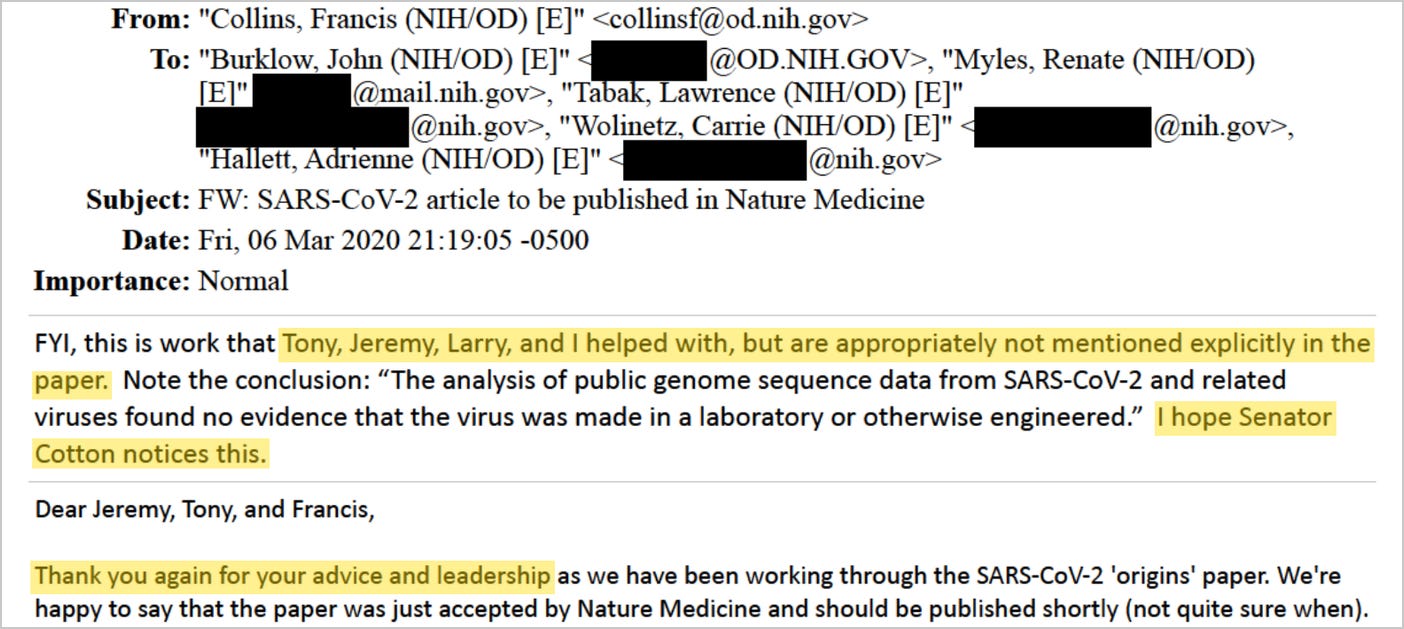
Collins forwards the accepted paper to his staff, March 6, 2020, above Kristian Andersen’s thank-you note to “Jeremy, Tony, and Francis.” Sen. Rand Paul’s June 11, 2026 release, p. 39.
The letter
On Wednesday, Nov. 18, NIH Director Jay Bhattacharya wrote to the editors of Nature Medicine. He asked them to investigate who really shaped Proximal Origin, and to correct the record or retract the paper.
The letter hasn’t been released in full. Politico and Die Welt broke the story together and quoted this line:
“The NIH is presenting the question of whether the byline and acknowledgments accurately reflect the individuals who contributed substantively to the conception, drafting, revision, or publication of the manuscript.”
The journal has 30 days to send NIH the scope of its review and a timetable. That puts the deadline around Dec. 18.
Nature Medicine told Politico it would not comment until it received the letter. Fauci, Collins and Farrar did not respond.
The government’s lawyers got there first
The letter didn’t come out of nowhere. On Oct. 1, HHS’s Office of General Counsel published Advisory Opinion 26-02, on “Authorship, Attribution, and Third-Party Contributions to Scientific Publications.” It is only four pages, and it uses Proximal Origin as its example.
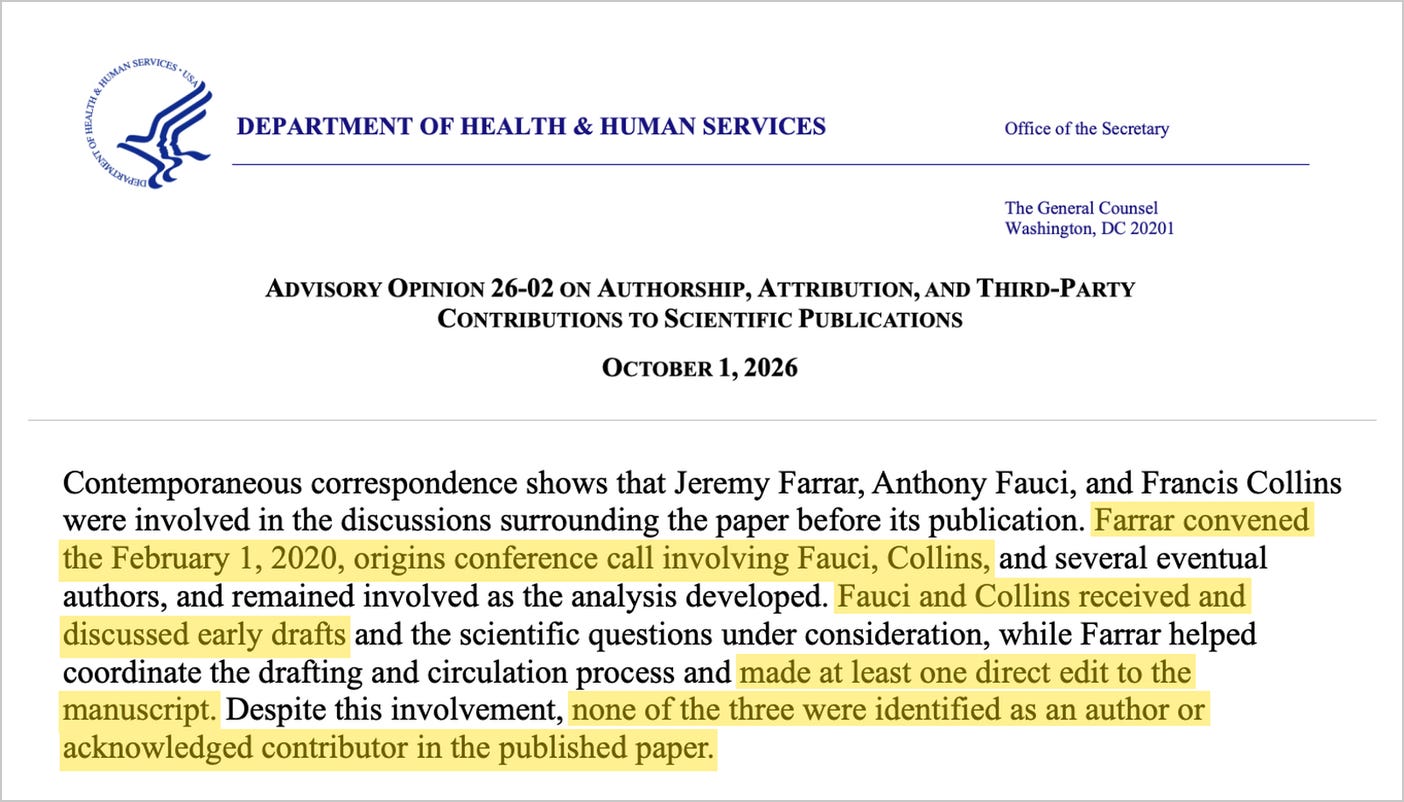
HHS Office of General Counsel, Advisory Opinion 26-02, Oct. 1, 2026, p. 1.
The opinion says Farrar convened the Feb. 1, 2020 call with Fauci, Collins and several of the future authors. It says Fauci and Collins “received and discussed early drafts.” It says Farrar “made at least one direct edit to the manuscript.” And it says “none of the three were identified as an author or acknowledged contributor in the published paper.”
The best part is in a footnote. On April 17, 2020, a reporter at the White House asked Fauci whether the virus could have been made in a lab. Fauci pointed to “a study recently” by “highly qualified evolutionary virologists.” Then he said:
“I don’t have the authors right now, but we can make that available to you.”
HHS’s own lawyers now write that Fauci “was aware of the authors and had, in fact, collaborated and advised in the final hypothesis. At the time, the general public was unaware of these facts.”
He didn’t have the authors right now. Six weeks earlier, the lead author had emailed him by name to thank him for his “advice and leadership.”
The paper trail
We have been through these records for years. Here is the short version, all from documents now public.
Jan. 31, 2020. Kristian Andersen, the lead author, tells Fauci the virus looks like it could have been engineered. Andersen later told Congress that Fauci suggested that if he thought it came from a lab, he should write it up as a peer-reviewed paper.
Feb. 1. Farrar convenes the call. Fauci and Collins are on it. That night Andersen writes to his co-authors that “the lab escape version of this is so friggin’ likely to have happened because they were already doing this type of work and the molecular data is fully consistent with that scenario.”
Feb. 4. The first draft goes from Eddie Holmes to Farrar, who sends it on to Fauci and others.
Feb. 16. Collins reads a draft and says it “ought to be made public ASAP.”
Feb. 17. Farrar asks the authors to change “unlikely” to “improbable” in the sentence about lab manipulation.
In another email, co-author Robert Garry writes that Farrar “has been amazing leader” and “should be author.” Holmes replies, as Matt Ridley quoted it in the Telegraph, that he offered, “but he wants to remain independent.”
March 6. Andersen writes to “Jeremy, Tony, and Francis”: “Thank you again for your advice and leadership as we have been working through the SARS-CoV-2 ‘origins’ paper.” He asks for any “comments, suggestions, or questions.” That same night Collins forwards it to his staff with “appropriately not mentioned.”
March 17. The paper is published. In the authors’ private Slack, Holmes writes that the last part was done under “pressure from on high,” and that “Jeremy Farrar and Francis Collins are very happy.”
April 17. Fauci, at the White House: “I don’t have the authors right now.”
The head of the Wellcome Trust and the two most powerful men at the NIH, the funders of the field, helped prompt the paper and read the drafts. Farrar edited it. Then they stood back and let the world think five independent scientists had settled the question.
Collins knew the rules
Here is the irony. In late 2010, Paul Thacker, then at the Project On Government Oversight, asked the NIH what it would do about ghostwriting. Collins answered him personally in February 2011.
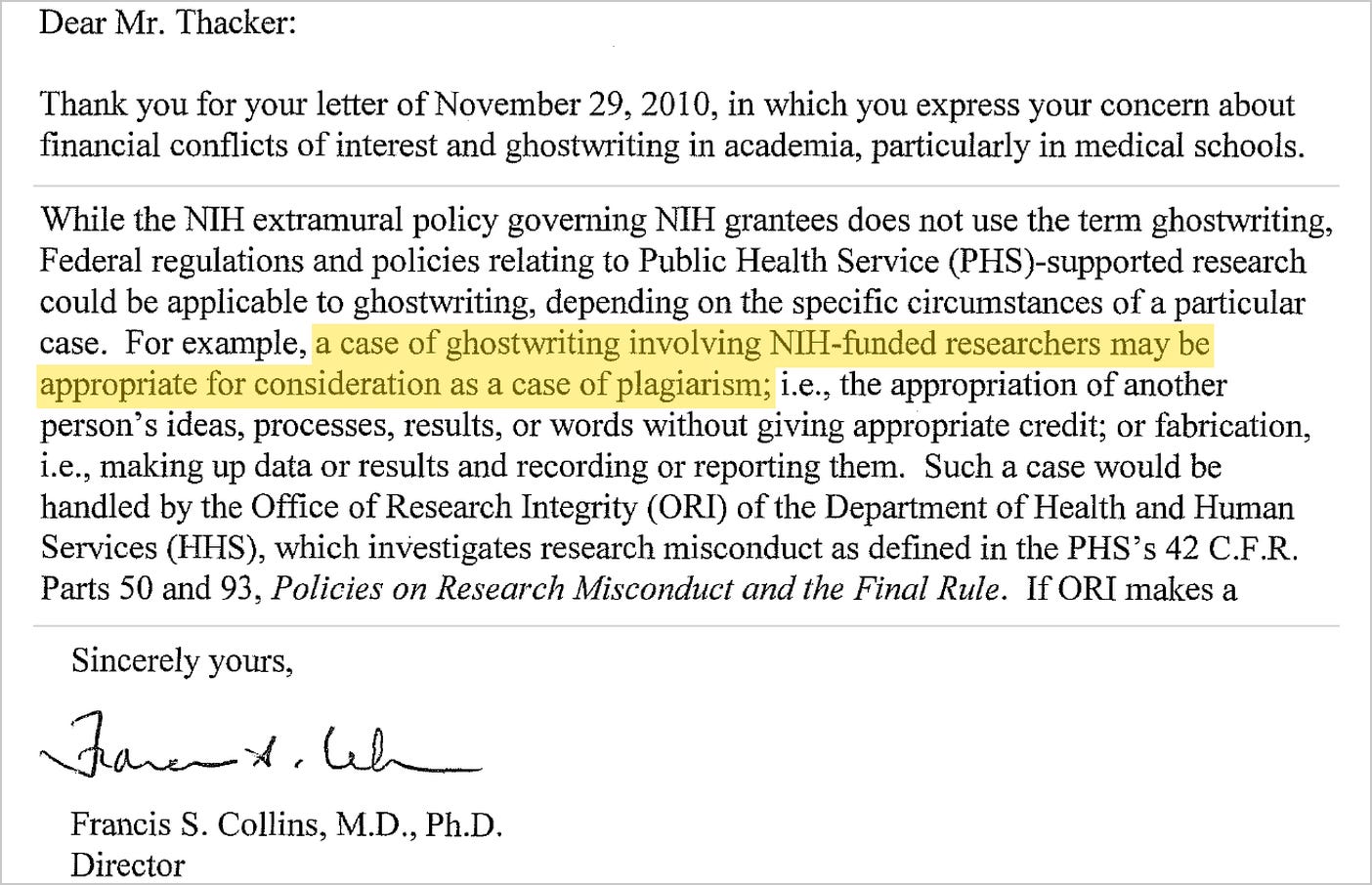
NIH Director Francis Collins to Paul Thacker, Feb. 17, 2011. Internet Archive copy of POGO’s posting.
Collins wrote that “a case of ghostwriting involving NIH-funded researchers may be appropriate for consideration as a case of plagiarism.” He said penalties could include ending grants, and even debarment.
Nine years later he was writing “appropriately not mentioned.”
The other side, fairly
The authors and officials deny all of this.
Andersen told Congress in 2023 that the authors changed their minds as new evidence came in: “This is not a flip-flop. This is simply the scientific process.”
Fauci told House investigators in January 2024 that he never edited or suggested edits to the paper. Asked whether Collins did, he said, “To my knowledge, he did not.”
NIH has said in the past that Collins was not an author and did not weigh in on the content.
Science magazine noted that Bhattacharya’s letter offers no new evidence, and that the NIH director has no authority over a private journal.
Science has a point on both counts. The letter adds no new evidence. It doesn’t need to. The evidence has been public for years, and the journal has ignored it. And NIH can’t force a journal to do anything.
HHS’s own lawyers also concede a limit. Under the federal rule, “research misconduct” means fabrication, falsification or plagiarism, and the rule says nothing about ghost authorship. But the opinion says that silence “should not be read to resolve whether the practice is consistent with accepted standards of scientific integrity.” The journal has its own rules. As Ridley points out, its policy asks authors to disclose any funder’s role in the “conceptualisation, design, data collection, analysis, and preparation of the paper.” Farrar ran one of the world’s biggest medical charities. Collins and Fauci ran the largest public funder of biomedical research in the world.
What our friends are saying
The people who’ve carried this fight for years are all over it.
Matt Ridley, who sat in the House of Lords in 2020, wrote in the Telegraph that he told his colleagues a lab leak could be ruled out, based on this one paper: “To my shame, I told them a lab leak could be ruled out.” He and other scientists have written to the editor, João Monteiro, twice. No answer.
Richard Ebright of Rutgers, quoted by The Defender, says the paper “is, provably, a product of science fraud,” and that Fauci, Collins and Farrar “prompted and oversaw” it.
Paul Thacker dug up the 2011 Collins letter. He also reminds us what Monteiro posted when the paper came out: “Let’s put conspiracy theories about the origin of #SARSCoV2 to rest and help stop the spread of misinformation.”
Jessica Rose at Brownstone walks through the authors’ Slack messages, including their own confusion about how Ian Lipkin ended up on the byline.
Hans Mahncke notes that before Jay could send one letter, the department’s lawyers had to write a legal opinion first. That’s how slow the machine moves, even with the right man at the top.
About Jay
We know Jay well. He co-wrote the Great Barrington Declaration in October 2020. That same month Collins called him one of “three fringe epidemiologists” and asked Fauci for “a quick and devastating published take down.” Now Jay sits in Collins’s old chair, asking Collins’s old journal to look at Collins’s old paper.
As I put it on X yesterday: Jay has the patience of angels. He understands that if he can roll with the punches, he can have a huge impact on that place just by not being ousted. This letter is what that patience looks like. It’s careful, it’s lawyered, and it’s very hard to dismiss.
We’ve been on this since 2023
Rational Ground has written about Proximal Origin in more than 20 posts. A few:
July 2023: Covid Origin Story Cover-up REVEALED, on the House report the day Andersen was grilled on Capitol Hill.
February 2026: Six Years Ago Today, They Chose the Lie, on the Feb. 1 call.
February 2026: Former CDC Director Drops Bombshells. Robert Redfield: “I think the proximal origin paper needs to be retracted, period.”
May 2026: A Career CIA Officer Just Said It Under Oath.
June 2026: A, B, C, D: Four Scientists and the Anatomy of a Cover-Up.
November 2026: They Buried the Lab Leak and Didn’t Need to Bribe Anyone.
Our COVID FOIA database now holds 125 findings on Proximal Origin, from the Slack messages to the transcribed interviews.
And two years ago, in the very first of my Covid Screwtape Letters, I had “Dr. F.” write to his uncle Screwtape in March 2020:
“To guard against such dangers, I’ve enlisted our brethren—scientists, politicians, media pundits—from across the globe to craft the perfect Proximal Origin defense... You see, I understand that the virus cannot be contained. But the lie? The lie can live forever.”
I wrote that as satire. Then Collins’s real email turned up: “I hope Senator Cotton notices this.”
What’s next
Nature Medicine has until about Dec. 18 to tell NIH what it plans to do. It has ignored scientists, a House committee and a mountain of documents for six years. It’s harder to ignore the agency that funds so much of the science it publishes.
We’ll be watching.
Sources: Politico, “NIH asks if Fauci secretly wrote paper that dismissed Covid lab leak theory,” Nov. 18, 2026 (with Die Welt). HHS Office of General Counsel, Advisory Opinion 26-02, Oct. 1, 2026. Sen. Rand Paul, “Fauci’s Two-Decade Relationship with the Intelligence Community,” June 11, 2026, p. 39 (Collins email). Collins to Thacker, Feb. 17, 2011. House Select Subcommittee on the Coronavirus Pandemic, “The Proximal Origin of a Cover-Up” (July 2023) and final report (Dec. 2024). Transcribed interviews of Andersen, Garry and Fauci. Proximal Origin authors’ Slack messages. Matt Ridley, The Telegraph, Nov. 18-19, 2026. The full set is in the Rational Ground COVID FOIA database.
Excellent work…to bad we have toothless dogs as body guards.