

On Sept. 12, 2023, two House committee chairmen wrote to the director of the CIA.
A “multi-decade, senior-level, current Agency officer” had come to them with a story. The CIA had put seven officers on a COVID Discovery Team. Six of the seven concluded the virus most likely came from a lab in Wuhan. The seventh, the most senior, favored a natural origin.
Then, the whistleblower said, the six “were given a significant monetary incentive to change their position.”
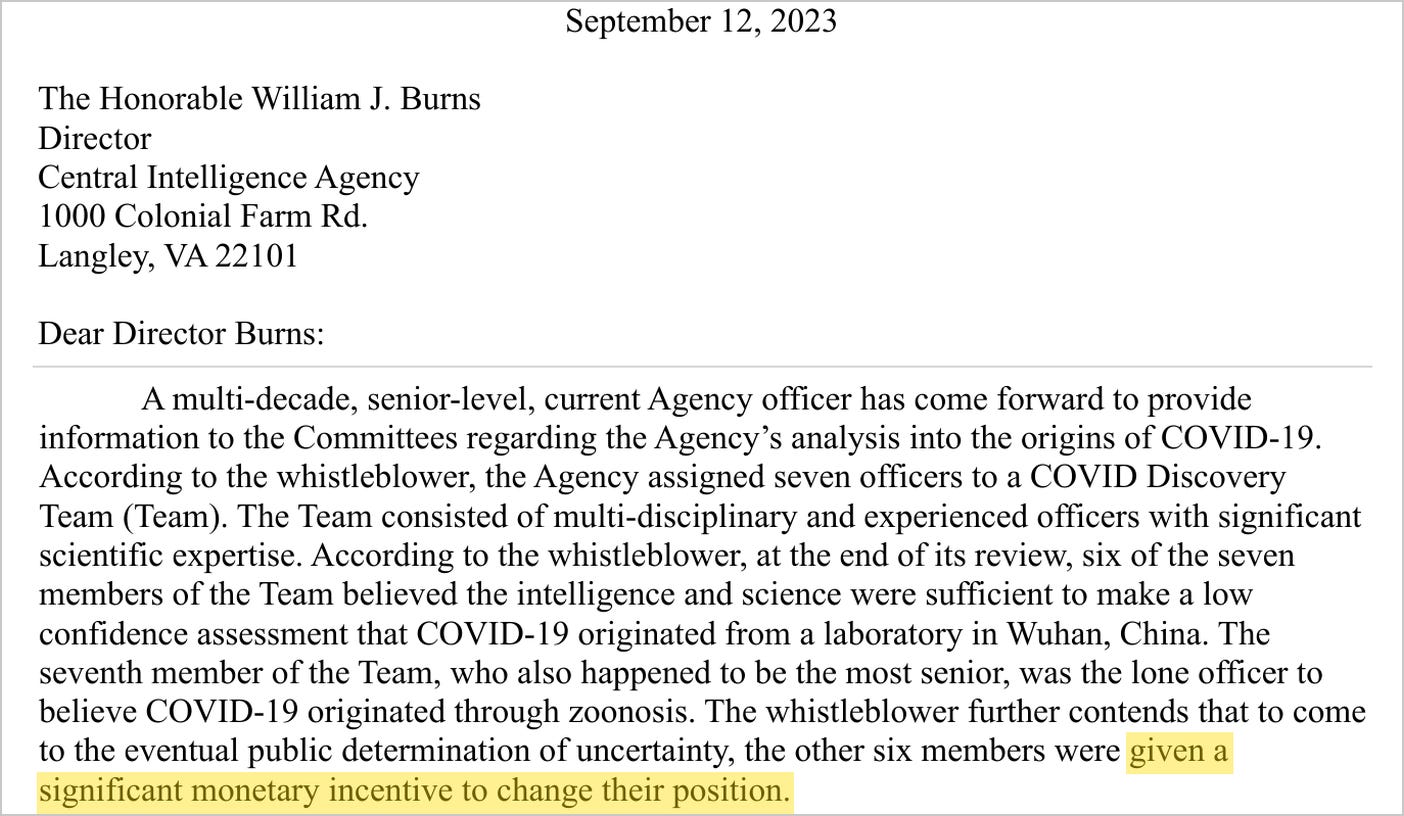
The Sept. 12, 2023 letter from Reps. Brad Wenstrup and Mike Turner to CIA Director William Burns.
Two weeks later came a second letter. It said Anthony Fauci “was escorted into Central Intelligence Agency (CIA) Headquarters—without a record of entry—and participated in the analysis to “influence” the Agency’s review.”
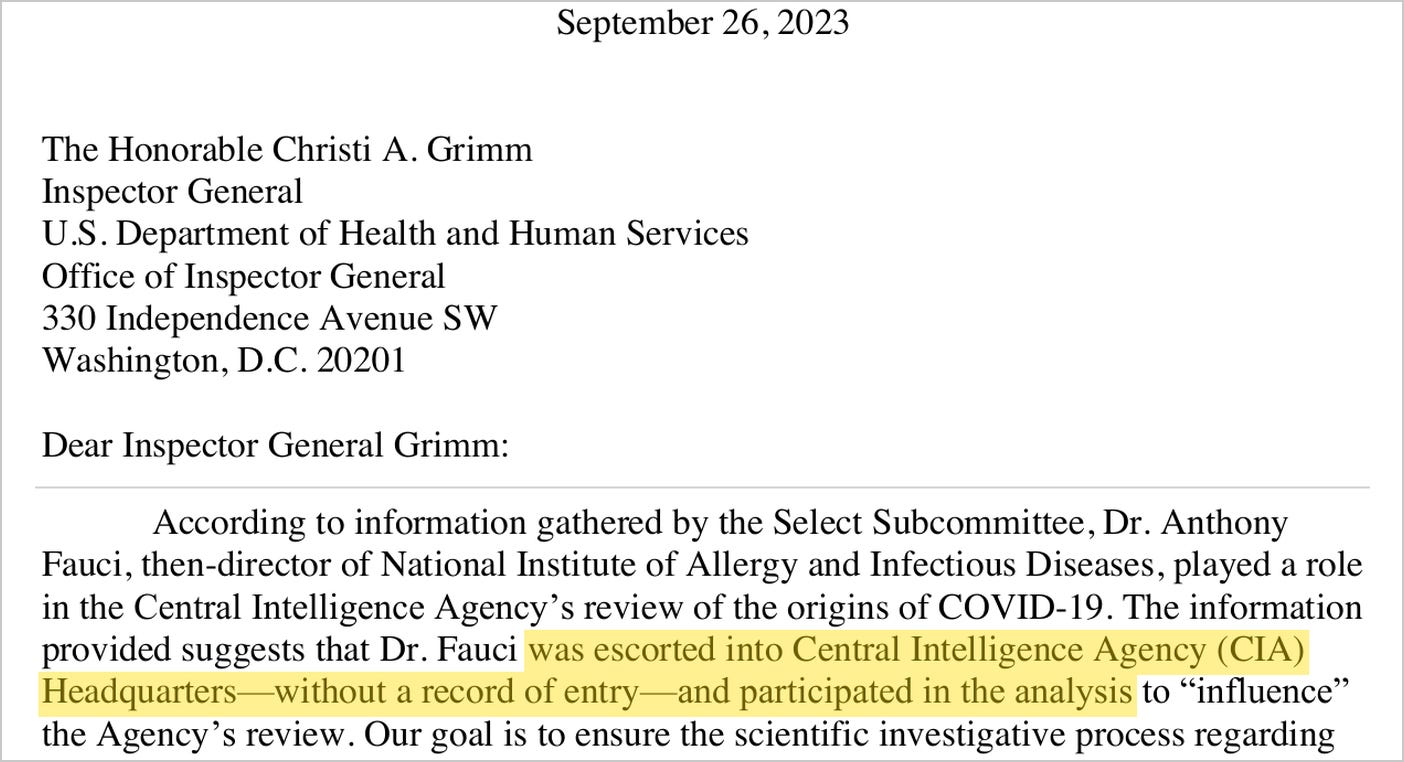
Wenstrup’s Sept. 26, 2023 letter to HHS Inspector General Christi Grimm.
We ran both stories here the day they broke. So did most of the right-of-center press. CIA paid off its analysts. Fauci smuggled into Langley.
Three years later, the records are out: the intelligence community’s declassified COVID files, a CIA officer’s sworn testimony, and a batch of emails from the intelligence community’s own panel of scientists, released just this fall.
I’ve now put all of it, including both 2023 letters, into the COVID FOIA Database. Here is the honest scorecard. Both headlines were wrong on the details. The truth is worse than either one.
What didn’t hold up
The bribe. In May, Jim Erdman III testified under subpoena before Sen. Rand Paul’s Homeland Security Committee. Erdman is a senior CIA operations officer who spent a year on the Director of National Intelligence’s transparency task force, going through the agency’s COVID records. On the payment story, he was blunt:
“The analysts were not bribed.”
The analysts who called it a lab leak, he testified, got a $1,500 performance award. That’s not a payoff.
The secret visit. The CIA’s own records, declassified by DNI Tulsi Gabbard in June, say: “WCPMC/CBD has no record of Dr. Fauci coming to CIA headquarters to discuss the origins of COVID-19.” What did happen was a secure video call on June 4, 2021, “for about 40 minutes.”

CIA analysts’ own account, written a week after the Sept. 26 letter. Declassified by DNI Tulsi Gabbard in June 2026.
So: no bribe, and no secret walk into Langley. We repeated both claims. On those details we were wrong, and you should hear that from me.
Now here’s the rest of what Erdman said about the money. At least one non-specialist who favored a natural origin, he testified, “was awarded four times that amount.” He asked that “any awards for COVID analysis between 2020 and 2024 be scrutinized to see if there was a pattern of rewarding one side of the COVID argument preferentially.”
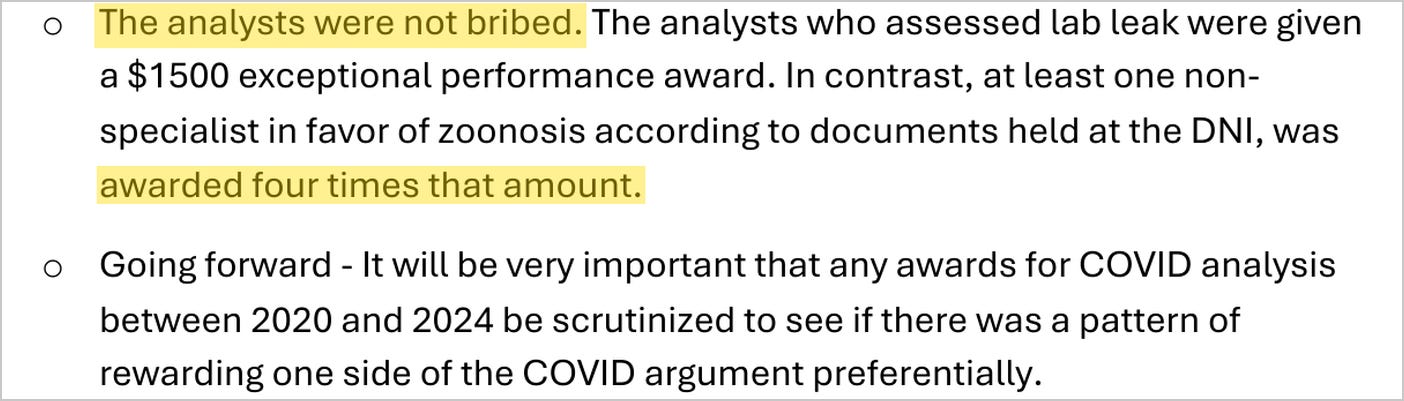
From Jim Erdman’s written testimony to Sen. Rand Paul’s committee, May 2026.
And the whistleblower’s head count lines up with Erdman’s. By March 2023, Erdman testified, “Six of seven technical experts assessed it was a lab leak.”
What Fauci said on that video call is documented too.
Nobody needed a bribe. The system did the job without one. Here’s how, in five steps.
1. The experts knew, and said so in private
Three days before the pandemic’s most famous phone call, Ralph Baric sent the intelligence community a slide deck. Baric, at the University of North Carolina, had worked with the Wuhan Institute of Virology for years. His deck included a slide titled “Origins” that “discussed the possibility of an accidental release by the WIV.”
On Feb. 1, 2020, Fauci convened a call with the scientists who would go on to write “Proximal Origin,” the paper that told the world the virus was natural. That night, its lead author, Kristian Andersen, wrote to his co-authors that “the lab escape version of this is so friggin’ likely to have happened because they were already doing this type of work and the molecular data is fully consistent with that scenario.”
The next day, co-author Andrew Rambaut explained why they should say “natural” anyway:
“Given the shit show that would happen if anyone serious accused the Chinese of even accidental release, my feeling is we should say that given there is no evidence of a specifically engineered virus, we cannot possibly distinguish between natural evolution and escape so we are content with ascribing it to natural processes.”
On Feb. 3, the intelligence community sat in on a National Academy of Sciences meeting about the virus. Its own notes record the consensus in the room: “Natural or laboratory accident.”
On Feb. 12, Jeremy Farrar, who wasn’t an author but had offered to help get the paper into a top journal, wrote that he hoped for a paper “which effectively puts to bed the issue of the origin of the virus.”
New this fall: an email from Feb. 6, 2020, sent to the intelligence community’s panel of outside scientists. The writer’s name is blacked out. U.S. Right to Know, which got the email through a records request, identifies him as Baric, and the details match his work. He wrote that he had “received a few concerning, if not threatening, emails” asking him to make public statements “refuting/excepting responsibility for making the 2019 virus.” The statement he was asked to write, he warned, “will allow them to refute these claims in china (or use it for nefarious purposes to shift blame).”
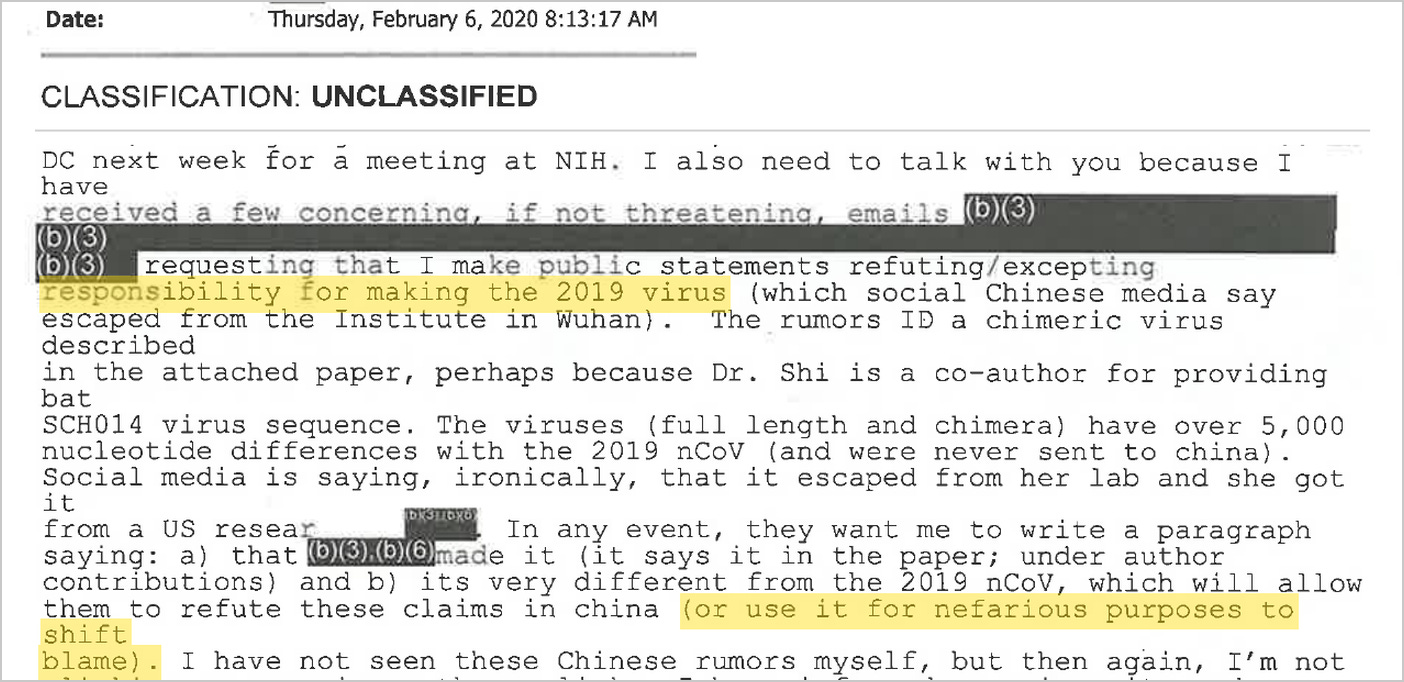
The Feb. 6, 2020 email to the intelligence community’s science panel. Released to U.S. Right to Know in September 2026.
The email doesn’t say who “they” were. My reading is that it means people in China. Either way, on Feb. 6, 2020, the American scientist who had built a chimeric SARS-like virus with Wuhan’s Shi Zhengli was telling the intelligence community that the public story about the virus’s origin was already being shaped, and that he was under pressure to help shape it.
2. The government’s own experts doubted the “consensus,” and billed for it
The intelligence community keeps a roster of cleared outside scientists, called the Biological Sciences Experts Group. The emails released in September show what they were discussing while the public was told the science was settled.
Proximal Origin was published on March 17, 2020. Ten days later, the panel’s call agenda included: “Thoughts on attached paper (Furin cleavage site uniqueness).” The furin cleavage site is the feature of the virus that made scientists suspect engineering in the first place. Members were reminded to log their time “so you can roll your time on this project into your next invoice accurately.”
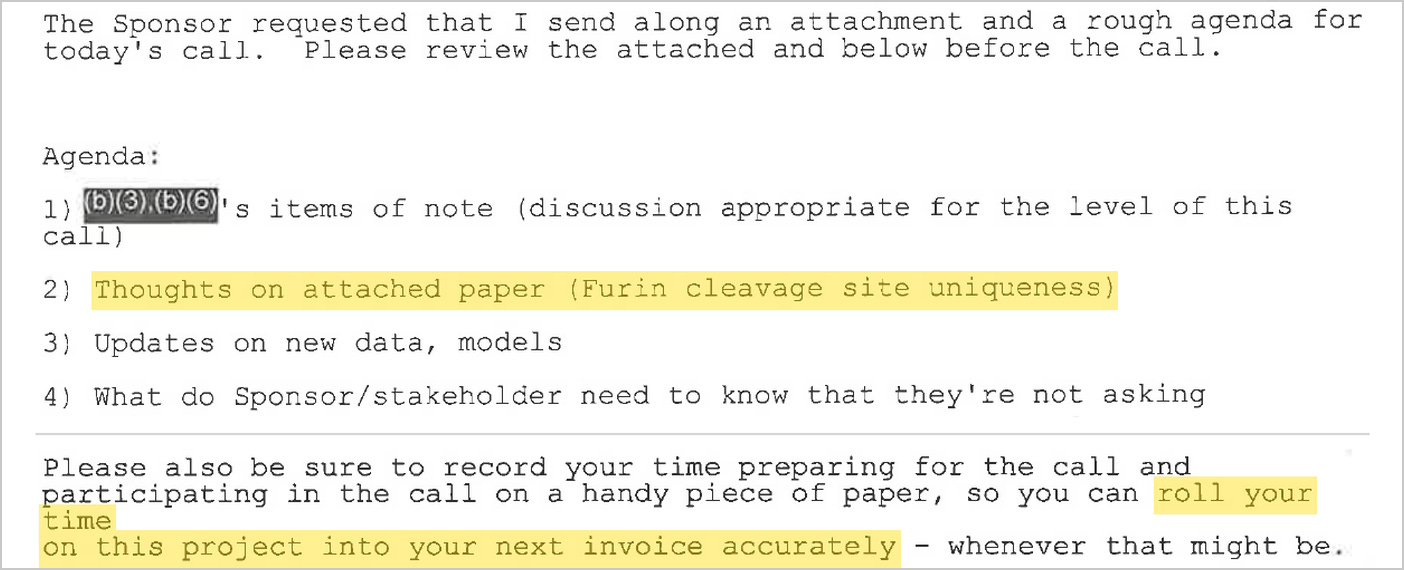
The panel’s March 27, 2020 call agenda, and the reminder about invoices.
On June 9, one panel scientist circulated a paper on the virus’s spike protein and asked: “where did these basic stretches come from? They are not found in the pangolin viruses, or the bat virus.”
On July 19, an outside expert’s email forwarded to the panel took on the claim of a “wide scientific consensus” against a man-made virus:
“I would bet that the consensus isn’t that wide at all.”
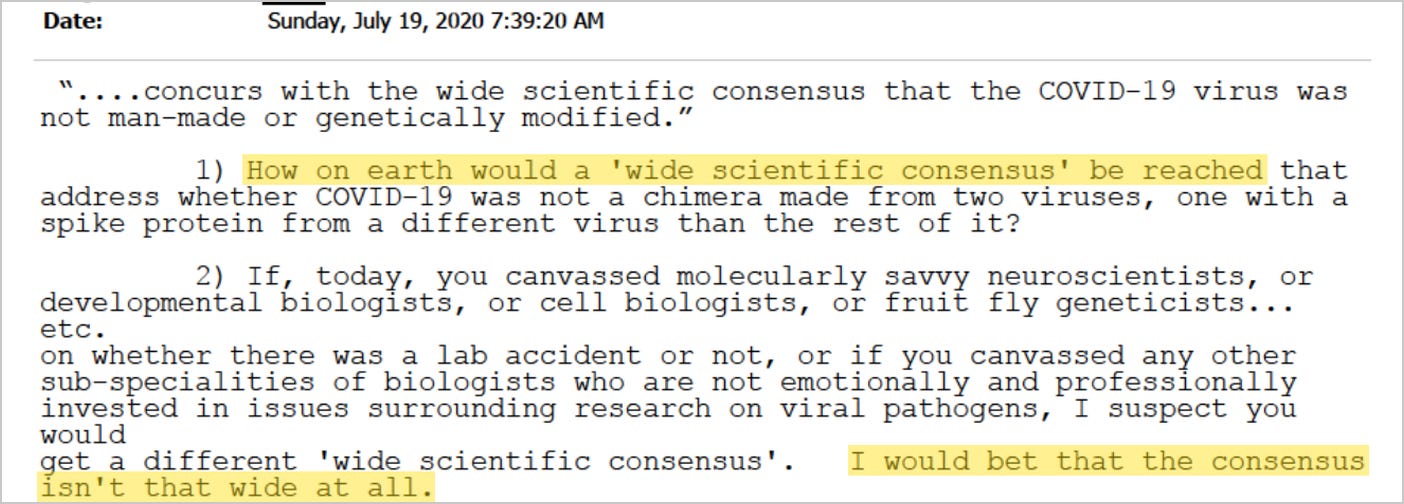
An email forwarded to the panel on July 19, 2020.
Meanwhile, in public: on April 16, 2020, NIH Director Francis Collins asked Fauci, “Wondering if there is something NIH can do to help put down this very destructive conspiracy…Anything more we can do?” The next day, Fauci cited Proximal Origin from the White House podium.
Inside the government, the dissent kept dying quietly. In May 2020, two Defense Intelligence Agency scientists wrote a rebuttal of Proximal Origin. Erdman says “It received little attention in the interagency space despite its accurate analysis.” That same month, a Department of Energy national lab reported “that all of the prerequisite conditions for a lab leak were present at the Wuhan Institute of Virology.” That report “was not included in any of the IC products in 2020.”
Who were these outside experts? Erdman testified that the officials running the panel “waived the typical counterintelligence requirements needed to properly manage risk.” And “several of these same IC scientists helped Dr. Fauci rewrite definitions of GoF in 2015 to lift a funding pause on dangerous research.” GoF is gain-of-function, the kind of research that makes viruses more dangerous in order to study them.
3. Fauci picked who the spies would ask
This is the real Langley story, and it’s better documented than the rumor.
In May 2021, President Biden ordered the intelligence community to study the virus’s origin in 90 days. On the June 4 video call, the CIA’s notes record: “Dr. Fauci recommended contacting a group of US scientists who closely follow this issue.”
A CIA memo records whom Fauci encouraged the agency to contact: Robert Garry, Kristian Andersen and Eddie Holmes, three of the Proximal Origin authors. The memo notes what they had in common: “all three of whom have advocated for features of the virus that they judge to be consistent with a natural origin.”
A senior intelligence official asked whether it was appropriate to take Fauci’s advice on whom to consult. According to Erdman, the officer running the 90-day study answered “that Dr. Fauci should be considered a SME rather than a public health official.” SME means subject-matter expert. Then: “The IC pursued Dr. Fauci’s recommendations.”
Erdman’s summary: Fauci used his position “to ensure the IC consulted with a conflicted list of curated Subject Matter Experts.”
Three years later, Congress asked Fauci whether he had briefed any intelligence agency about viral research. He answered: “not to my knowledge.”
There is money in this part of the story, but it isn’t a bribe. At his May hearing, Sen. Paul charged that one Proximal Origin author “received a $9 million grant from Dr. Fauci’s own agency after he changed his opinion from lab leak to natural origin.” That’s Paul’s charge, and we rate it as such. But it is a matter of record that the scientists Fauci sent the CIA to were the ones who had written the natural-origin paper.
4. When the analysts said “lab,” someone said “stop”
Over and over, the CIA’s own experts reached a lab-leak conclusion, and over and over, it didn’t stick.
February 2021. Erdman quotes an email from the National Intelligence Council: “if the CIA could make a call, they would likely assess lab leak.”
August 2021. “Sometime between 12 and 17 August 2021, the CIA changed its assessment from lab incident to a non-consensus determination. There is no indication based on the documents in DIG holdings to indicate why the assessment changed.”
Late 2022. A draft assessment with a lab-leak call went to senior managers. “One day later, a new intelligence report was published that allegedly contradicted the new information.” The analysts were sent back to start over. Before that, “eight of the 10 were in support of the lab leak scenario at a low confidence level.”
March 2023. Six of seven technical experts still said lab leak. Managers, “none of whom were SMEs,” changed the conclusion to “we may never precisely know the origin of SARS-CoV-2.” The edits were made “in the middle of the night – 1:53 am,” and the document doesn’t show who made them.
What happened to those analysts? “They no longer serve as analysts in WCPMC, their careers have been impacted, while those managers have been promoted into very senior positions.” (WCPMC is the CIA’s weapons and counterproliferation center, the unit that owned the question.)
The newly declassified files add one more detail. At a July 2023 briefing for the House Intelligence Committee, the CIA was asked about reports that its analysts had shifted from lab to undecided. An official sitting in on the briefing “explained that he made the call to stop the shift to lab because [REDACTED] had come in the day before they were ready to publish which made them back off the call.”

Readout of a July 2023 House Intelligence Committee briefing. Declassified in June 2026.
That’s not a bribe. It’s a pattern.
5. Close it out, and classify the rest
In November 2024, after the election, the CIA changed its stance again. Erdman says it “was not based on significant new information. It was directed by the CIA and WCPMC senior leadership.”
The result is a document dated Jan. 16, 2025, which U.S. Right to Know pried loose this summer. Its first page says:
“Most CIA analysts assess that a research-related origin of the pandemic is more likely than a natural origin. We have low confidence in this judgment.”
Pages 2 through 8 are blacked out in full.
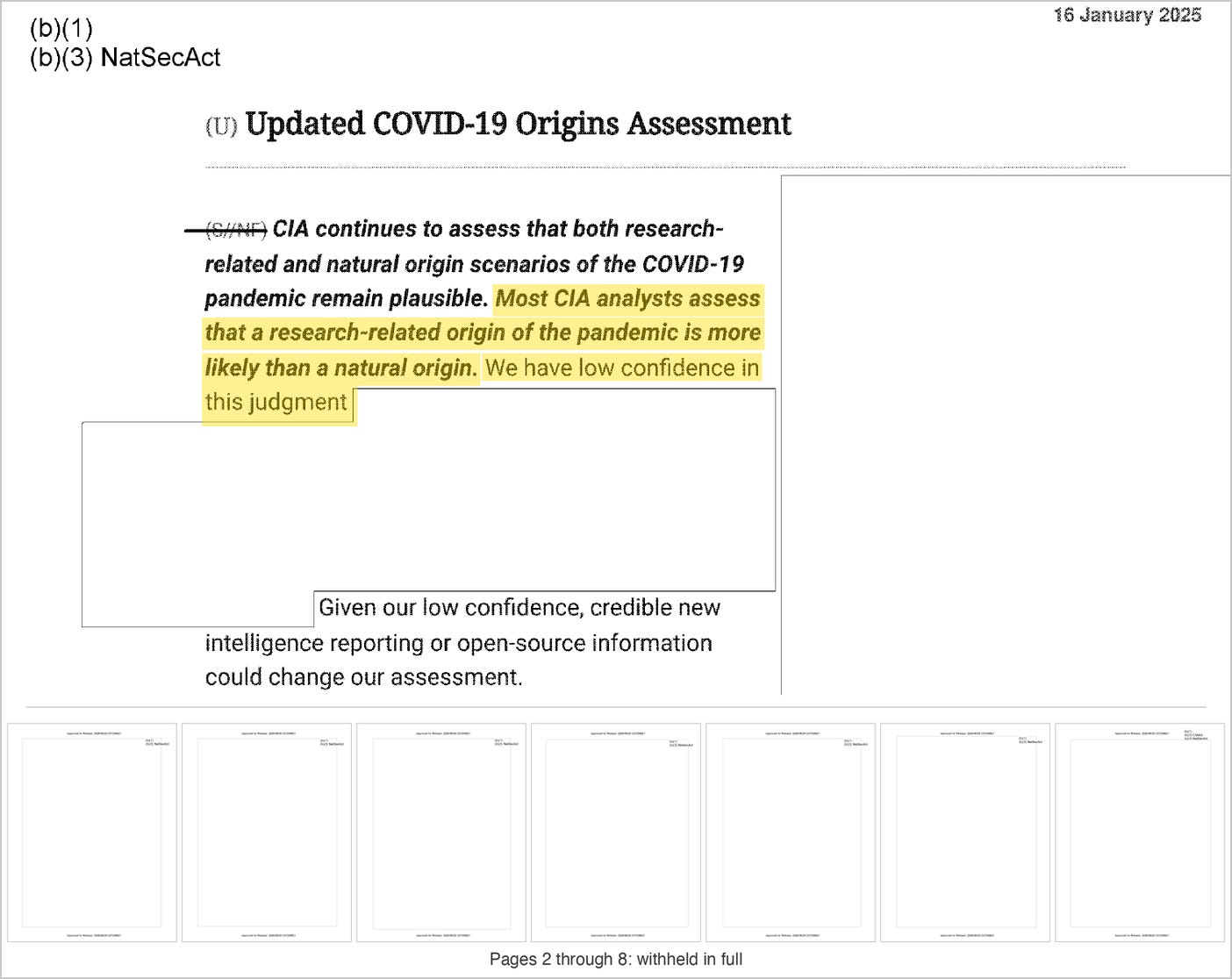
The CIA’s Jan. 16, 2025 assessment, released to U.S. Right to Know. Pages 2 through 8 are withheld.
Sen. Paul put it this way in May: “That is not analysis. That is a cleanup operation.”
What we can’t say
I hold these stories to the same rule as the database. Here’s what the records don’t support, so you don’t overstate it either:
The Baric email. His name is redacted. The identification is U.S. Right to Know’s, and it’s unclear who “they” were.
The CIA’s verdict. The agency rates its own lab-leak judgment “low confidence,” and in 2021 four agencies and the National Intelligence Council leaned toward natural origin, also with low confidence.
Erdman. He’s one witness, testifying under subpoena, and much of what he describes rests on documents the CIA still hasn’t released.
The $9 million grant. That’s Sen. Paul’s charge, not a finding.
The award gap. We know a natural-origin analyst got four times more. We don’t know why.
The bottom line
In 2023 the story was that someone paid the analysts to change their minds. The record shows that nobody had to. You only had to:
pick who gets asked,
fund the ones who agree,
overrule the ones who don’t,
and classify the rest.
Every document in this piece is in the COVID FOIA Database, with the exact quote and a link to the source: now 738 findings. Paid subscribers can open it from the Members area. Everyone else can join at rationalground.com.
They wrote it all down. We’re reading it, line by line, including the parts that prove us wrong.
— Justin