

Yesterday we published the text messages from Anthony Fauci’s government iPhone. On January 25, 2021, he told the Surgeon General and the CDC Director that fever after the second dose “theoretically could be associated with miscarriage in the 1st trimester.” Rochelle Walensky replied two minutes later: “Definitely a good point, esp after dose two.” Vivek Murthy agreed forty minutes after that.
Three officials, in writing, treating a reproductive risk as a real question worth raising.
Now here is what was happening to Americans who raised the same question in public.
The deck
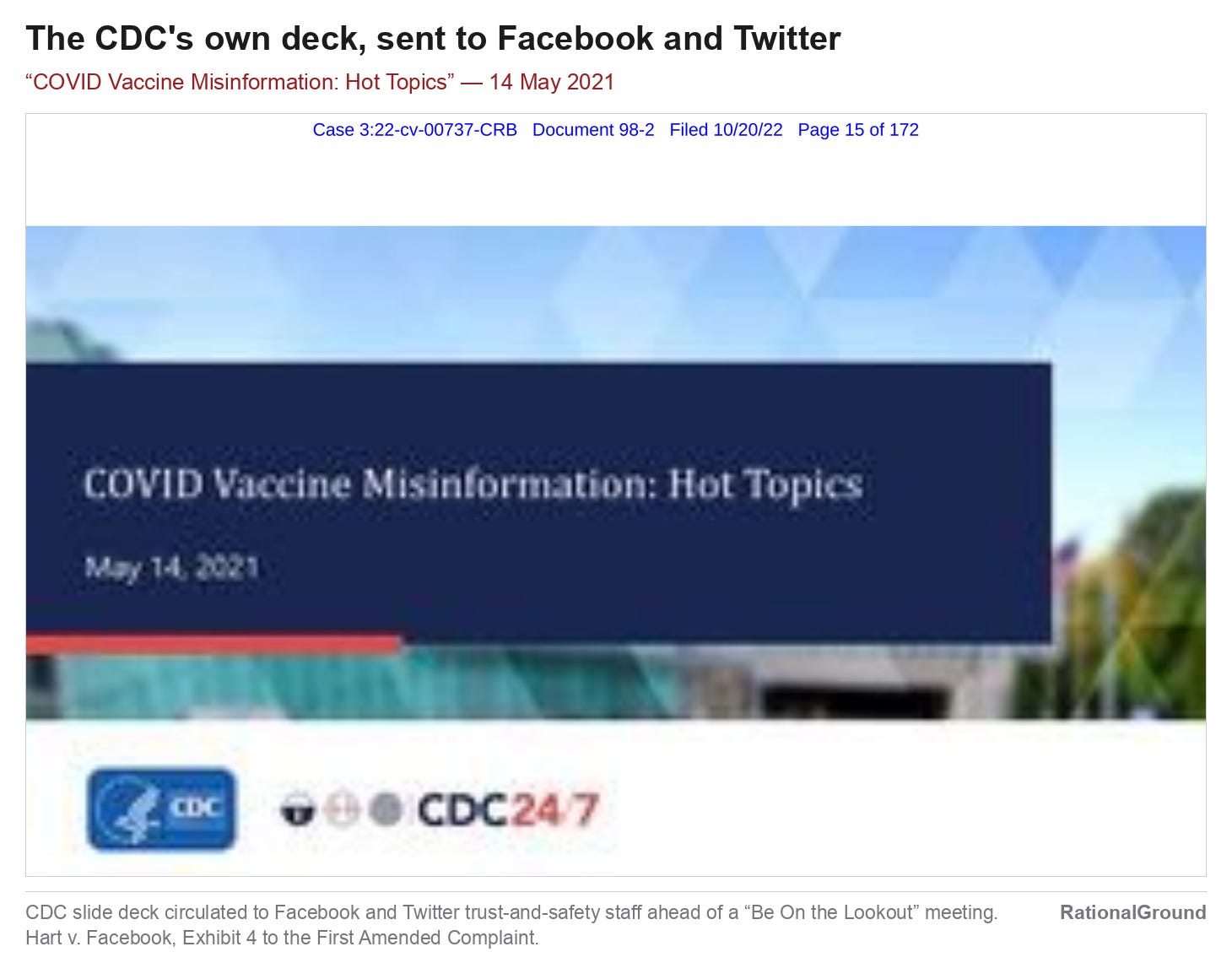
The lawsuit I filed against Facebook and other government entities elicited some interesting exhibits during discovery.
The CDC produced a slide deck for the trust-and-safety teams at Facebook and Twitter. It is on CDC letterhead, carries the CDC 24/7 logo, and is titled “COVID Vaccine Misinformation: Hot Topics.” It is dated May 14, 2021. Two decks with that title appear in the exhibits.
Inside: a formal agenda of misinformation topics, a set of “Example posts” marked as what the platforms should be on the lookout for, and a logistics slide naming a CDC point of contact for the recurring meetings.
The slides are marked “NOT FOR FURTHER DISTRIBUTION.”
The meetings had a name. They were called “Be On the Lookout” meetings — BOLO. The first misinformation deck went to Facebook in December 2020, a month before the text messages. Formal BOLO meetings ran May 14, May 28, and June 18, 2021.
This is not a leak, an allegation, or an inference. It is the case record in Hart v. Facebook, and the deposition of the CDC’s Chief of Digital Media.
The loop, in one sentence
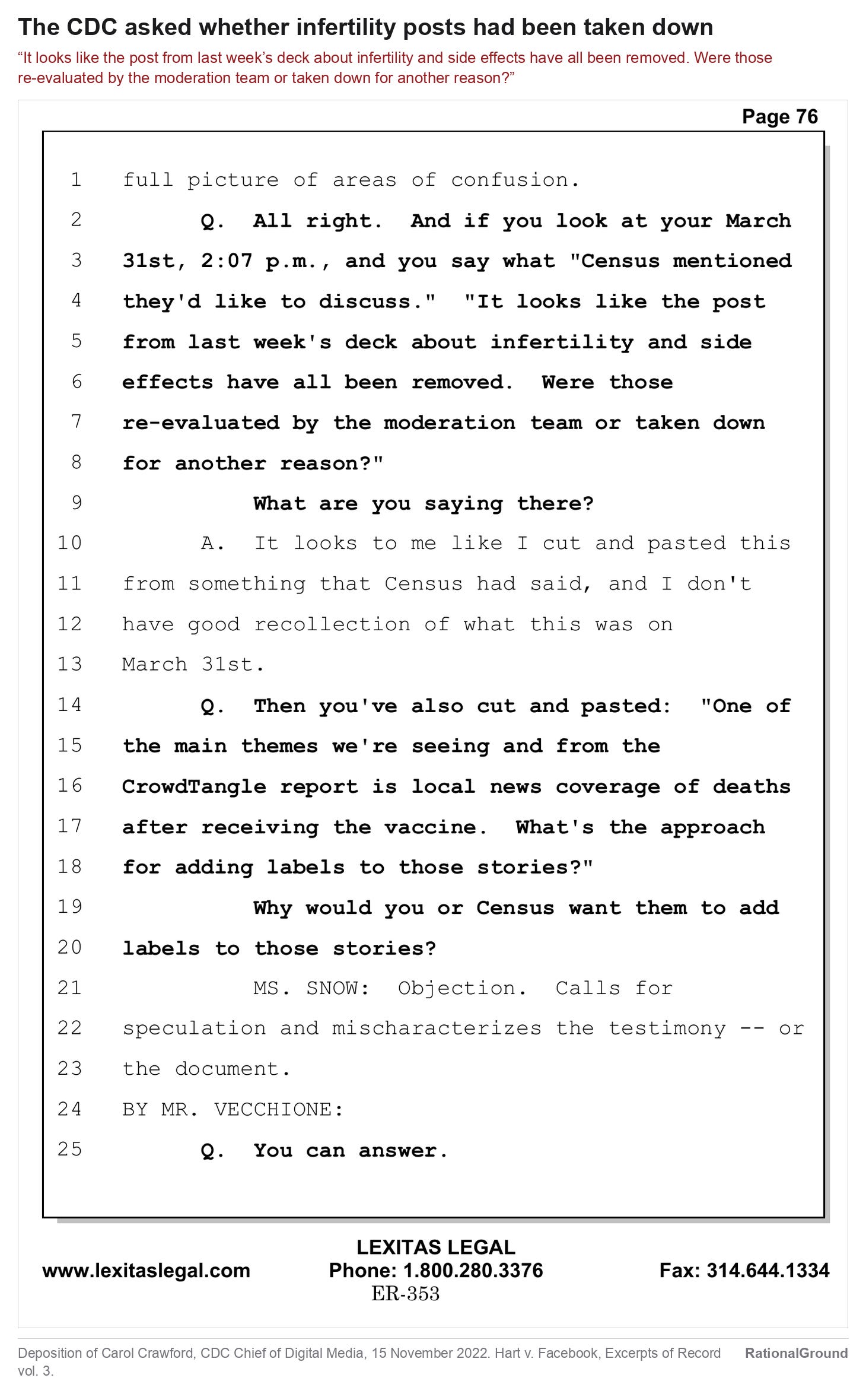
March 31, 2021. The CDC to Facebook:
“It looks like the post from last week’s deck about infertility and side effects have all been removed. Were those re-evaluated by the moderation team or taken down for another reason?”
Read that again slowly, because it is the entire argument in a single sentence.
Posts about infertility and vaccine side effects were in a CDC deck. The posts came off the platform. The CDC followed up to ask why they came off.
Flag, removal, confirmation. The government checking its own work.
And in the same exchange, a second question — about local news coverage of deaths after vaccination:
“One of the main themes we’re seeing and from the CrowdTangle report is local news coverage of deaths after receiving the vaccine. What’s the approach for adding labels to those stories?“
Not fringe accounts. Not anonymous cranks. Local news coverage.
A note on “Census,” which appears throughout the record: it does not mean the Census Bureau as you’d assume. It refers to a CDC-linked communications team working the same channel.
Four categories. Two of them were reproductive health and the government’s own data.
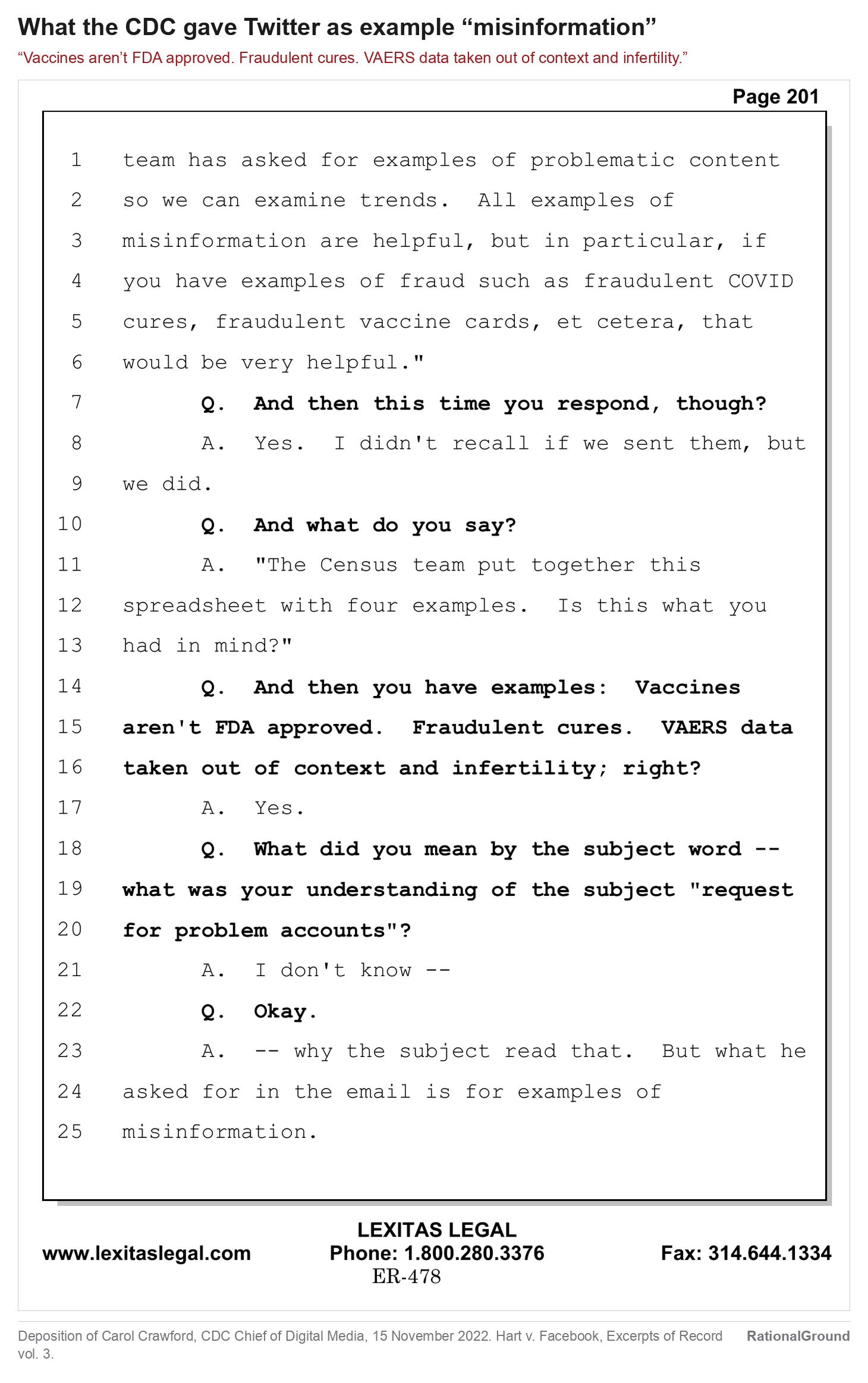
Carol Crawford, the CDC’s Chief of Digital Media, sent Twitter a spreadsheet of four example misinformation categories — at Twitter’s request, so the platform could see what would come up in the BOLO meetings:
Vaccines aren’t FDA approved
Fraudulent cures
VAERS data taken out of context
Infertility
We’ll be fair about the first two. Fraudulent cures are actual fraud, and so are forged vaccination cards, which appear elsewhere in the same workflow. Nobody sensible objects to a platform removing a scam.
The other two are a different animal.
VAERS is the government’s own adverse-event reporting system. It exists so that the public can report and examine suspected harms. Citizens discussing the contents of a federal safety database became a category on a federal misinformation list.
And infertility is not a product claim. It is a safety question about reproductive health — the identical territory the three most senior health officials in the country were privately texting about ten weeks earlier.
There is significant evidence that the Covid vax can impact fertility.
Crawford’s testimony on the fourth category: “I’m assuming this was people claiming that getting the vaccines led to infertility.”
Assuming. About a category she supplied.
The themes that carried “potential risks”
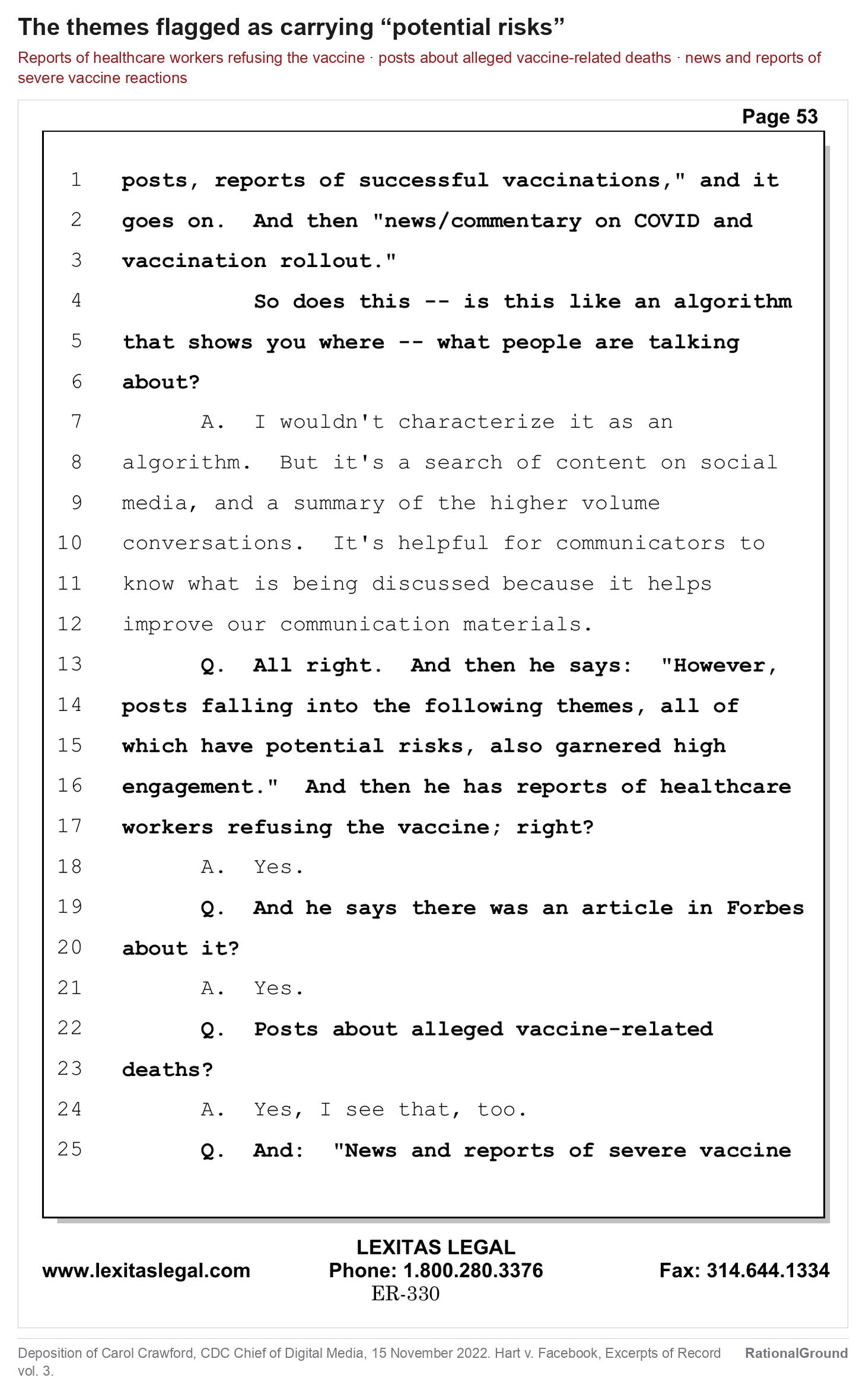
From the monitoring reports flowing to the CDC, here are the themes singled out as carrying “potential risks”:
Reports of healthcare workers refusing the vaccine — with a Forbes article cited
Posts about alleged vaccine-related deaths
News and reports of severe vaccine reactions
Nurses declining a shot is a fact about the world. It either happened or it didn’t. It is not a claim that can be true or false — it is an event, reported in Forbes.
It was flagged as a risk.
Then the standard moved
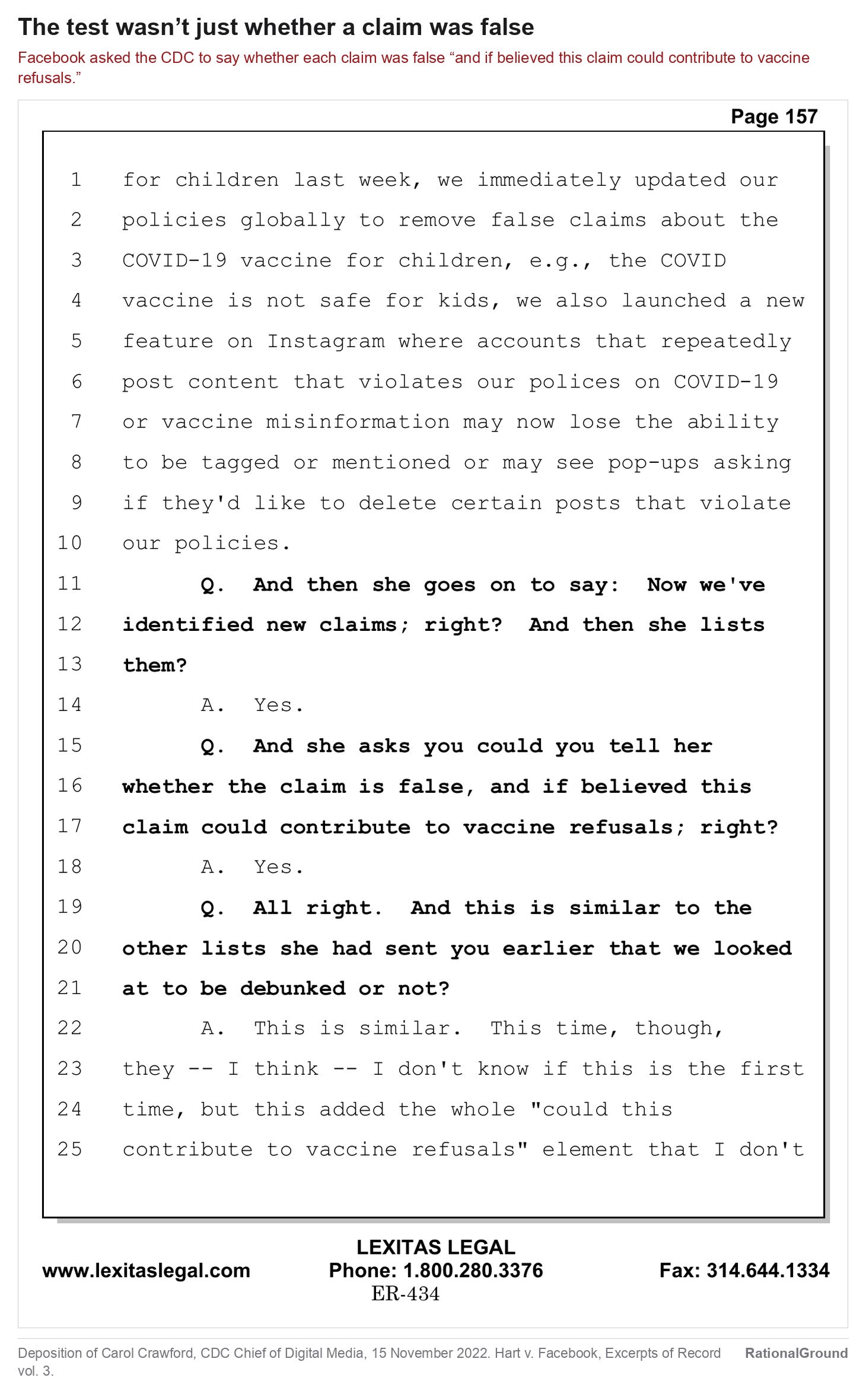
Facebook sent the CDC lists of claims and asked the agency to assess, for each one, whether it was false “and if believed this claim could contribute to vaccine refusals.”
Crawford noticed the change herself: “this added the whole ‘could this contribute to vaccine refusals’ element.”
Understand what happened there. The test was no longer is this false. The test became is this false, and would believing it cause someone to decline a vaccine.
Those are entirely different questions, and only one of them is about truth. Under the second test, a true statement that discourages vaccination is a problem to be managed.
The same message describes a new Instagram penalty for accounts repeatedly posting content that violated COVID policy: they “may now lose the ability to be tagged or mentioned or may see pop-ups asking if they’d like to delete certain posts.”
Not removal. Erasure from the conversation, and nudges to delete your own words.
A claim the CDC admitted it could not debunk
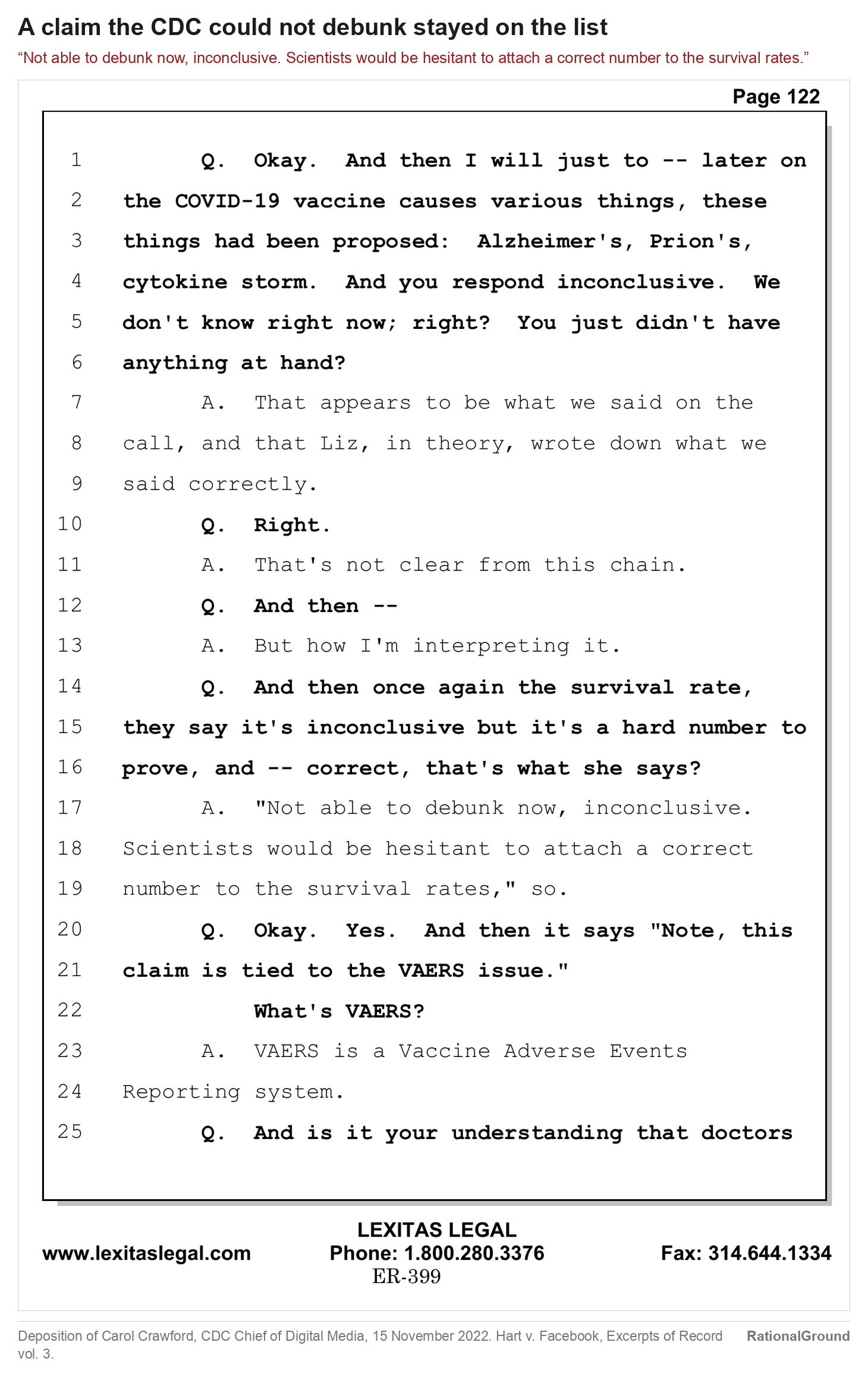
On a claim about COVID survival rates, the CDC’s own internal note reads:
“Not able to debunk now, inconclusive. Scientists would be hesitant to attach a correct number to the survival rates.”
The note adds that the claim is “tied to the VAERS issue.”
The agency could not say the claim was false. It said so, in writing, to itself.
The claim stayed in the misinformation workflow anyway.
Pre-clearing a product that didn’t exist yet
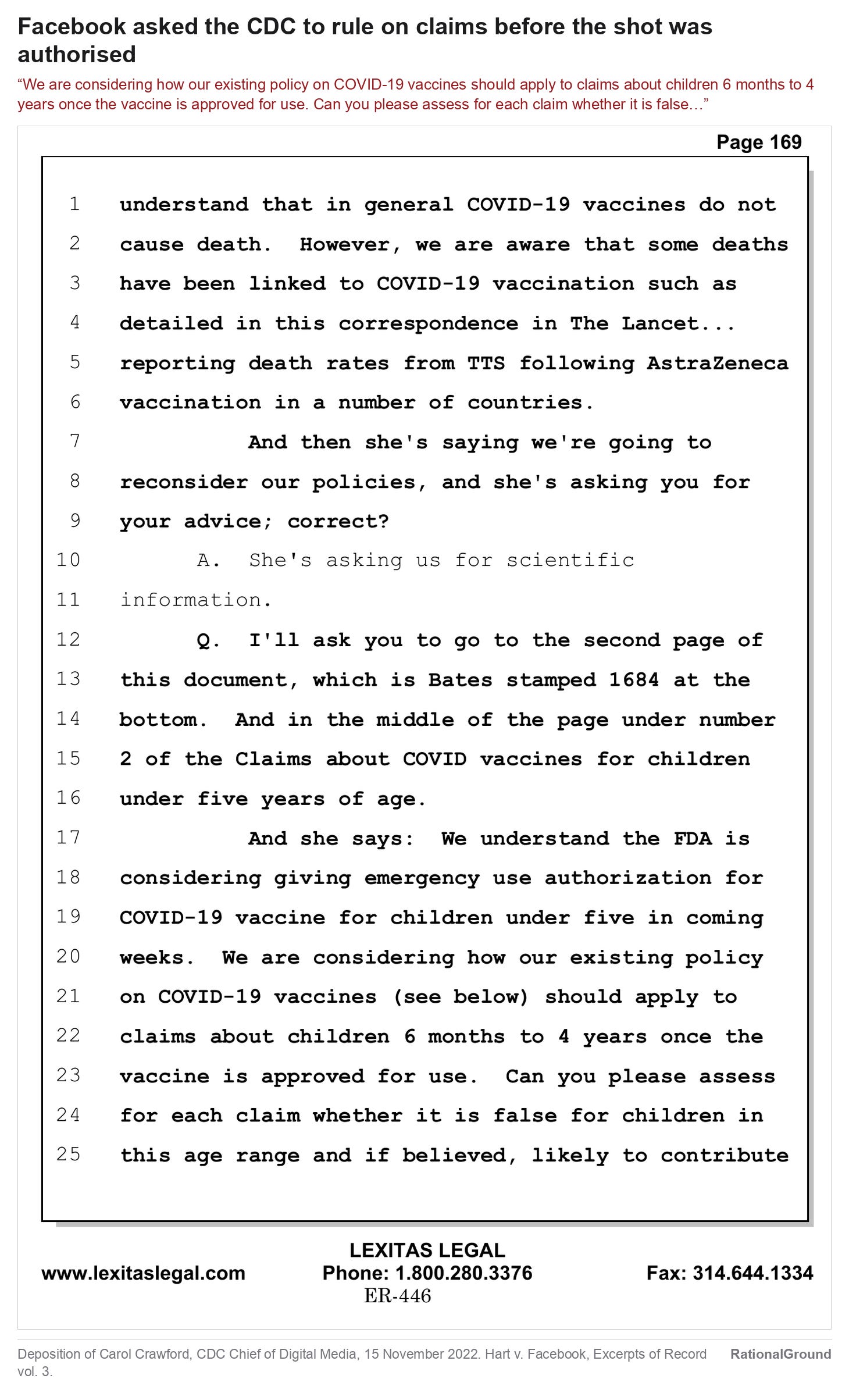
Facebook, to the CDC, on paediatric claims:
“We understand the FDA is considering giving emergency use authorization for COVID-19 vaccine for children under five in coming weeks. We are considering how our existing policy on COVID-19 vaccines should apply to claims about children 6 months to 4 years once the vaccine is approved for use. Can you please assess for each claim whether it is false for children in this age range and if believed, likely to contribute…”
A private company asked a federal agency to determine in advance what would be false about a medical product that had not yet been authorised for the population in question.
The safety data did not exist yet. The misinformation policy did.
Facebook later told the CDC that once authorisation came through for children, it “immediately updated our policies globally to remove false claims about the COVID-19 vaccine for children, e.g., the COVID vaccine is not safe for kids.”
What a federal appeals court made of this
The Fifth Circuit reviewed the same programme in Missouri v. Biden:
“The CDC’s relationship with the platforms began by defining—in ‘Be On the Lookout’ meetings—what was (and was not) ‘misinformation’ for the platforms… the CDC was entangled in the platforms’ decision-making processes.“
Entangled. A court’s word, not ours.
And the finding that disposes of any remaining argument that this only ever touched falsehoods — a platform committed to a policy change:
“focused on reducing the virality of anti-vaccine content even when it does not contain actionable misinformation.“
Even when it does not contain actionable misinformation. Content that broke no rule, throttled because of what it was about.
The counter-argument, in her own words
Crawford’s position throughout her deposition is that the CDC was sharing scientific information and asking questions, not directing removals:
“I don’t think we were asking them to add labels… We were asking them what their approach for labels were.”
That is her testimony and we’re not going to paraphrase her into an admission she never made. She says the platforms invited the CDC to flag major themes, and she says she was answering questions rather than issuing instructions.
Put her denial next to the March 31 email and decide for yourself. An agency that is merely curious about approaches does not follow up to confirm that specific posts came down.
What this cost, and why it still matters
Here is our position, stated plainly.
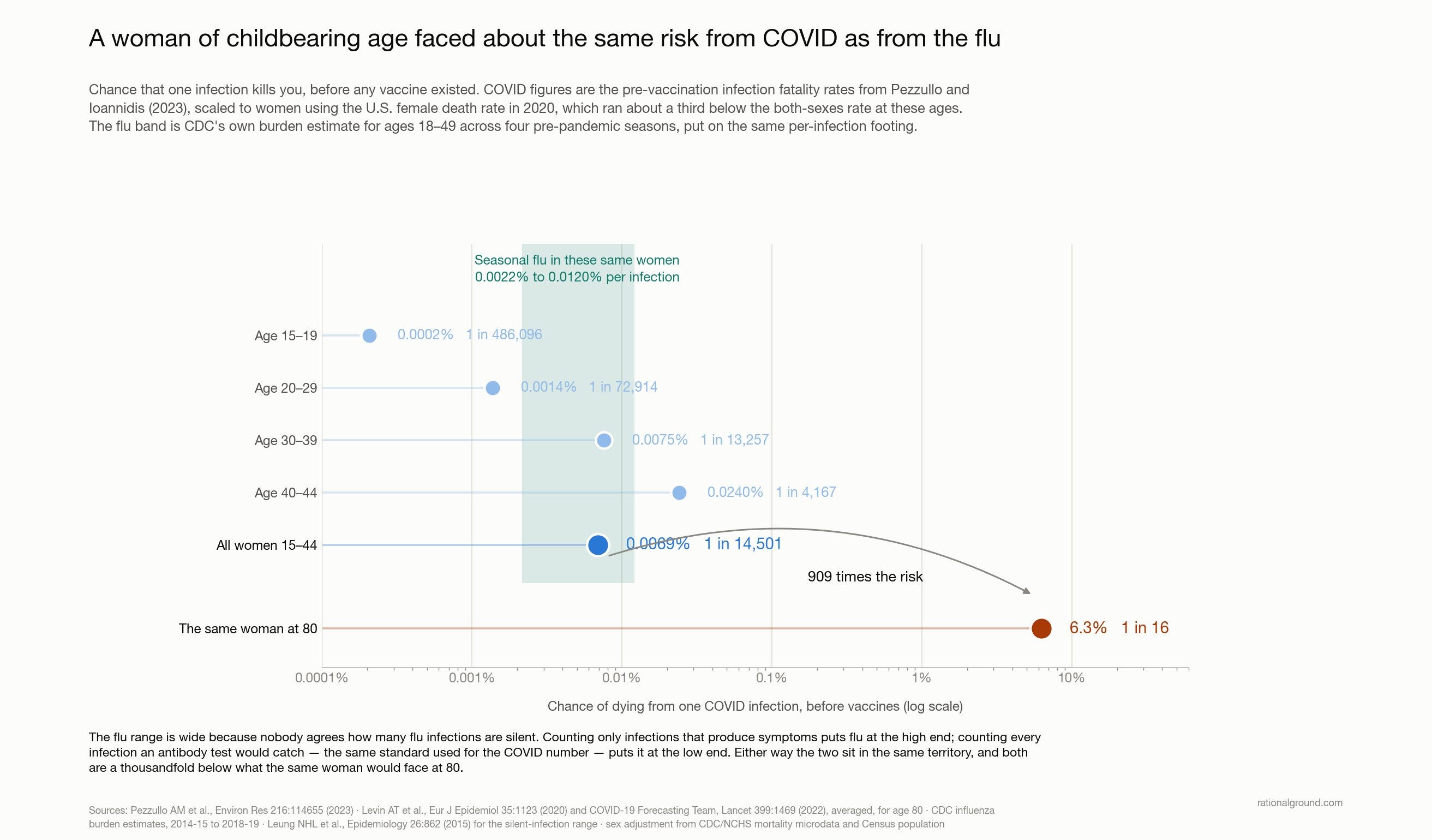
The jury is genuinely still out on what these vaccines did to pregnant women. We do not claim they caused miscarriages. We claim the risk was never zero — the officials running the response said as much to each other in writing — and that the benefit to healthy pregnant women, who were at low absolute risk from COVID, was oversold with a confidence the data never supported.
But that is not the scandal. The science can be argued. The scandal is that it couldn’t be.
While Fauci, Walensky and Murthy were privately agreeing that fever after dose two could be linked to first-trimester miscarriage, their own agency was sending private companies decks with “infertility” on the list, checking whether those posts had come down, asking about labels on local news coverage of deaths, and flagging nurses who declined the shot as a risk theme.
The conversation they were permitted to have with each other was the conversation Americans were not permitted to have with each other.
That asymmetry is the whole of it. Not a disagreement about virology — a government that reserved a question for itself and policed the public out of it. And it is precisely why the question is still unresolved five years later: the process that would have surfaced an answer was throttled while the answer was still forming.
One more date. On April 1, 2021, HHS entered a $15 million advertising agreement with Facebook. Nick Clegg told Surgeon General Murthy that Facebook had removed over 20 million pieces of COVID and vaccine content.
And on July 13, 2021 — after the ad money, after the BOLO meetings — this newsletter’s founder was suspended from Facebook over a graphic about masking children. That suspension is why Hart v. Facebook exists, and why these documents are public at all.
We were told we were spreading misinformation.
The people who told us that were, at the same time, texting each other about miscarriage risk.
Sources: the case record in Hart v. Facebook — 32 documents, 1,354 pages, including the November 15, 2022 deposition of Carol Crawford, CDC Chief of Digital Media, and the First Amended Complaint with exhibits. Every image above is a page from the court record with its Excerpts of Record stamp visible. Appellate quotations are from the Fifth Circuit’s opinion in Missouri v. Biden. Originals at the Liberty Justice Center’s case page. Text-message quotations are from the August 10, 2026 release by Senators Ron Johnson and Rand Paul.