

David Morens, Anthony Fauci’s longtime adviser at NIAID, has now been indicted by the Department of Justice.
According to STAT, Morens was charged Tuesday over allegations that he concealed and falsified records to keep communications out of reach of Freedom of Information Act requests. The New York Post reported — in a story flagged by Sean Spicer — that Morens has been charged with conspiracy against the United States; destruction, alteration, or falsification of records in federal investigations; concealment, removal, or mutilation of records; and aiding and abetting.
Let’s pause on that.
For years, the public was told that anyone asking hard questions about COVID’s origins was trafficking in conspiracy theories. Lab-leak questions were censored. Scientists were smeared. Journalists were scolded. Ordinary citizens were deplatformed for noticing obvious conflicts of interest.
Now one of Fauci’s closest lieutenants has been indicted for allegedly hiding the paper trail around precisely those questions.
Morens is presumed innocent unless and until proven guilty. That matters. But the indictment itself is not a minor personnel matter. It is not a clerical dispute. It is not “whoops, I used the wrong inbox.” It is the legal system finally catching up to conduct we have been documenting at Rational Ground for years.
We wrote this story before Washington admitted it was a story
Back in June 2023, I wrote “Unveiling Morens: An Exposé of Transparency Evasion and Possible Deception”. At the time, the facts were already disturbing enough.
Morens, a senior scientific adviser at NIAID and close Fauci associate, had written:
“As you know, I try to always communicate on gmail because my NIH email is FOIA’d constantly… just send to any of my addresses, and I will delete anything I don’t want to see in the New York Times.”
That was not subtle.
It was not ambiguous.
A public official involved in pandemic-origin discussions was telling outside actors how to communicate in a way that would avoid public disclosure. In that same piece, I warned that the behavior raised “serious questions” about whether public records laws were being evaded and whether Fauci’s circle was trying to influence the COVID-origin narrative without fingerprints.
Nearly a year later, in “Fauci Protege Morens Plays Hide and Seek”, I wrote that the revelations were “not merely a matter of procedural misstep but a symptom of a much deeper malaise affecting the transparency and integrity of our public health institutions.”
That still seems too polite.
By May 2024, the story had grown worse. In “New Revelations: How Fauci and Morens Hid Data and Misled the Public”, we covered the now-infamous line:
“I learned from our FOIA lady here how to make emails disappear after I am FOIAed, but before the search starts, so I think we are all safe. Plus I deleted most of those earlier emails after sending them to Gmail.”
Again: not subtle.
Not ambiguous.
Not a conspiracy theory.
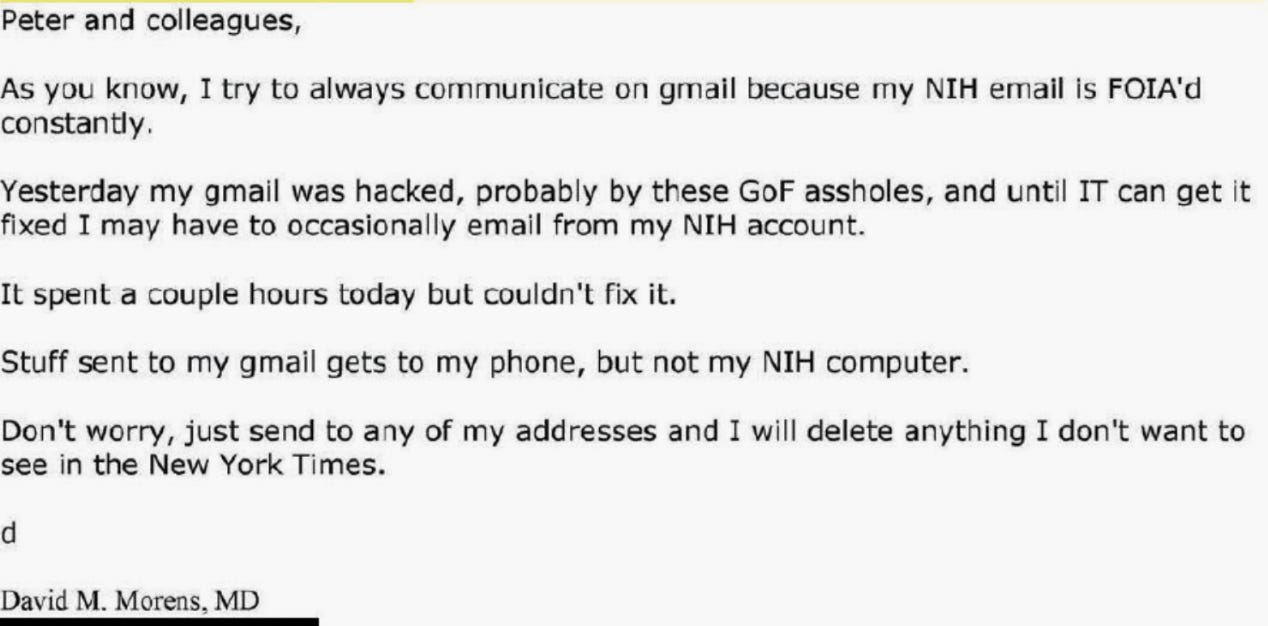
A senior government scientist was bragging, in writing, about learning how to make emails disappear.
The hearing was a warning flare
The May 2024 congressional hearing should have been the moment the entire press corps stopped and asked: what on earth was going on inside NIAID?
In “Kickbacks, Mysoginy, Black Humor, and Hiding Emails: Dr. Fauci’s Lieutenant on the Hot Seat”, we covered the scene as members of Congress confronted Morens with his own messages.
Rep. Kweisi Mfume, a Democrat, told him:
“Sir, I think you’re going to be haunted by your testimony today.”
Rep. Michael Cloud pressed him on the “FOIA lady” email. Morens tried to brush it off as joking, euphemism, black humor. But there are only so many times a man can say he was joking about avoiding federal records law before the joke becomes the evidence.
The emails described back channels to Fauci. They described personal Gmail use. They described sharing documents with Peter Daszak of EcoHealth Alliance. They described ways to show information on Zoom or pass it to “Tony” privately rather than leave a searchable government record.
And now, according to the new reporting, prosecutors allege a conspiracy involving Morens and others to keep communications away from FOIA requests while working around the controversy over COVID origins and EcoHealth funding.
This was always about more than one man
The temptation now will be to make Morens the fall guy.
Washington loves a containment strategy: isolate the scandal, sacrifice the subordinate, preserve the institution.
But Morens was not some random lab tech who accidentally forwarded a memo to the wrong account. He was a longtime adviser to Fauci. He co-authored papers with Fauci for years. He sat near the center of the public-health empire that shaped pandemic policy, funding priorities, and public narratives.
In “Bending Modernity to Their Will”, I wrote about the broader Fauci-Morens worldview. Their 2020 Cell article did not merely discuss pathogens. It gestured toward “rebuilding the infrastructures of human existence” and asked whether modernity itself could be bent “in a safer direction.”
That phrase still captures the spirit of the pandemic regime better than any slogan:
Bend modernity in a safer direction.
Close schools. Close churches. Close businesses. Police speech. Suppress dissent. Manage narratives. Censor lab-leak discussion. Trust the institutions. Follow the science.
And when the public asks to see the emails?
Use Gmail.
Delete what you do not want in the New York Times.
Learn how to make emails disappear.
The lab-leak fight was never only about the lab
Some defenders will say this indictment does not prove COVID came from a lab.
Fine. That is not the point.
The point is that the public had a right to an honest inquiry. Scientists had a right to debate. Journalists had a right to investigate. Citizens had a right to ask why a novel coronavirus emerged in the same city as a lab doing risky coronavirus research with connections to U.S.-funded intermediaries.
Instead, the lab-leak hypothesis was treated as heresy.
As I wrote earlier this year in “Six Years Ago Today, They Chose the Lie”, the February 1, 2020 teleconference was the hinge point. Scientists privately worried about engineered features and a possible lab origin. Within weeks, the public received “Proximal Origin,” a paper that became the establishment’s cudgel against dissent.
The consequences were enormous:
Facebook labeled lab-leak posts as misinformation.
Scientists who asked questions were smeared.
Reporters treated legitimate inquiry as dangerous.
Platforms suppressed discussion.
Government agencies slow-walked, redacted, or resisted disclosure.
The question is not whether Morens personally caused all of that. He did not.
The question is whether his alleged behavior reveals the culture that made all of that possible.
And the answer is yes.
The public was right to distrust them
Last month, in “Why We Lost Trust”, I wrote that the public-health collapse was not a vibes problem. It was an itemized bill.
Origin of the disease — wrong.
Transmission — wrong.
Masks — wrong.
School closures — wrong.
Natural immunity — wrong.
Vaccine transmission claims — wrong.
Censorship — wrong.

And on the origin question, the institutions did not merely get it wrong. They enforced their preferred answer while the people closest to the controversy were apparently taking active steps to keep the public from seeing the record.
That is why this indictment matters.
It is not because David Morens is a household name. He is not. It is because he represents the hidden layer of pandemic governance: the advisers, grant managers, friendly scientists, NGO intermediaries, FOIA officers, and narrative enforcers who operated behind the public-facing saints of The Science™.
The public saw Fauci at the podium.
Behind the podium was an ecosystem.
Morens was part of that ecosystem.
Follow the evidence upward
Fauci has denied knowing about Morens’s efforts to evade federal records requirements. He has said he did not conduct official business through personal email. President Biden preemptively pardoned Fauci before leaving office, insisting it did not imply wrongdoing but was necessary under “exceptional circumstances.”
Those facts now sit in a very different light.
If Morens is guilty, who else knew?
Who was included in the back channels?
Who received information that was kept off official systems?
Who at NIH or NIAID understood that FOIA searches could be gamed?
Who at EcoHealth participated?
Who decided that suppressing “alternative theories” about COVID’s origin was a legitimate use of institutional power?
And most importantly: what did the American people still not get to see?
The answer cannot be “we indicted the old adviser, now everyone move along.”
That would be the oldest Washington trick in the book.
Accountability is not vengeance
There will be a predictable response from the institutional class: this is political revenge, an attack on science, a chilling effect on public servants.
No.
Accountability is not an attack on science. Hiding public records is an attack on science.
Deleting emails is not public service. It is public betrayal.
Using private channels to avoid lawful disclosure is not a harmless workaround. It is the exact kind of behavior that destroys trust in government.
If the allegations are proven, Morens did not merely embarrass NIAID. He helped confirm what millions of Americans already suspected: that the pandemic response was managed by people who believed transparency was optional, dissent was dangerous, and the public had no right to see how decisions were really made.
We were told to trust them.
We asked for the records.
They allegedly learned how to make the records disappear.
That is the story.
And if the Department of Justice is serious, David Morens should be the beginning of the investigation — not the end.
“We have posted online more than 10,000 pages of David Morens emails, which we obtained through #FOIA requests and litigation. See document batches labeled Morens:”
https://x.com/garyruskin/status/2049174879404998848
its a good start but until they have Fauci then justice for the millions of innocent people who died because of his behavior will never be done. Morens needs to understand he is going to die in prison if he doesn't give the DOJ what they need to get Fauci. Fauci can be tried in an international setting or maybe a State could try him. Or force the unconstitutional pre pardon by the auto pen to be resolved by the supreme court after We jail Fauci and treat him like the Jan 6th people were treated, Isolation no actual charges filled for years etc.