

A study comparing 1.47 million matched Florida adults found Pfizer recipients died at meaningfully higher rates than Moderna recipients over 12 months. It cleared peer review on November 1. It also does not say what a lot of people are about to tell you it says.
On November 1, Global Epidemiology published “Twelve-month all-cause mortality after initial COVID-19 vaccination with Pfizer-BioNTech or mRNA-1273 among adults living in Florida.” The authors are MIT’s Retsef Levi, Fahad Mansuri, Melissa Jordan, and Florida Surgeon General Joseph Ladapo. These are all people we trust.
If that sounds familiar, it should. This went up as a preprint in April 2025 and was immediately dismissed as unreviewed junk. It is now reviewed. That is the news, and it deserves to be stated plainly before anyone starts arguing about what it means.
What They Did
Florida keeps a centralized immunization registry and links it to state vital statistics. The authors started with 9,162,484 non-institutionalized adult Florida residents who got two mRNA doses less than six weeks apart between December 18, 2020 and August 31, 2021 — 5.3 million Pfizer, 3.8 million Moderna.
From that pool they built matched pairs: 735,050 Pfizer recipients paired 1-to-1 with 735,050 Moderna recipients, matched on seven criteria — age group, sex, race, ethnicity, calendar month of vaccination, vaccination site (nine categories), and census tract. Then they followed deaths for 12 months after the second dose.
Census-tract matching is the part worth pausing on. It means each pair lived in the same small neighborhood, got vaccinated in the same month, at the same type of location, at roughly the same age. The difference between them is which vial they happened to get.
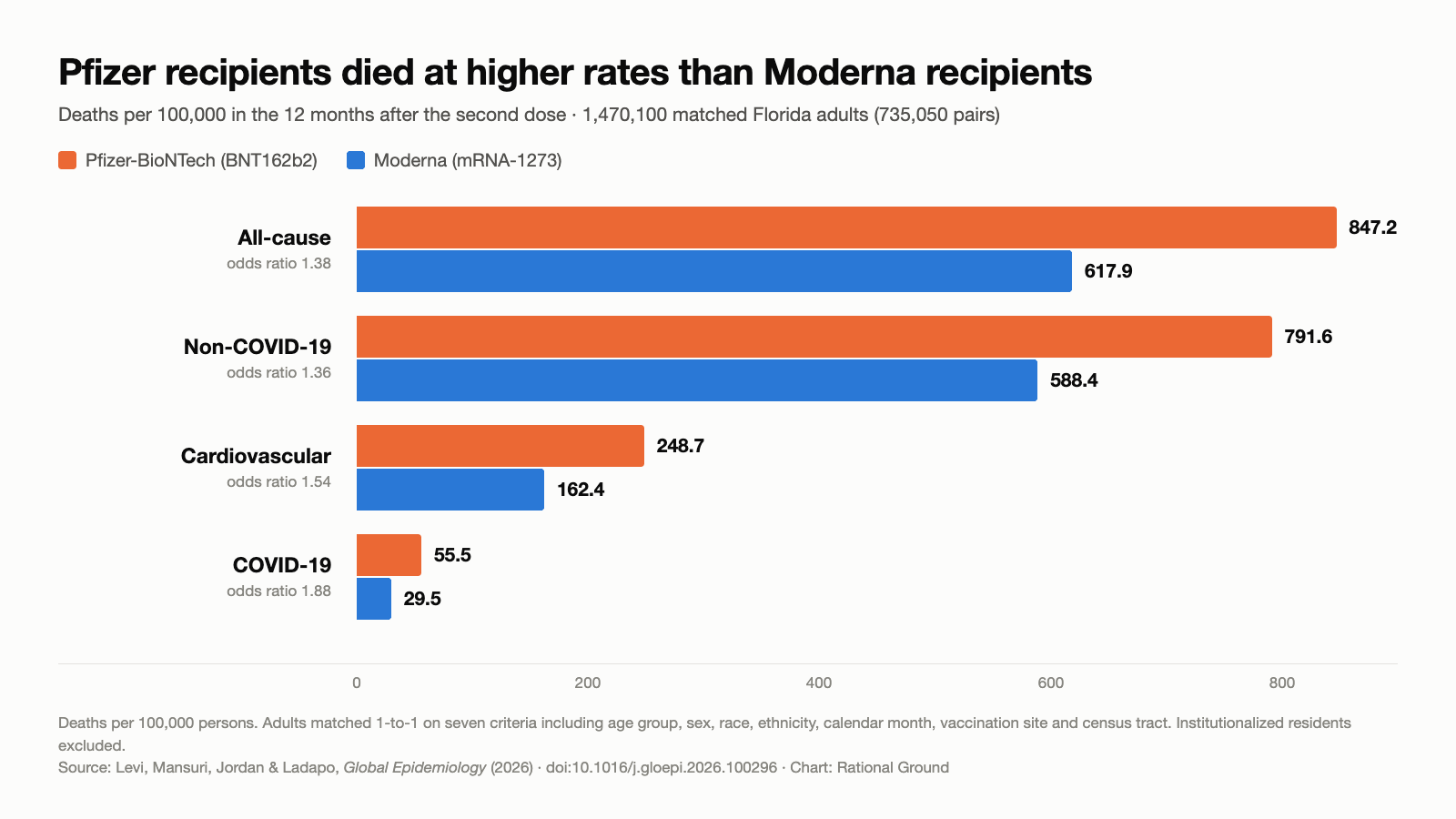
Pfizer recipients died at higher rates on every measure:
All-cause: 847.2 vs. 617.9 per 100,000 — odds ratio 1.384 (95% CI 1.331–1.439)
Cardiovascular: 248.7 vs. 162.4 — OR 1.540 (1.431–1.657)
COVID-19: 55.5 vs. 29.5 — OR 1.882 (1.596–2.220)
Non-COVID-19: 791.6 vs. 588.4 — OR 1.356 (1.303–1.412)
The gap was largest among recipients over 60. Negative control outcomes showed no sign of meaningful residual confounding. And a sensitivity analysis found that to erase the result, you’d need an unmeasured factor 1.5 times more common among Pfizer recipients and associated with death at an odds ratio of at least 6.4. That is a demanding bar for a hidden confounder to clear.
Why This Design Is Better Than the Usual
Here is the methodological point that most coverage will skip, and it’s the reason this study is worth taking seriously.
Studies comparing vaccinated people to unvaccinated people are notoriously unreliable, because the two groups differ in ways nobody can measure. People who show up for vaccines also show up for cancer screening, take their statins, and don’t die of untreated diabetes. This is healthy vaccinee bias, it is large, and it has wrecked observational studies in both directions.
Comparing two vaccinated groups largely dissolves that problem. Both cohorts cleared the same behavioral hurdle — they went and got two shots. Whether a Floridian got Pfizer or Moderna in early 2021 was mostly an accident of which clinic had which vial on which day.
That is a genuinely cleaner comparison than most of what gets published in this field, and it’s why the Veterans Affairs system has run similar head-to-head designs — one of which, cited by the authors, found higher cardiovascular event risk after Pfizer than after Moderna over 266 days.
That is a serious finding and it should be replicated in other state registries immediately — which is a thing any state with a linked immunization registry and vital statistics could do this year if it wanted to.
It is also not proof that either vaccine raised anyone’s mortality relative to no vaccine, because the study was not built to answer that question. Both of those sentences are true. The temptation this week will be to keep the first and drop the second.
The authors’ own closing line is the right one to end on, and it is more interesting than the death-toll arithmetic: these results “underscore the need to evaluate vaccines using clinical endpoints that extend beyond their targeted diseases.”
Translated: if you only ever measure whether a vaccine prevents the disease it targets, you will never find out what else it does. That has been the hole in the evaluation framework for twenty years, and it is the reason a study like this had to be run by a supply-chain professor and a state health officer instead of by the agencies that licensed the products.
$56.
We just told you the number on our own side of the argument is wrong. That is the publication. $56 for the year — the FOIA database, the forecast, and a straight read of the evidence whichever way it points.
👉 Join at $56 — members.rationalground.com.
Study: Levi R, Mansuri F, Jordan MM, Ladapo JA. “Twelve-month all-cause mortality after initial COVID-19 vaccination with Pfizer-BioNTech or mRNA-1273 among adults living in Florida: Statewide cohort study.” Global Epidemiology, published November 1, 2026. doi:10.1016/j.gloepi.2026.100296. Open access. Figures above are quoted from the authors’ deposited manuscript, the openly available version of record of this DOI; the study previously circulated as a medRxiv preprint (10.1101/2025.04.25.25326460). Chart by Rational Ground.
No matter, with the leftists in charge the mRNA vaccine parade will go on. The left might hate big tech and data centers but they love mandates that destroy people's lives.