

This is the fifth chapter in a continuing series. The first took you inside the Directorate, where decline is managed like inventory. The second walked Maple Street, where an extra bedroom became permission again to see a family grow. The third went below the streets of Oderstadt, where men flushed silence to imitate pressure. Chapter four took to the air—over a chain of Great Lakes islands—where fewer children mean fewer doctors. Now it’s time to slow down for a census.
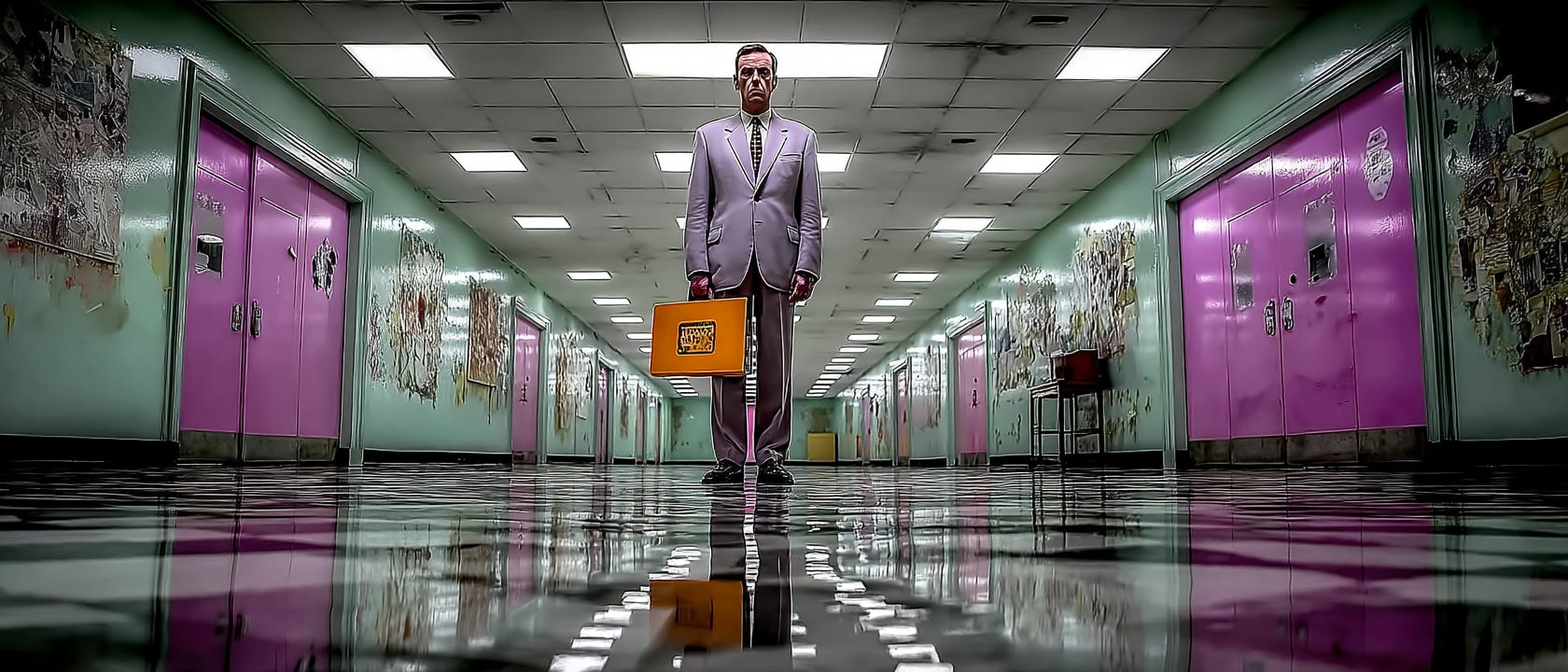
The Ministry, in its thrift and tenderness, has assigned me to count what remains of District 9(B). I accepted the task with the modest pride of an archivist entrusted with ashes: the work would be clean, exact, and, I told myself, harmless. My name is Felix Adler, civil demographer, mid‑career, mid‑height, mid‑hope; I carry three pens, two spare nibs, and the quiet conviction that the act of counting—done honestly—matters even when no one answers.
The map for 9(B) looks respectable on paper: thirty‑two blocks, four parks, one school squinting at a playground. On the tram, the buildings arrange themselves in tidy ranks, their windows unblinking, their curtains working on automatic schedules like eyelids too polite to sleep in public. Automated sprinklers tick at the corners; drone pods alight with packages addressed to names that do not open doors. A banner on a civic fence reads CITIZEN CONTINUITY PROGRAM in a blue that suggests forgiveness. I write these details down, but I’m uncertain that sight itself can be notarized.
The protocol is new. The Bureau calls it Low‑Density Enumeration—a term that implies the people have become a kind of gas. “Approach every address,” the handbook says, “with the same presumption of presence. Do not infer absence from stillness.” Each instruction has the courtesy of a classroom rule. I knock with the rhythm I learned on fieldwork during better years: three light raps, a pause, then one large intention. The first door answers with a woman’s voice that is perfectly polite and perfectly wrong. It comes from an intercom the color of oatmeal.
I convey my purpose and start in:
“Name and date of birth?” I ask.
“Yes,” the voice says. “Confirmed.”
“Number of occupants?”
“Two.”
“Children under eighteen?”
“Zero.”
“Employment?”
“Remote.” The intonation is a metronome; the vowels have been sharpened by software into something like dental work.
I tick boxes. The second house answers in the same voice, the same phrasings in a different order. I may have blushed. There is a pleasure in regularity, but this felt less like order than rehearsal. At the third address a porch light woke as I climbed the steps, and the recorded woman greeted me by name.
“Good morning, Felix.”
The syllables sat too even on the tongue. I paused, turned my pen in my hand to feel something human, and proceeded. A demographer, like a doctor, must not let personality contaminate the sample.
At the end of the block, a man in a fluorescent vest was watering the sidewalk with a hose. He watered with care, avoiding cracks. “Caretaker?” I asked.
“Klara,” she corrected me, removing her cap—my error; the reflective vest had borrowed my assumptions. She was fifty, perhaps, with a face that had learned to keep even weather in order.
“You live here?” I said.
“I live adjacent to here,” she said very slowly. “Someone must persuade the houses to remember what living looks like. Lights, blinds, deliveries—if the machines forget the schedule, your forms take fright.”
She showed me a ring of keys, and then, like a conjurer, a tablet with a grid that mirrored my own map. Next to each address, a dot: green when the devices were behaving, amber when the compost bin had not been lifted on time, red when a doorbell failed its cheery lie.
“You’re the continuity program,” I said.
“I am continuity’s janitor,” she said, without bitterness. “And you are continuity’s archivist. We keep our stations.”
“What’s beyond this?” I asked, making the gesture people make when they mean truth and pretend they mean street.
She considered. “Beyond is the ledger you will write that says we are what we pretend. Nobody wants to cut pipes or close parks. It is cheaper to pay you to tick boxes and me to keep windows blinking than to draw a map that admits subtraction.”
We continued together for three addresses. Klara stood back while I asked my catechism and the voice inside answered as if it had slept between questions for a hundred years. The fourth house failed to speak on cue; she tapped an app and the bell found its manners. “We’ll fix the firmware,” she said, with the gentleness of a nurse rearranging a pillow for a patient who has stopped needing rest.
The school appeared at the end of a long block. Its bell had been unbolted the year they consolidated with a campus farther upriver. Someone had painted over the outlines where the brackets used to be; the paint was honest about the patch. Through the glass I could see the gym floor, a pale geography. I remembered the remark the budget director made at a hearing I once enumerated for: We will not be shamed out of prudence. It had sounded like wisdom at the time, the way euphemism often does when you are tired.
The manual allows field notes. Mine began to thicken.
House 17: respondent anticipates questions, offers occupation before asked.
House 19: recorded laughter after “children?”—algorithmic; used last year.
House 21: blinds open/close sequence misaligned; note to continuity.
Park 3: sprinklers perform in absence of grass.
At midday, in a narrow alley where hedges still believed the century was young, I knocked and heard not the woman but a male voice—calm, careful, in which I recognized something of myself. “Good afternoon, Felix,” I said, from inside the house. “Let’s get you home.” The questions I asked came back to me in my own punctuation.
I was briefly vain—someone at the Bureau liked the way I spoke—but vanity is a delicate glue. “Please list occupants,” I said.
“Felix Adler.”
“Age?”
“Forty‑four.”
“Employment?”
“Enumeration.”
“Children?”
A pause. “Zero.”
I did not scratch out the page; a civil servant does not injure paper. Instead I wrote in smaller letters, as if modesty could make the sample less absurd, and I finished the survey with the obedience of a functionary reciting the creed of a church he has ceased to attend.
The intake at Central had called me careful. I have been called worse. It is true I love forms—the clean architecture of questions, the way answers settle into boxes like birds into nests. It is true I carry my pens in a case lined with felt and feel faintly disloyal when I borrow a ballpoint. It is true that, when I cannot sleep, I sometimes copy out columns of numbers until their order persuades me that I am not lost. More importantly, it persuades me to sleep.
That night, after I turned in my counts at the substation where the tube swallows documents with a gallant hiss, I dreamed what you would predict: corridors of doors, each opening on a mirror that opened on a corridor. In the morning I set aside the dream with the same reserved respect I afford to petitions from citizens I cannot help: I filed it mentally and went back to work.
Klara was at the corner with a broom. “Yesterday’s wind,” she said. “How many people live here, today?” I asked. “As many as you need,” she answered, and then, misreading my flinch, added, “I mean, as many as the plan requires.” She turned the broom, and I watched how the bristles made sense of dust. We admire the artifact that insists on order even when order is a kind of fiction.
In the afternoon she unlocked a low building at the block’s end. Inside: servers humming with the persistence of insects, a rack of chargers, a table with a kettle and two cups. “Citizen Continuity,” she said, tapping a console. “We do not lie; we coordinate. If the Bureau expects a response at noon, we make sure noon feels true.”
On the far wall, a whiteboard laid out CLIENT TYPES in a calligraphy that belonged to a calmer discipline—Legacy Owner, Absent Heir, Municipal Hold. For Legacy Owner someone had drawn a key. For Municipal Hold someone had drawn the outline of a house with a flag that did not flutter.
“Do you tell them,” I asked, “that you are answering for them?”
“We tell them the lights will be on,” she said. “We tell the Bureau the lights are on. Between those two courtesies, a neighborhood survives without making new people to justify itself.”
I sat with my tea and counted the fans in the server racks. Their tidy noise warmed me more than the cup. I asked her why she cared so much, and she lifted one shoulder in a European way that said because work is work and because someone must.
On the third day of the count I tried a block beyond the tram’s reach. The houses there had the cautious look of dogs who have forgotten whether walk is still a word. The intercoms behaved; the answers came; I added them to my book. At the last address the porch light flickered, on, off, on, as if receiving a joke from a radio in another room. “Please state the number of occupants,” I said, preparing myself for Two.
“One,” the voice said. “Self‑audited.”
I did not move. There are sentences you step around as if they are sleeping.
“In what sense,” I asked, and hated the question.
“Counting is an act of faith,” the voice said—my voice again, which is to say a clever approximation of a careful man. “This unit maintains faith.”
“Are you occupied?” I asked, and felt like the sort of person who looks into a cabinet to confirm the existence of cups.
“We are compliant.”
I wrote the word and drew a box around it. It did not become truer. Behind the door, machines maintained a temperature safe for nobody. On the lawn, a sprinkler spun a circle no feet would cross. From somewhere on the next block, a bell rang once—not from a school, there is no bell now—but from a bicycle, or a memory, or some human somewhere who had found a reason to enjoy life.
I finished District 9(B) the next afternoon. My report was praised for stability metrics. An administrator whose titles multiplied since we last met wrote: “Your enumeration aligns with the Continuity Plan. Reliable as ever, Adler.” There was a small unsayable in the sentence where my name sat like a period. I filed the file.
That evening I walked without purpose until I reached the river, where the city runs out of excuses and becomes its own dumb element. In the pocket notebook I keep for thoughts too undisciplined for ministry paper, I wrote, “Civilization does not end with silence; it ends when silence is still carefully tabulated.” I closed the book before the sentence could become righteous. The air smelled of algae. A child’s voice—a real one—shouted on the far bank and then fell into the water’s ordinary shushing. I went home.
The only exhibit in my apartment that could pass for ornament is a corkboard where I pin discarded bus transfers and small moths that have found their way into my lamp’s globe. The transfers curl; the moths fade to a universal brown—elegant creatures rendered modest by light. I keep them not out of cruelty but as a sort of apology: to notice something is to flatter it with duration. Sometimes I think the State hired me for the same reason: not to save anything, only to prevent it from being forgotten at once.
I drafted a final page for the Bureau. It contains all the numbers the system expects. It also contains a line at the bottom, in the space reserved for Notes:
“House 28: Resident present. Age: forty‑four. Occupation: enumeration. Children: zero. Method: echo.”
I signed it and delivered it in person. The clerk at the intake window—kind eyes, careful nails—ran her stamp with the professional satisfaction of someone who knows how much order a small action can create. “Another district finished,” she said. “Reliable as ever, Mr. Adler.”
“Thank you,” I said, and resisted explaining to her that I had just counted myself in a house that was not a house at all, and that the count had been unassailable, and that the city would now be able to fund a park without a child to fall from its climbing frame.
Back in my apartment I wrote on the flyleaf of my census ledger the sentence I was afraid to mail:
Population: One. Self‑audited.
I placed the book on the shelf between Low‑Density Protocols (ed. 3) and Historic Enumeration: Methods & Morals. Then I turned off the lamp and watched the room get honest. I could not count myself to sleep that night.
Awaiting the next to explain more. So much for make work drone workers. Need to address the loneliness factor alluded to in last paragraph.