

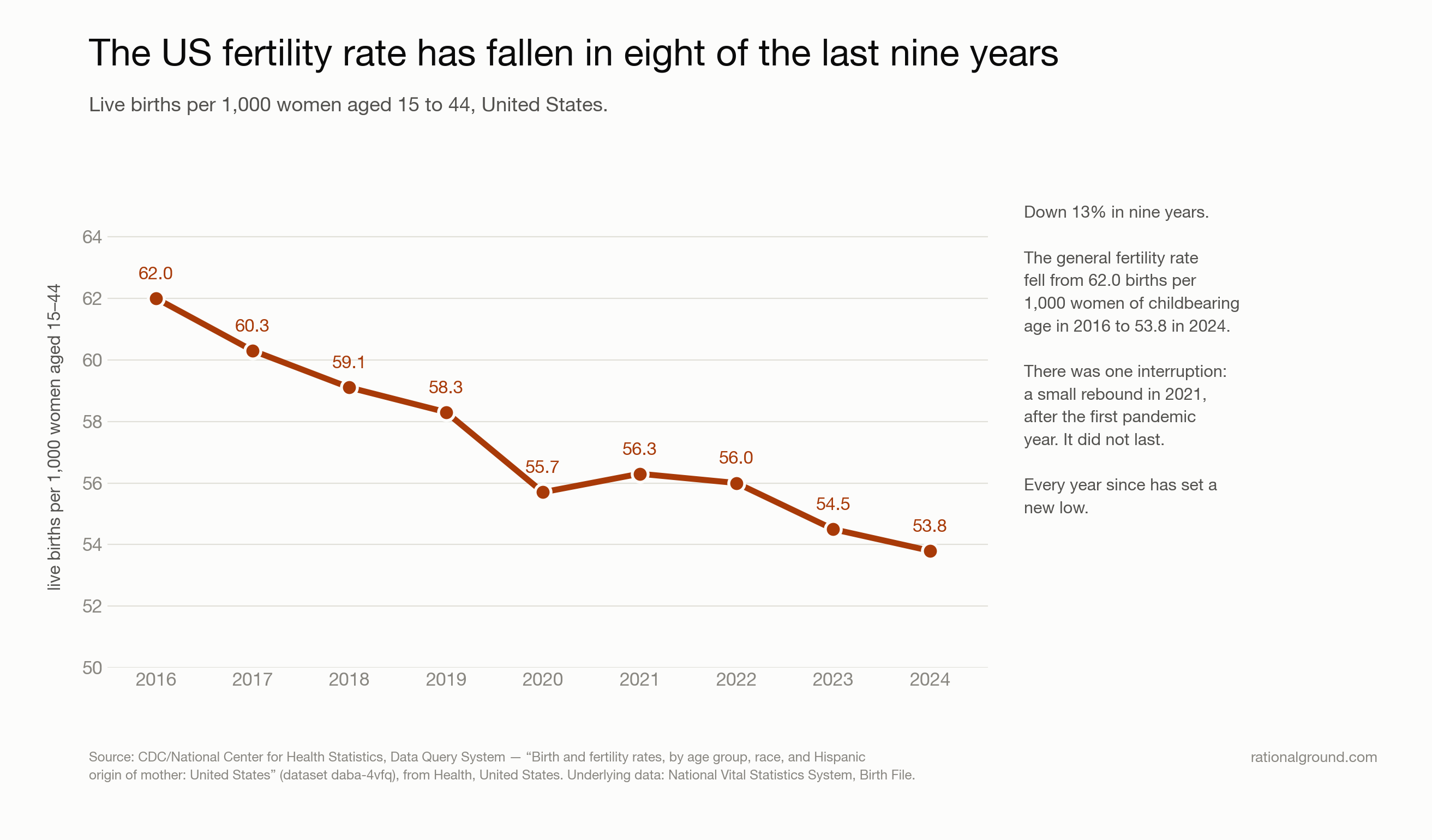
The American fertility rate has now fallen in eight of the last nine years.
From 62.0 births per 1,000 women of childbearing age in 2016 to 53.8 in 2024. That is a 13% drop in nine years, and the single interruption was a small rebound in 2021 after the first pandemic year. It did not last. Every year since has set a new low.
This is the kind of number that gets filed under “interesting demographic trend” and then ignored, because nothing appears to happen. No one is hurt today. The schools are still open. The pension checks still clear.
That is exactly the problem. The consequences of a birth rate arrive twenty and forty and sixty years after the births don’t. Which means the damage from the last nine years is already locked in — and the countries that started falling before we did are living in our future right now.
First, look at where the births went
The headline number hides the more interesting story. American births aren’t simply falling. They’re moving in different directions - but they all point to the same thing: decline.
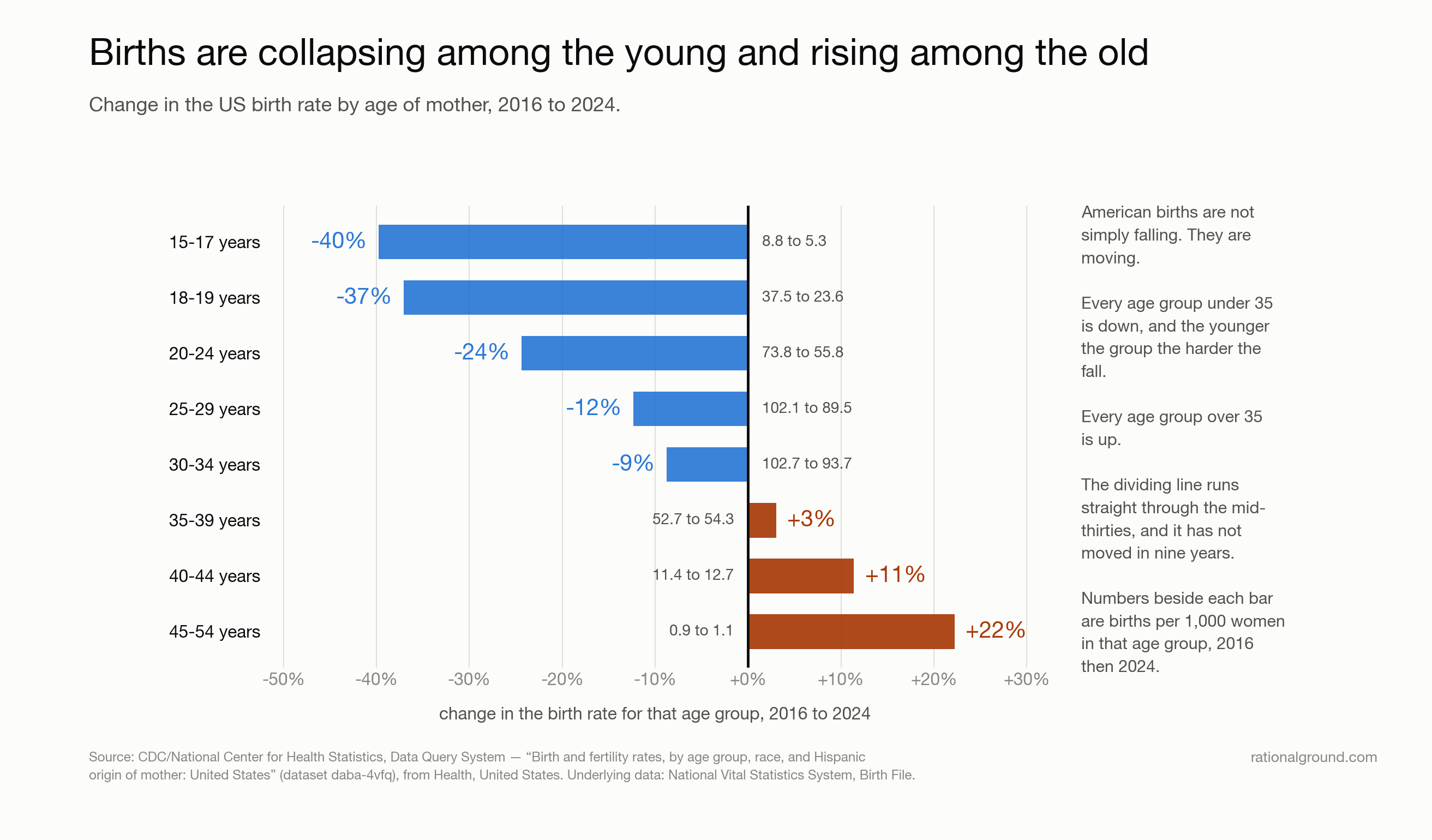
Every age group under 35 is down, and the younger the group, the harder the fall — teen births down 40%, ages 18-19 down 37%, ages 20-24 down 24%. Every age group over 35 is up. Births to women 45 and older rose 22%.
The dividing line runs straight through the mid-thirties, and it has not moved in nine years.
Some of this is a genuine social good and nobody should pretend otherwise. A 40% collapse in births to 15-to-17-year-olds is a win by many standards. But the same shift has a second effect that doesn’t make the press release: a birth delayed is frequently a birth that never happens. Push the average first birth far enough into the thirties and biology starts taking a cut of the intention. The chart isn’t a picture of Americans choosing childlessness. It’s a picture of Americans choosing later, over and over, until later closes.
And the fall is not evenly shared.
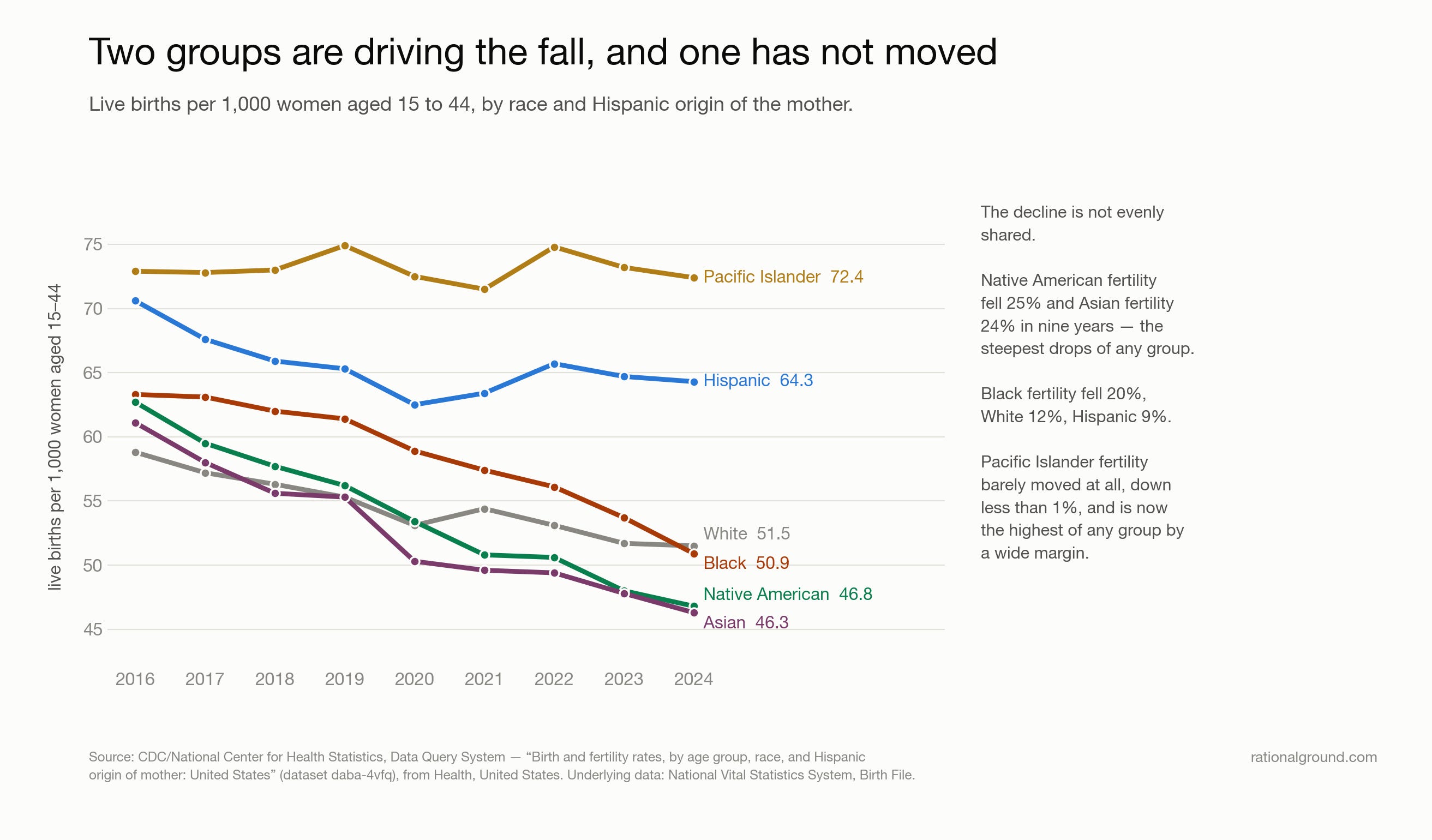
Native American fertility fell 25% and Asian fertility 24% in nine years — the steepest drops of any group. Black fertility fell 20%, White 12%, Hispanic 9%. The Hispanic rate, long the demographic cushion under American population projections, is now 64.3 and dropping.
Now look at Greece
Here is the part that makes this urgent rather than academic. We do not have to speculate about what comes next. Europe started down this road decades ahead of us, and the bills are arriving on schedule.
Greece spends 14% of its entire economy on pensions — and it was 16.4% in 2021, the highest share in the EU, before reform trimmed it. That money comes from workers. Today roughly five Greek workers support two retirees. By 2050 it’s four workers supporting three. The old-age dependency ratio nearly doubles, from 39 to 74.
Now here’s the line item nobody reads. The European Commission’s own 2024 Ageing Report projects that total age-related spending rises only modestly — from 25.1% to 26.5% of GDP by 2070. Manageable! Except look under the hood at how that number stays flat. The dependency ratio alone pushes pension costs up 6.2 points of GDP. The forecast only balances because the same model assumes the benefit each retiree actually receives falls (−2.9), that coverage narrows (−1.3), and that people work longer (−1.1).
The reassuring projection is reassuring because it has already priced in a smaller check. Europe has not solved this. Europe has scheduled the cut and declined to announce it.
It slows the economy, and we can measure by how much
Maestas, Mullen and Powell, in the American Economic Journal: Macroeconomics (2023), used variation across US states from 1980 to 2010 and found that every 10% rise in the share of the population over 60 cuts GDP per capita by 5.5%.
The mechanism is the surprise. Only a third of that came from fewer people working. Two-thirds was productivity — each remaining worker producing less. Aging doesn’t merely shrink your workforce. It appears to slow down the one you still have.
Their estimate is that aging shaved 0.3 percentage points a year off American per-capita growth between 1980 and 2010. Compounded across a generation, that is the difference between a rich country and a much richer one.
Charles Jones takes it further in the American Economic Review — “The End of Economic Growth?” — and his argument is uncomfortable and clean. Modern growth models run on people discovering ideas. Fewer people, fewer ideas. If population shrinks permanently, you don’t get slower growth. You get what he calls the “empty planet” outcome: living standards stagnate for a population that keeps dwindling.
That is the top journal in the field, not a pamphlet.
Old societies stop starting things
This one I’d never seen quantified until now. Liang, Wang and Lazear in the Journal of Political Economy found that a one-standard-deviation drop in a country’s median age raises new business formation by 2.5 percentage points — roughly 40% of the average rate.
And the detail that should stop you: older societies have lower entrepreneurship at every age, including among their young. A 30-year-old in an old country starts fewer companies than a 30-year-old in a young one.
The authors’ proposed mechanism is blockage. When older workers hold the senior positions, younger workers never acquire the skills and responsibility that let them strike out on their own. An aging society doesn’t just have fewer founders because it has fewer young people. It produces less capable young people.
The map empties before the country does
Depopulation is not a gradual, even thinning. It’s a doom loop in specific places: the school closes, the bus route ends, the clinic shuts, the last young family leaves.
Greece closed more than 700 schools in 2025. Student numbers are down about 150,000 since 2018. A Greek school is suspended below 15 students and permanently closed after three years under the line.
Greece peaked at 10.82 million people in 2010 and was at 10.43 million by 2023 — 400,000 people gone in thirteen years.
Italy’s fertility rate hit 1.18 in 2024, the lowest in the EU. Italy now counts roughly 1,000 comuni fantasma — ghost towns — and as many as 6,000 abandoned hamlets.
Spain’s countryside has lost 28% of its population in fifty years. Five rural regions covering 53% of Spanish land hold 15% of Spanish people. The España Vaciada — “emptied Spain” — movement put 100,000 protesters in Madrid in 2019 and forced the creation of a government ministry for depopulation.
A government ministry for depopulation. Sit with that.
And then there’s the army
EU births fell below 4 million in 2022, the first time since 1960. That is the recruiting pool, and it is already fixed for the next eighteen years. You cannot appropriate your way out of it.
Germany reports 20,000 military billets sitting entirely vacant, with its own parliamentary commissioner warning that the armed forces are aging and shrinking simultaneously. In 2026 Germany began screening every 18-year-old man for military suitability — a step back toward the conscription it had abandoned. France, Croatia and Latvia are moving the same way.
The EU defense commissioner says Europe needs to be able to move 100,000 troops quickly. Finding them is now the binding constraint. Not the budget. The people.
The bill that comes forty years out
Demographers track something called kinlessness — adults who reach old age with no living spouse and no children. Among Americans 55 and older, roughly 7-8% of White adults and 10-11% of Black adults were kinless as of 2015, projected to reach 8-10% and 12-13% by 2040.
Unpaid family care is the invisible foundation of elder care in every Western country. It never appears in a budget because nobody invoices for it. The kinless have less wealth, worse health, and less support, and somebody pays for that.
Low fertility today is a long-term-care bill forty years out, and it lands on a working-age population that is smaller for the same reason.
Where I’ll concede the argument
There is a serious counterargument and it deserves a fair hearing, not a strawman.
Acemoglu and Restrepo find no negative relationship between aging and GDP growth across countries. Their explanation: aging societies automate. Robot adoption rises precisely where the middle-aged workforce is shrinking, and productivity rises fastest in the industries most open to automation. Scarce labor makes labor-saving technology pay.
But notice what automation cannot do. A robot does not pay into a pay-as-you-go pension system. It does not serve in an infantry battalion. It does not keep a rural school open, and it will not sit with you when you’re 86 and kinless.
Yet (I guess).
Who pays the pensions, who staffs the nursing home, who fills the army, and who lives in the village. Those four questions are the case, and automation answers none of them.
And money alone doesn’t buy babies
Before anyone reaches for the obvious fix: Hungary spends around 5% of GDP on family policy, among the highest in the world and at a scale no other Western country has attempted.
Its fertility rate went from 1.23 in 2011 to about 1.56 in 2024. That is real movement and pronatalists are entitled to it. It is also, after fourteen years and enormous cost, nowhere near the 2.1 replacement level. Demographers add a further caution: some of that gain is timing rather than quantity. The period fertility rate rises when women who postponed births catch up, which flatters the number without necessarily producing more children per woman over a lifetime.
The honest read is that pronatalist spending moves the needle and does not come close to solving the problem.
The part that should actually frighten you
Wolfgang Lutz and colleagues proposed the “low fertility trap” — three self-reinforcing loops. Demographic: fewer girls born now means fewer potential mothers later, so births keep falling even at a steady birth rate. Sociological: people who grow up with few siblings want fewer children themselves, so the preference shifts, not just the behavior. Economic: rising material expectations plus falling relative income for young adults pushes childbearing later, and later becomes never.
Every one of those loops feeds the next one.
And underneath all of it sits the fact that makes this different from every other policy problem: population momentum runs in reverse.
Because the large cohorts are already past childbearing age, decline continues for decades even if the fertility rate recovered to replacement tomorrow. There is no fast lever. There is no emergency appropriation. There is no election that fixes it.
The 2040s are already set. We are only now getting around to reading the terms.
Charts: CDC / National Center for Health Statistics, Data Query System — “Birth and fertility rates, by age group, race, and Hispanic origin of mother: United States,” from Health, United States. Underlying data: National Vital Statistics System, Birth File. Note that the US figures above are the general fertility rate — births per 1,000 women aged 15-44 — while the Italian and Hungarian figures are total fertility rate, births per woman. Different units, same direction.
Sources: Maestas, Mullen & Powell, AEJ: Macroeconomics (2023) · Jones, American Economic Review 112(11) (2022) · Liang, Wang & Lazear, Journal of Political Economy 126(S1) (2018) · Lutz, Skirbekk & Testa, Vienna Yearbook of Population Research (2006) · Acemoglu & Restrepo, NBER WP 24421 · European Commission 2024 Ageing Report and Greece country fiche · ECB Economic Bulletin, May 2024 · Eurostat · Verdery et al., Journals of Gerontology: Series B 74(8) · AEI and N-IUSSP on Hungary.
Add to your calculations the explosion in autism that further reduces military & working populations. It also negatively impacts caregivers who work less, have financial burdens for medical care & lifelong care. Toby Rogers wrote his doctoral dissertation on the economic impact of current autism rates.