

For years, Ralph Baric was the quiet center of the COVID-origins story.
He was the coronavirus engineer at the University of North Carolina whose handwritten note on the 2018 DEFUSE proposal warned that American researchers would “likely freak out” over the biosafety of what was planned. He was the “B” in the story we published — the man who actually knew how to build these viruses. And for six years, he mostly didn’t talk.
On April 10, 2026, that changed. Baric sat for a voluntary transcribed interview with the staff of Senator Rand Paul’s Homeland Security Committee. On July 23, Paul released the transcript. Read in his own words, it is the most candid account we have yet from anyone who was actually at the workbench.
Here is what he said.
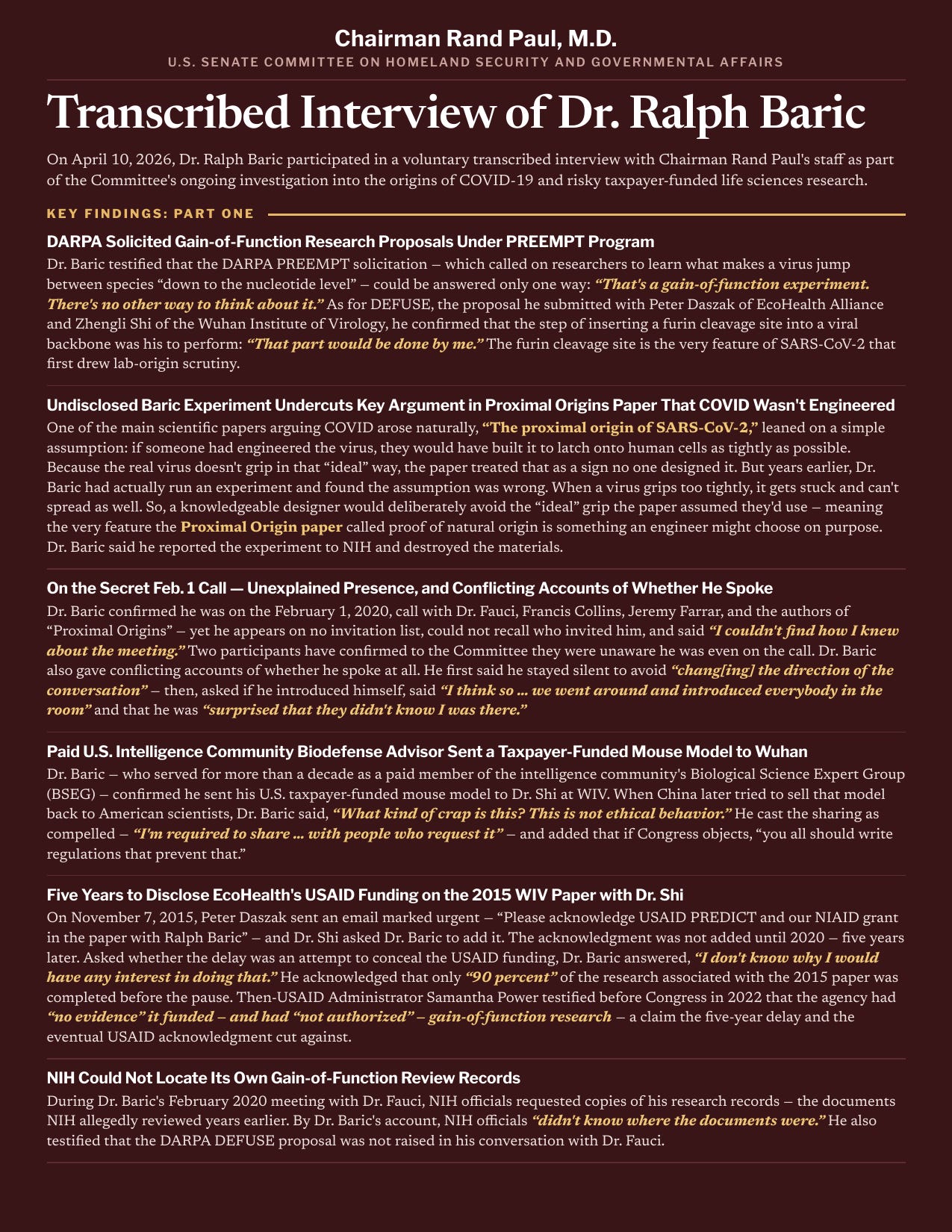
“That’s a gain-of-function experiment. There’s no other way to think about it.”
Start with the word everyone spent years fighting over: gain-of-function.
DARPA’s PREEMPT program — the solicitation that DEFUSE was written to answer — asked researchers to learn what makes a virus jump between species “down to the nucleotide level.” Investigators asked Baric what that meant. He didn’t hedge:
“That’s a gain-of-function experiment. There’s no other way to think about it… when I read that, that’s exactly what they’re asking for.”
Then they turned to DEFUSE itself — the proposal Baric submitted alongside Peter Daszak of EcoHealth Alliance and Zhengli Shi of the Wuhan Institute of Virology. The plan described finding a bat coronavirus, and, if the science warranted, dropping a furin cleavage site into a viral backbone. The furin cleavage site is the exact feature of SARS-CoV-2 that first made serious scientists look sideways at a natural origin — because its closest relatives don’t have one.
Who would have performed that insertion? Baric was asked directly.
“That part would be done by me.”
Let that land. The single most suspicious feature of the pandemic virus was, on paper, a job assigned to a lab in North Carolina — by the lab’s own principal investigator, under oath-grade questioning.
DEFUSE was never funded; DARPA rejected it. No one has shown that SARS-CoV-2 is the DEFUSE construct. But the thing skeptics were mocked for even describing — a plan to engineer a furin site into a bat coronavirus, with a named American scientist to do the cutting — Baric just confirmed in plain English.
The experiment he buried — and what it does to “Proximal Origin”
This is the part that should reset the entire debate.
The Proximal Origin of SARS-CoV-2 — the March 2020 paper used to shut the lab-leak question down — rested on a deceptively simple argument. If someone had engineered this virus, the authors reasoned, they would have built it to bind human cells as tightly as possible, the “ideal” configuration. The real virus doesn’t bind in that ideal way. Therefore, they concluded, no one designed it.
Baric ran an experiment, years earlier, that quietly demolishes that logic.
He explained that a biochemist colleague believed the tightest possible grip on the human receptor would be “the most optimal and most dangerous form of virus.” Baric disagreed — and tested it:
“If they react too well, that interaction can’t come apart… the virus, as it tries to release, gets caught up in what’s called a dominant negative effect, and it will prevent virus replication… I tested that hypothesis and showed that I was right, that the super-binding things were just as deleterious as the really poor-binding ones.”
In plain terms: grip too tightly and the virus gets stuck and can’t spread. So a knowledgeable designer would deliberately avoid the “ideal” binding that Proximal Origin assumed an engineer would use. The very feature the paper held up as proof of natural origin is exactly what a competent engineer might choose on purpose.
And then the tell:
“I subsequently told NIH and destroyed those viruses. I have never told anyone, and I would recommend that this committee not release that.”
He reported it to NIH. He destroyed the materials. He’d told no one. The finding that undercuts the field’s central natural-origin argument sat unpublished — and the man who ran it asked Senate investigators to keep it quiet.
The ghost on the February 1 call
Regular readers know the February 1, 2020 teleconference — Fauci, Francis Collins, Jeremy Farrar, and the authors of Proximal Origin, one day after Kristian Andersen privately called a lab origin “so friggin’ likely.”
Baric confirmed he was on that call. But he appears on no invitation list. He couldn’t say who invited him:
“I couldn’t find how I knew about the meeting.”
Two participants have since told the Committee they didn’t even know he was on the line. And Baric gave conflicting accounts of whether he spoke — first saying he stayed silent so as not to “change the direction of the conversation,” then saying “I think so… we went around and introduced everybody,” and that he was “surprised that they didn’t know I was there.”
The world’s foremost coronavirus engineer was on the call that shaped the official origin narrative — and can’t explain how he got there.
The rest of the ledger
Three more admissions, briefly, because they matter:
The mouse model. Baric served more than a decade as a paid member of the intelligence community’s Biological Science Expert Group. He confirmed sending his U.S. taxpayer-funded humanized-mouse model to Shi at the Wuhan lab. When China later tried to sell that model back to American scientists, he said: “What kind of crap is this? This is not ethical behavior.” He framed the sharing as compelled — “I’m required to share” — and told Congress that if they don’t like it, “you all should write regulations that prevent that.”
Five years of silence on USAID money. In November 2015, Daszak sent an urgent email asking that USAID PREDICT and NIAID funding be acknowledged on Baric’s paper with Shi. The acknowledgment wasn’t added until 2020 — five years later. That delay sits awkwardly against then-USAID Administrator Samantha Power’s 2022 testimony that the agency had “no evidence” it funded, and had “not authorized,” gain-of-function research.
NIH lost its own homework. When NIH officials met with Baric in February 2020 and asked for his research records — the ones NIH supposedly reviewed years earlier — Baric says they “didn’t know where the documents were.” And DEFUSE, he testified, never came up in his conversation with Fauci.
Read it honestly
None of this is a confession that Baric built SARS-CoV-2. DEFUSE was never funded. A plan to insert a furin site is not proof that this furin site came from that plan, and Baric plainly believes his own work was responsible and defensible. He is a hostile-but-voluntary witness, questioned by a committee with a thesis.
But strip the spin from both directions and what remains is remarkable enough. The engineer who would have done the furin-site work says the program was gain-of-function, “no other way to think about it.” He ran and buried an experiment that turns the marquee argument of Proximal Origin inside out. He was on the secret call and can’t say why. And the federal agencies that were supposed to be watching couldn’t find their own records.
For years, saying any of this out loud got you called a conspiracy theorist. The furin-site designer just said it himself — into a court reporter’s transcript.
(Senator Paul separately released private Slack messages from the Proximal Origin authors the same week; their contents reinforce the same gap between what these scientists said in public and in private. We’ll have more on those.)
About the source. Quotations are drawn from the official transcript of the April 10, 2026 voluntary transcribed interview of Dr. Ralph Baric before the U.S. Senate Committee on Homeland Security and Governmental Affairs, released July 23, 2026 by Chairman Rand Paul, and from the Committee’s summary of key findings. The interview and companion Slack release were first publicized by Senator Paul.
I still don’t understand why BARIC is not being held accountable?
Ralph BARIC was making Covid infectious to human lung tissue at the university of North Carolina long before the pandemic. (funded through Fauci) And he was collaborating with the Wuhan scientist Shi Zhengli.
University of North Carolina - BARIC’s work (starting in the early 2000s and continuing through the 2010s) included experiments that tested or increased the ability of bat coronaviruses to infect human cells.
What he was doing
At the University of North Carolina, Baric’s lab:
* studied bat coronaviruses with potential to spill over into humans
* built recombinant/chimeric coronaviruses
* tested whether spike proteins from bat viruses could:
* bind to the human ACE2 receptor
* infect human airway or lung cells in lab systems
Baric and Shi Zhengli:
Around 2013 (confirmed collaboration period begins)
* By 2013, Baric and Shi were already publishing together on SARS-like bat coronaviruses.
* A key 2013 Nature paper identified bat coronaviruses capable of binding human ACE2 receptors, which became the foundation for later collaboration..
". . .their contents reinforce the same gap between what these scientists said in public and in private."
Set aside everything else, and this still remains. Why would anyone do this unless they didn't really believe what they were saying in public?