

Four days after the election, Republicans are stuck in the same argument.
One camp says our voters stayed home. The other says our voters switched. JD Vance says "the main problem is not turnout." Ron DeSantis was quoted saying "a lot of our voters stayed home."
They're both right. And the numbers tell you exactly how right.
Trump won 2024 by 1.5 points. Democrats won the 2026 House vote by about 13. That's a swing of about 14 points. I broke it apart using the two biggest surveys of who voted: the network exit poll and NORC's 113,000-person Civic Health and Elections study. Both split the swing almost the same way.
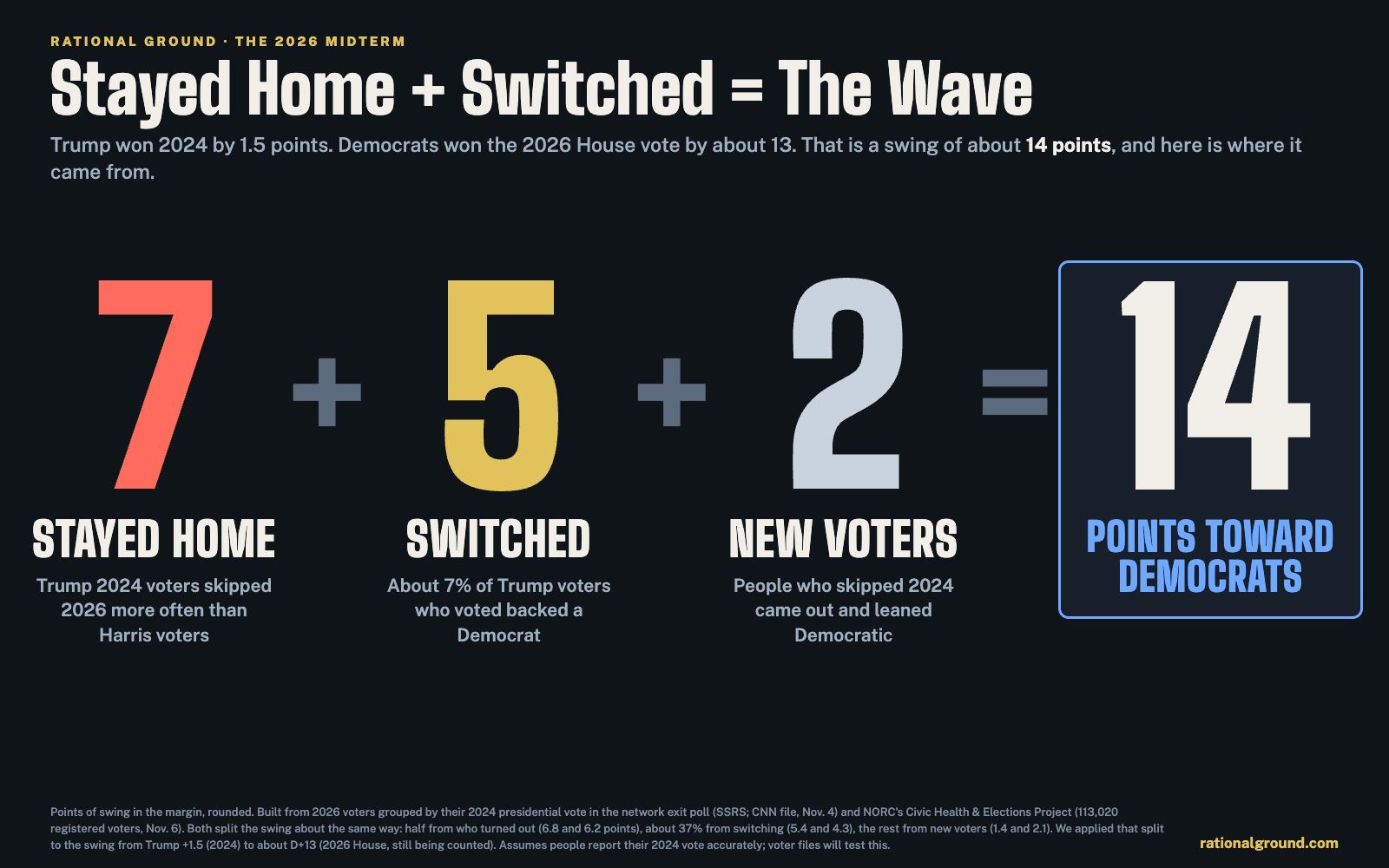
7 points: Trump voters who stayed home.
5 points: Trump voters who switched.
2 points: new voters who skipped 2024 and leaned Democratic.
Bottom line: it wasn't one OR the other. It was BOTH.
Few switched. More stayed home.
Start with the switchers, because this is where the surveys agree most.
The exit poll, NORC and the Economist/YouGov post-election poll are three separate surveys. All three land on the same number: 7% of Trump's 2024 voters backed a Democrat for the House. Only 2% to 3% of Harris voters went the other way.
Seven percent doesn't sound like much. But Trump voters were half the 2024 electorate. Seven percent of half the electorate is a wave.
Now the ones who stayed home. In YouGov's post-election poll, 76% of Trump voters said they voted in 2026. Among Harris voters, it was 87%. The exit poll and NORC tell the same story a different way. Trump won 2024. But the people who showed up in 2026 said they had voted for Harris by about 5 points.
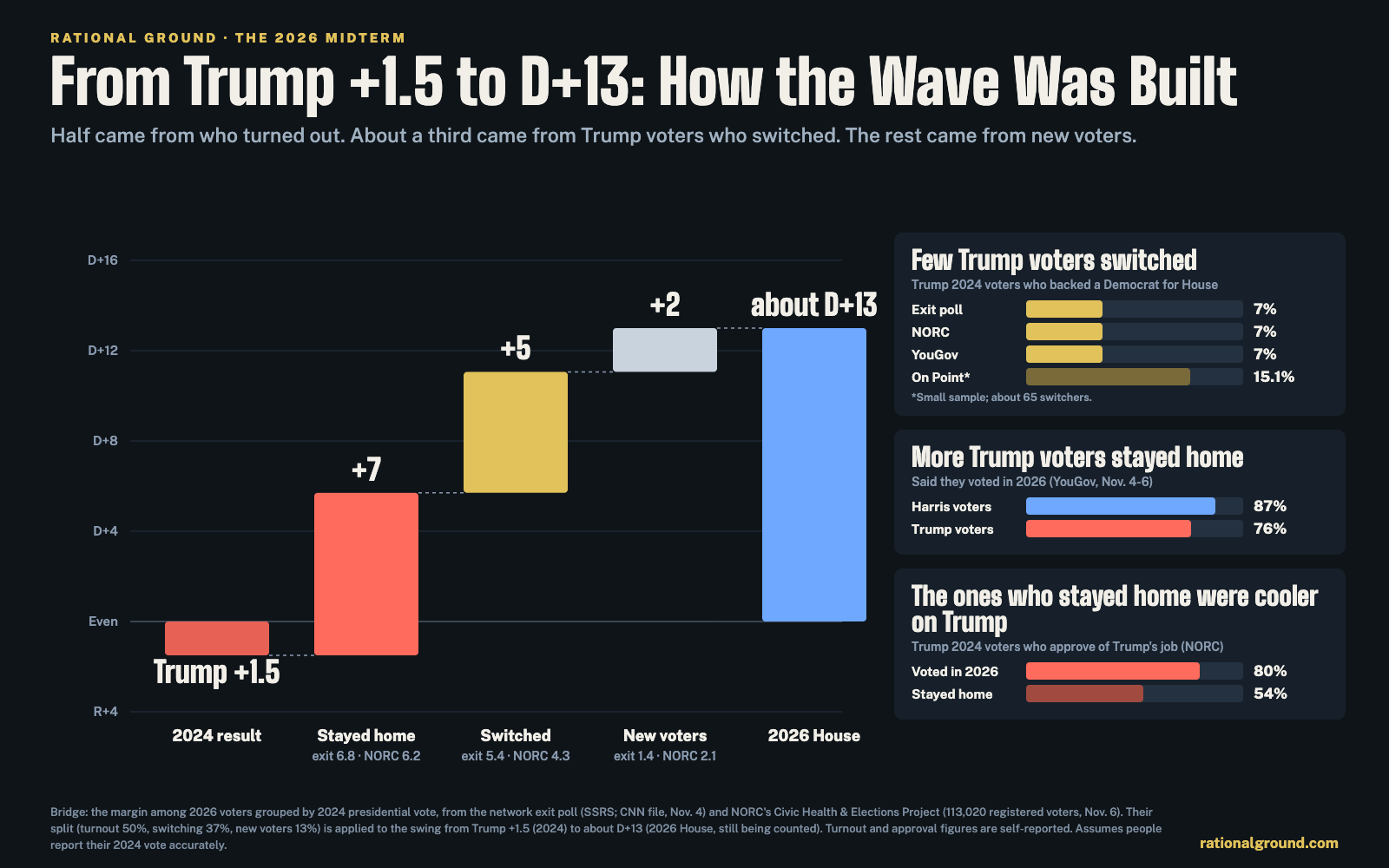
Here's the part you might have guessed. The Trump voters who stayed home were not MAGA diehards who forgot to vote.
In NORC's survey, Trump voters who skipped 2026 approve of Trump's job by just 54% to 44%. The Trump voters who showed up approve 80% to 20%. More than a third of the stay-homes call themselves neither Republican nor Democrat.
Why did they stay home? Their top reasons, in NORC's survey:
"I don't like the candidates" (27%)
"My vote doesn't matter" (26%)
Not interested in politics (25%)
In YouGov's post-election poll, trouble getting a ballot (19%) and distrust of the system (19%) ranked high too.
One more thing. People who voted Republican for the House in 2022 turned out at about the same rate as 2022 Democratic voters (93% vs. 94% in NORC). The party's regular midterm voters mostly showed up. The ones who stayed home were the newer, softer, Trump-only voters.
So Republicans didn't lose their base. They lost the EDGES of it. And the edges went both ways: some switched, some sat it out.
A caveat, because someone will raise it: some Trump voters who regret their vote won't admit it to a pollster. Some of them may show up in these surveys as Harris voters or non-voters. That could make "stayed home" look bigger than it was. The state voter files will settle it. North Carolina's should start showing Nov. 3 votes in the coming days.
Which groups moved
The exit poll is the number everyone quotes. You've probably seen a chart or two built on it. The trouble is that CNN, NBC, Fox and AP all report one survey this year, run by a firm called SSRS. Four networks, one poll.
So I lined it up against every other source I could find:
NORC's 113,000-voter study
The New York Times' voter model
The Economist/YouGov post-election poll
The UnidosUS / African American Research Collaborative study of Latino, Black and Asian American voters
I averaged them and compared each group with how it voted for president in 2024. The country as a whole moved about 14 points. Here's who moved more and who moved less.
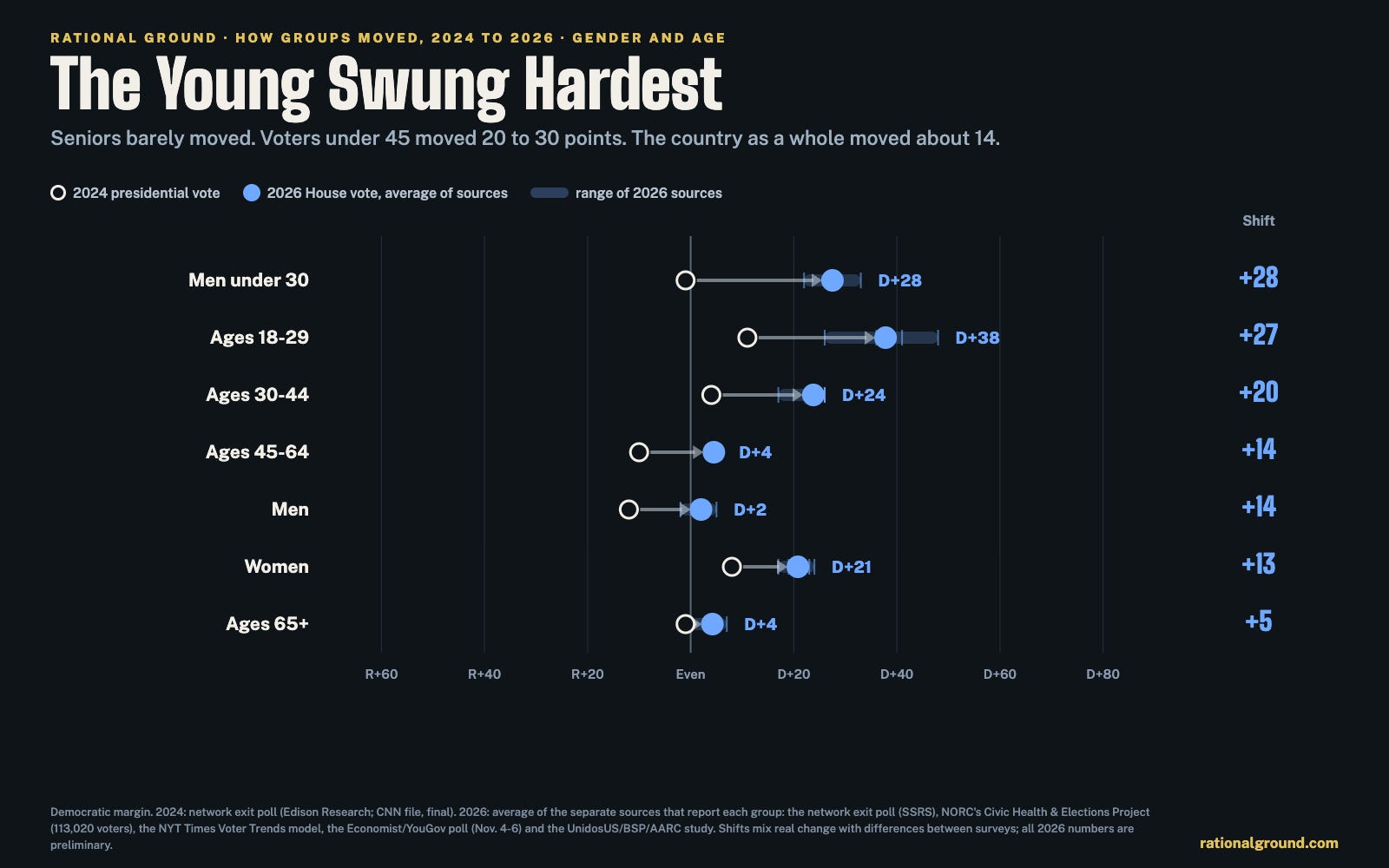
The young swung hardest. Voters under 30 moved about 27 points. Young men went from roughly even in 2024 to Democrats by about 28. Seniors barely moved.
One note: the exit poll has young voters at D+48. That's the highest of the four sources. The average is about D+38. Still huge, just not as huge as the headline.
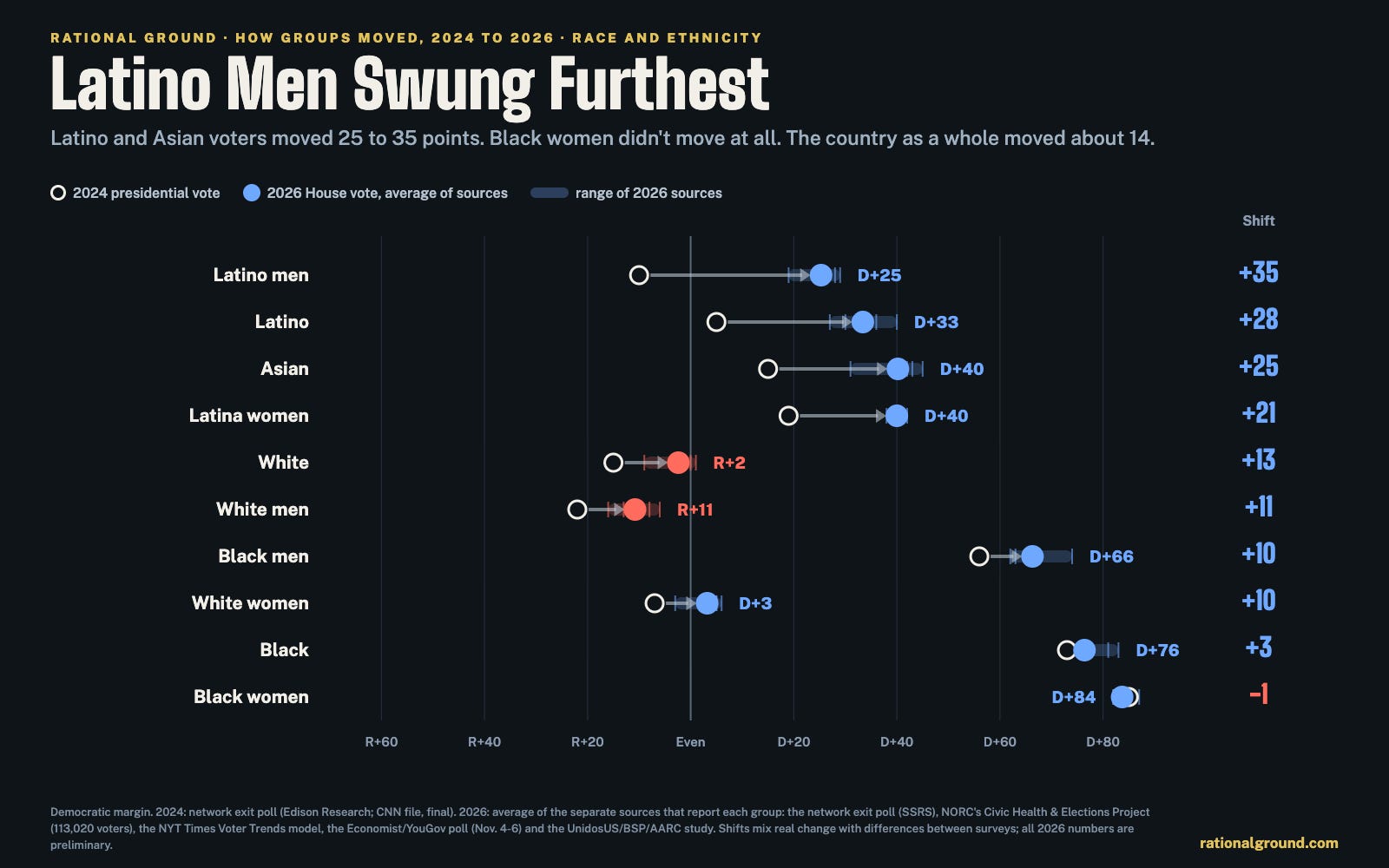
Latino men swung furthest: about 35 points. In 2024 they voted for Trump by about 10. In 2026 they voted Democratic by about 25. Latino voters overall moved 28 points and Asian voters 25.
Two years ago, Latino men were the proof that Trump was building something new. In 2026 they were the first to leave.
White voters moved about 13 points, right around the national number. Black women didn't move at all; they were already about 85 points Democratic.
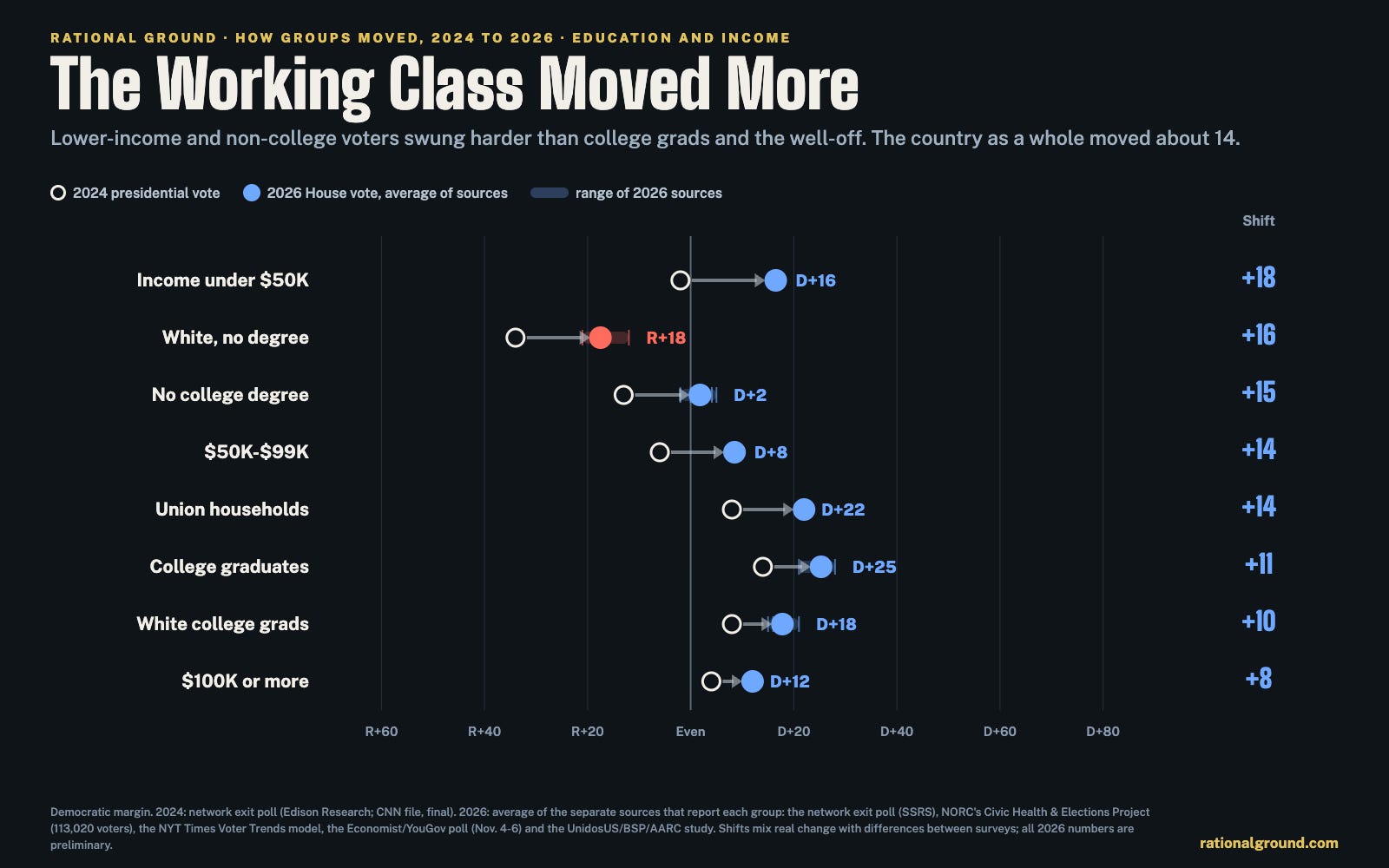
The working class moved more than the college crowd. Voters earning under $50,000 moved about 18 points. Non-college voters moved 15. College graduates moved 11 and $100K-plus voters moved 8.
That's the opposite of the story Democrats have been telling about themselves for a decade. It's also the story of prices. When groceries and gas are the top worry, the people who feel it most move first.
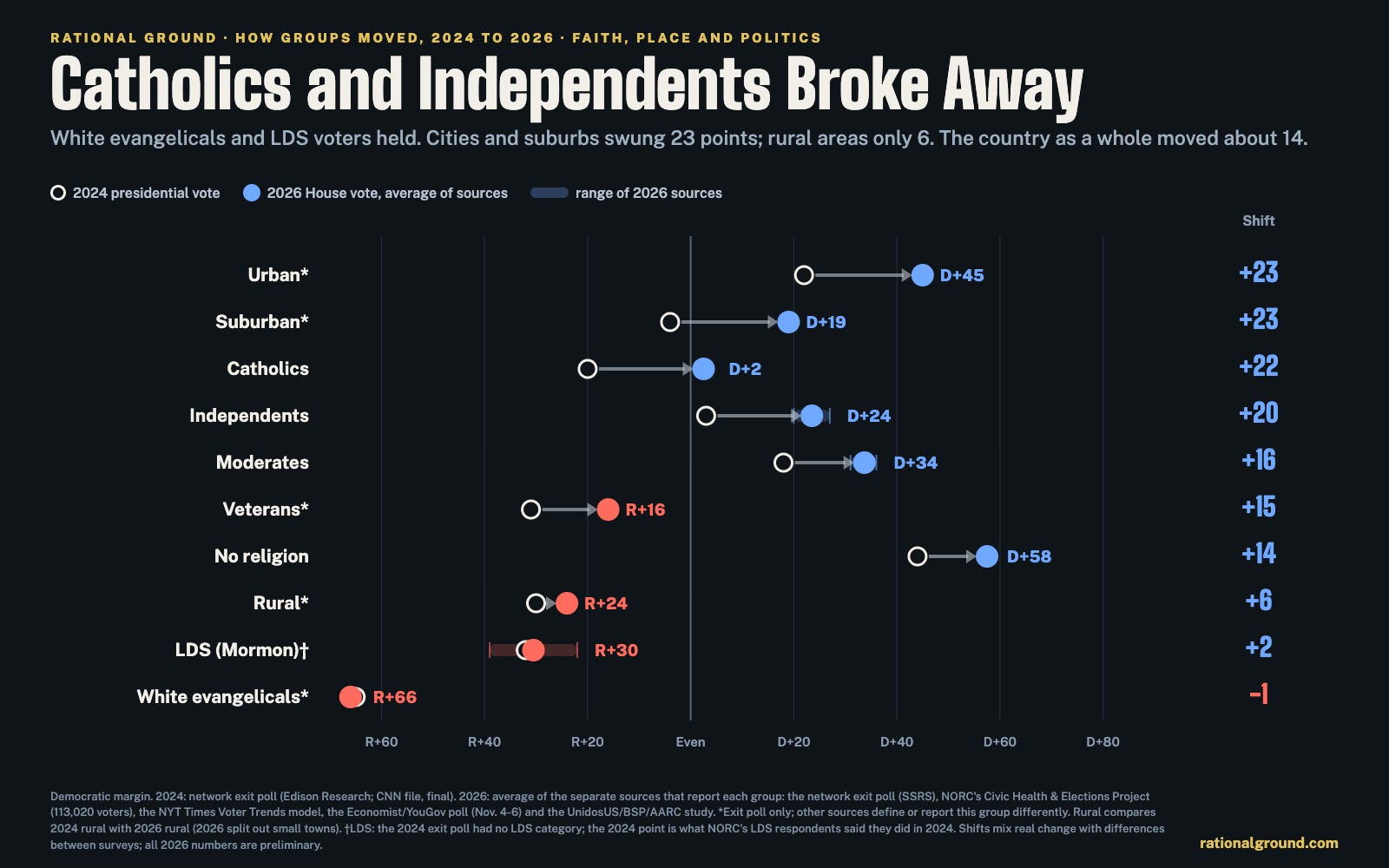
Catholics and independents broke away. Catholics went from Trump +20 to roughly even. Independents went from about even to Democrats by more than 20.
White evangelicals held. So did LDS voters, roughly (the two surveys that report them disagree, and the 2024 baseline is shaky). Rural voters moved only about 6 points. The core of the coalition stayed put. Everything around it moved.
What each side was voting on
The two parties weren't even voting on the same thing.
In the exit poll, Republican voters' top issue was the economy (41%), then immigration (28%). Democratic voters' top issue was democracy (47%), then the economy (37%). The Iran war was the top issue for 3% to 4% of either side.
The biggest gap was Trump himself.
Democratic voters: about 8 in 10 said Trump was a factor in their House vote, as a reason to vote against him.
Republican voters: only about a third said they were voting for him. More than 6 in 10 said he wasn't a factor at all.
Two separate polls (the exit poll and YouGov) show the same split.
Opposing Trump fired up Democrats. Supporting Trump didn't do the same for Republicans.
The Trump wing is shrinking
This didn't start on Election Day. Every month, Scott Rasmussen's RMG Research asks voters which of four candidates they'd prefer, all with equal skills and temperament:
a Republican with Trump's policies
a traditional Republican
an AOC-style Democrat
a traditional Democrat
In July 2025, the Trump-style Republican got 35%. By October 2026 it was down to 26%, the lowest since the question started in 2020. The traditional Democrat was at 24%.
Rasmussen says the Trump option fell from 49% to 32% among white men since January 2025. Those leaving split about evenly between traditional Republicans and traditional Democrats.
That's the same picture as the exit polls: the edges walked away, in both directions.
The money didn't stop it
Trump's super PACs put $372 million into about 80 races this fall. Those races swung toward Democrats by about 15 points. The typical House district swung 14.
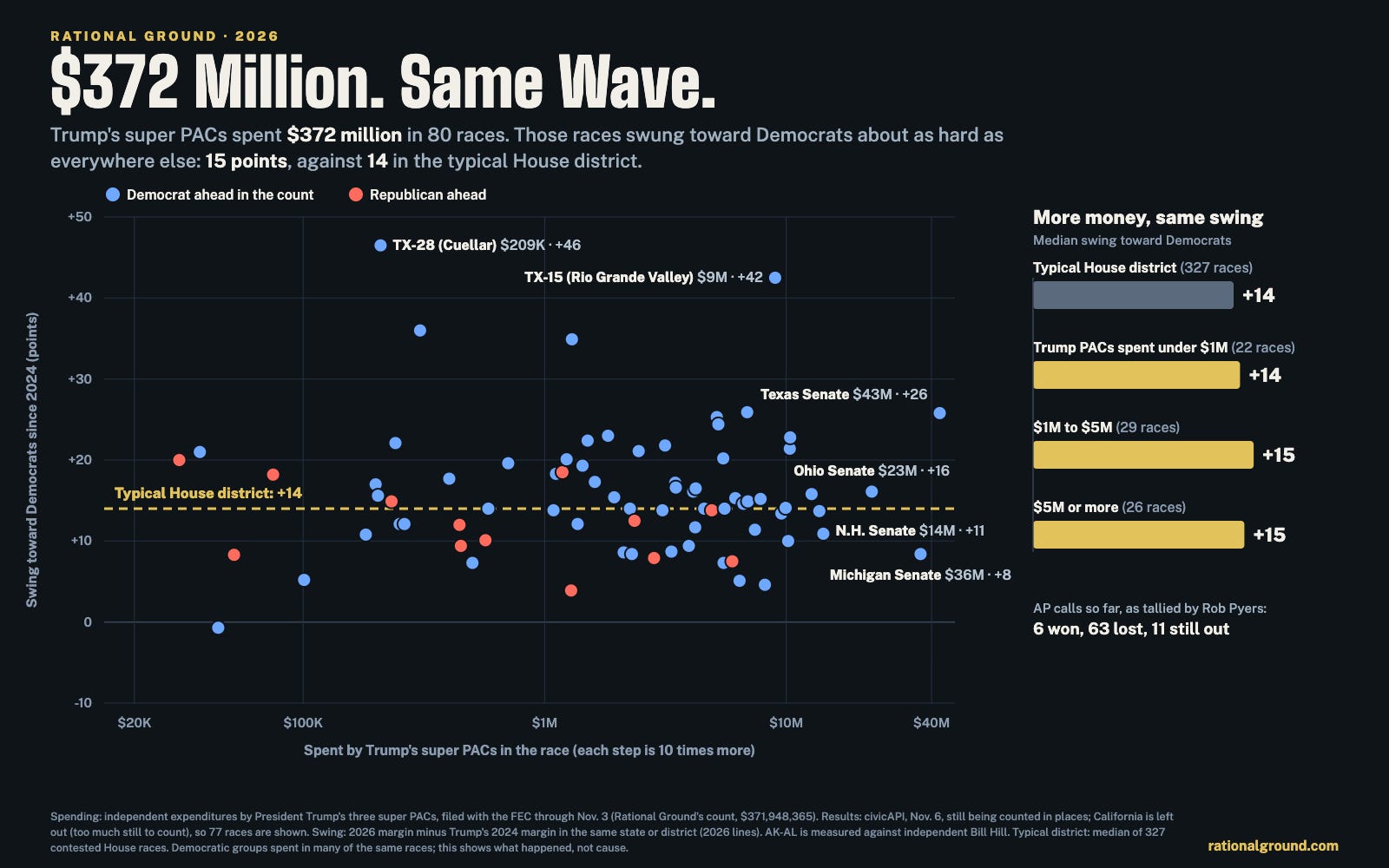
To be fair, they spent where Republicans were already in trouble, and Democratic groups spent heavily too. Without that money, things may have been worse. But it didn't beat the wave. The wave rolled right over it.
What it means
Here's what I take from all of it.
1. This wasn't a realignment but coming back will be a slog. Republicans' regular voters mostly showed up. Evangelicals held. Rural America barely moved.
2. It was a rejection at the low-propensity edged. Young voters, Latino men, working-class voters, Catholics and independents came to Trump in 2024. They're the ones who left in 2026, some to the Democrats and some to the couch.
3. The way back runs through prices. The economy and prices were at or near the top for both parties' voters. The voters who left are the ones who feel prices most.
Bottom line: Republicans didn't lose their base. They lost the people who made it a majority. The question for 2028 is whether anyone can win them back.
Sources: the 2026 network exit poll (SSRS; CNN's national file); NORC Civic Health & Elections Project (113,020 registered voters, Nov. 6); Economist/YouGov poll (Nov. 4-6); New York Times Voter Trends (preliminary); UnidosUS / BSP Research / African American Research Collaborative 2026 election poll; Napolitan News / RMG Research; FEC independent-expenditure filings. The 2024 group results are from the 2024 network exit poll. Every 2026 number is preliminary and will move as counting finishes. Every table, source and caveat is on our free page: members.rationalground.com/who-voted. The poll-by-poll rundown is at members.rationalground.com/every-poll.
But you can't compare oranges to apples, a midterm election to a presidential election! The turnout in presidential elections is substantially higher. Voting in the presidential election, then staying home for a midterm is very usual, not an anomaly. And you always get new voters who very too young to vote in the previous election. You have to compare 2026 midterms to 2022 midterms and 2018 midterms (if you want to include the Trump factor).
This was just basic arithmetic. While the Republican turnout stayed about the same as in the previous midterm, the Democratic turnout increased substantially, especially in urban areas. If you're a Democratic operative, identify the people who lost their COVID and Biden's era benefits and fundings in 2025-2026, their jobs in DEI etc or are afraid to lose those, call them and ask to go vote. Don't you want your free ACA medical insurance back? Ethnicity and religion don't explain everything and not everything under the Sun is about allegiance (or lack of it) to Trump. But you design polls in a certain way, you get certain answers.
https://timothywiney.substack.com/p/abandon-the-ss-trump