

Two men who ran American biomedical science were on the record this month. Only one of them spoke.
On Wednesday, July 29, Anthony Fauci sat before the Senate Homeland Security and Governmental Affairs Committee — subpoenaed, sworn, and silent. Within minutes of the gavel he read a statement accusing Chairman Rand Paul of running a prosecution in search of a crime, and then delivered the line he would repeat, by reporters’ count, more than four dozen times in the first two hours:
“On the advice of counsel, I respectfully decline to answer based upon my rights under the Fifth Amendment.”
Fauci has testified before Congress more than 250 times across nearly four decades. This was the first time he took the Fifth.
Two weeks earlier, on July 15, Jay Bhattacharya sat down with Marissa Streit for an hour on PragerU’s Real Talk. No subpoena. No counsel. No carve-outs. He is the sitting Director of the National Institutes of Health and Acting Director of the CDC — the most legally exposed chair in American public health — and he answered every question put to him, including the ones with his own agencies’ fingerprints on them.
Put the two transcripts side by side and you have the whole story of the last six years in one frame.
What silence sounds like
Let’s be precise about what Fauci declined to discuss, because the list is the indictment.
He would not answer about the origins of SARS-CoV-2. He would not answer about gain-of-function research. He would not answer whether he misled Congress about either. And — this is the part worth sitting with — he would not answer a procedural question about documents.
Other exchanges were more personal and frustrating but damning to Dr. Fauci.
Paul’s predicate for the subpoena was two emails. On February 2, 2020 — one day after the now-infamous call that produced “Proximal Origins” — Fauci wrote to then-NIH Director Francis Collins about getting ahead of “the science and narrative” of the virus’s origins, and closed with: “Please delete this e-mail after you read it.” On July 20, 2020, he sent his chief of staff a message disparaging Paul, with the same instruction attached.
In 2024, under oath, Fauci denied deleting records or obstructing anything.
Paul’s response to the Biden pardon, which blankets Fauci from 2014 through January 2025, was the sharpest thing said in the room: a pardon “does not convert a misleading statement to a truthful one.” He closed with a promise — “There will be repercussions to your refusal to testify today.”
Set aside whether you think a preemptive pardon was justified. Notice the structure it created. The pardon removed the legal jeopardy for everything already done. The Fifth Amendment now removes the obligation to describe it. Between the two, the entire record of how American pandemic policy was made has been walled off from the only body empowered to examine it.
That is not a legal technicality. That is an accountability vacuum with a constitutional roof over it.
What openness sounds like
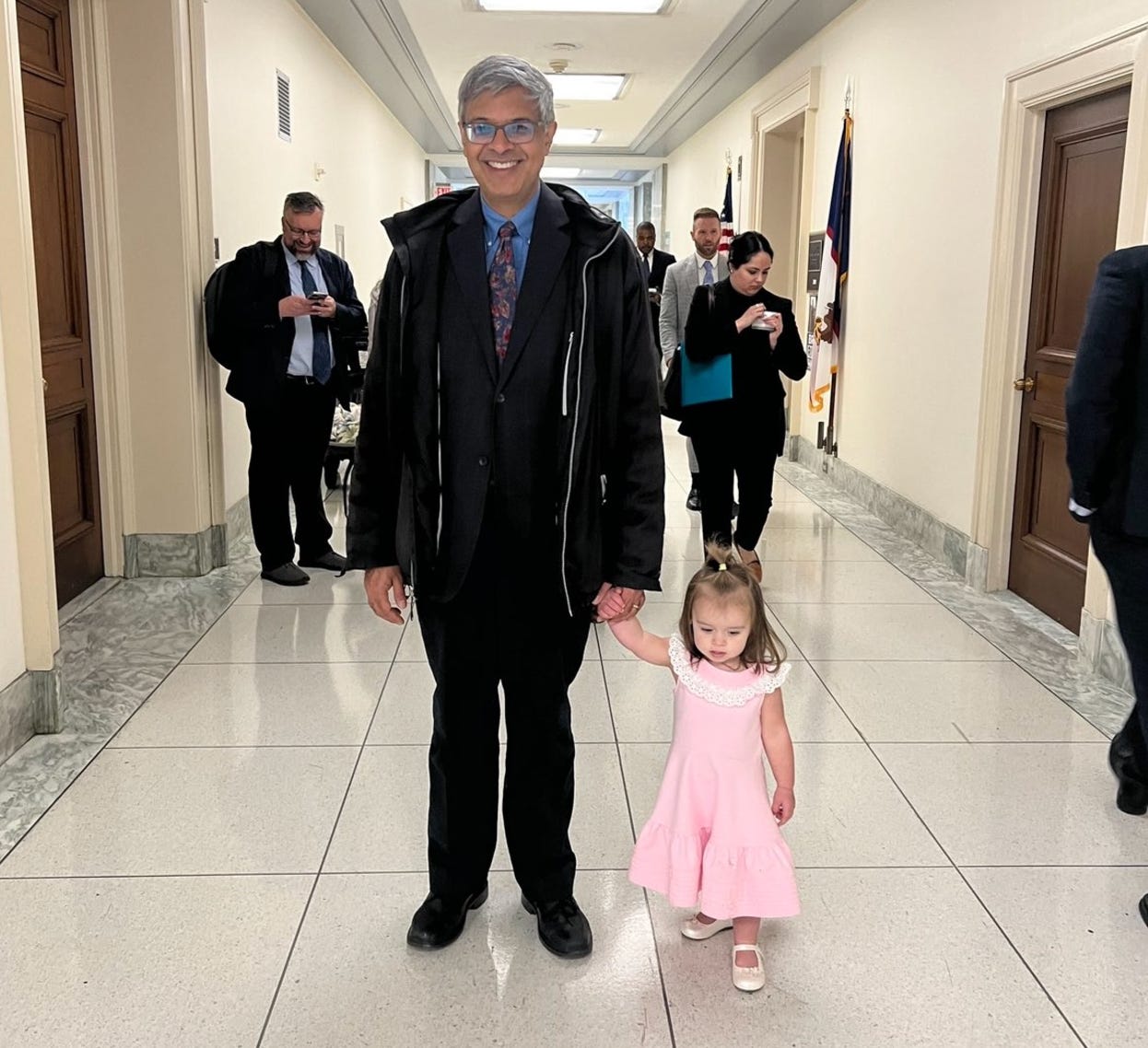
Now the other transcript.
Bhattacharya opens the PragerU interview by describing 2020 as the year his career stopped mattering to him — he watched children locked out of school, he opposed the mandates, he got canceled for it. “I thought my career was over,” he says. “And now I’m the director of the National Institutes of Health.”
He was blacklisted on Twitter at the government’s request. He co-authored the Great Barrington Declaration, the document Francis Collins famously demanded a “quick and devastating published takedown” of on October 8, 2020 — a takedown organized from inside the very building Bhattacharya now runs.
And here is what he says, in public, unprompted, about the institution he inherited:
“Most scientists and people in public health — if they’re honest — recognize the colossal failures that happened of science and public health during that era.”
He names the damage without hedging: kids out of school for two and three years and still behind, the economic hangover, and — a phrase no NIH director has ever uttered — “all the people that suffered from vaccine injuries that are unacknowledged.”
On the mandate-era claim that started the whole censorship apparatus, he is blunter than any of his critics predicted he would dare be as a sitting director:
“Does the COVID vaccine stop you from getting and spreading COVID? I can see and you can see that it doesn’t — but it’s a peer-reviewed journal that says that it does.”
Asked directly about reports of a 235-word screening list at NIH, he doesn’t spin it, doesn’t refer it to comms, doesn’t say the report is under review:
“I am deeply against banned word lists. I don’t believe in them. I will not have my institution embrace them.”
He explains that grant-screening tools use keywords and that a human reads what they flag — and that in many cases the reviewer discovers the DEI language was camouflage, tacked on by researchers who had learned that “in order to get a grant, you have to pretend to be doing DEI and then you’d secretly be doing good science underneath.”
Read that twice. The Director of the NIH just described his own agency’s recent grant regime as a system that taught American scientists to lie in order to work.
The reversal is structural, not rhetorical
Anyone can hold a press conference about restoring trust. What separates this from the usual Washington penance tour is that Bhattacharya is dismantling the specific machinery that produced the failure.
The replication crisis. He puts the number on the table: “60% of the time, 70% of the time, the published biomedical research literature is not reliable.” Methods aren’t described clearly, datasets aren’t available, tissue samples aren’t available. So NIH is now funding replication work as first-class science, standing up an NIH journal that publishes replication studies with the peer reviews attached in public, rebuilding literature search so a paper displays every study that tested the same idea instead of the prestige of its masthead, and building metrics that reward sharing data and code.
The safety trap in peer review. He and a Stanford colleague indexed every new word and phrase in the biomedical literature since 1940 to date how old the ideas in a given paper are. The finding: in the 1980s, NIH-funded researchers published ideas zero to two years old. By the 2000s and 2010s, seven to eight years old. The agency had quietly optimized for will this work over will this disrupt — partly because you had to already hold a large NIH grant to sit on a study section, which means the incumbent reviews the insurgent. The fix, which he concedes has a boring name, is the uniform funding strategy: institute directors are now pushed to read the full review rather than rank by a composite score that mostly predicts publishability. “I fundamentally don’t care if a project gets a paper in a journal,” he says. “I care if the project disrupts science.”
Epistemology. This is the deepest cut, and it’s the one that indicts the Fauci-Collins era most directly without ever naming it. Bhattacharya reaches for Galileo — the first scientific revolution wasn’t about telescopes, it was about stripping ecclesiastical authorities of the power to rule on physical reality. Then:
“Why is it that a relatively small number of people, in a very non-transparent way, get to decide for all of society what’s true or false about physical reality?”
That is a description of 2020 and 2021 written as a philosophy lecture. The Proximal Origins paper was an ecclesiastical ruling. The GBD takedown was an ecclesiastical ruling. The blacklist was enforcement.
Mandates. On childhood vaccines he refuses both scripts. He defends MMR and DPT as essential and says so plainly. He also says every medicine has a benefit and a harm, that we owe something to the people harmed, that the COVID shot isn’t necessary for most kids, and that the schedule has been shifted toward a European model with Secretary Kennedy. Then the sentence that is the entire argument of the last six years compressed into fourteen words:
“It’s not going to be a universal take-it-or-else. You have no trust.”
The same chair, six years apart
Here is the juxtaposition, stated as plainly as it deserves.
The men who built the policy will not describe it — one is pardoned and silent, the other authored the takedown email and has never sat for a hearing like Wednesday’s at all. The man they tried to erase now holds the chair, and cannot stop describing it: the failures, the injuries, the censorship, the rot in peer review, the flatlined life expectancy, his own agency’s capture.
One era is protected by counsel. The other is conducted on camera, for an hour, with the tape running.
Bhattacharya was asked what success looks like in twenty years. Not a Nobel, he said. Not a citation count. Reverse the longevity flatline. People living longer, healthier, more fulfilling lives. “That’s the measure.”
It is a modest answer from a man who was told his career was over for saying children should be in school.
Fauci had four dozen chances Wednesday to say something equally modest. He took the Fifth instead.
Quotes from Dr. Bhattacharya are drawn from “Dr. Jay Bhattacharya on Depoliticizing the NIH and Ushering in a New Era of Scientific Innovation,” Real Talk with Marissa Streit, PragerU, July 15, 2026, lightly cleaned of verbal stumbles. Hearing quotes and details are from contemporaneous reporting on the July 29, 2026 Senate Homeland Security and Governmental Affairs Committee hearing (STAT, TIME, Boston Globe, Axios) and from Chairman Paul’s own committee release on the February 2 and July 20, 2020 emails.
"Fauci had four dozen chances Wednesday to say something equally modest. He took the Fifth instead."
So what are we going to DO about it? I want this man legally/properly held to account!
Richard Horton, editor-in-chief of The Lancet. In April 2015 he wrote an editorial (“Offline: What is medicine’s 5 sigma?”) after attending a symposium on research reliability, where he argued much of the scientific literature, perhaps half, may simply be untrue, afflicted by studies with small sample sizes, tiny effects, invalid exploratory analyses, and flagrant conflicts of interest, along with an obsession for pursuing fashionable trends of dubious importance.
Horton isn’t the only major figure who’s said something similar — John Ioannidis (Stanford) made a related, more rigorous argument in his famous 2005 paper “Why Most Published Research Findings Are False,” and Marcia Angell, former editor of the New England Journal of Medicine, has made comparable claims about clinical research specifically.