

On Jan. 5, 2022, USAID invited Daniel Rogers to give an agency-wide talk. Rogers is the co-founder and executive director of the Global Disinformation Index, the London- and New York-based group that rates news sites for "disinformation risk" and sells advertisers a list of sites to avoid.
About 130 USAID employees joined the video call, according to Rogers. The invitation, sent to all staff, said the talk was co-sponsored by the Office of Security and the democracy center as part of the "quarterly SEC Guest Speaker Series which aims to help all USAID staff." The agency's democracy office co-hosted. Johnny Walsh, the deputy assistant administrator over democracy programs, ran the questions.
The recording is one of three videos in the "USAID Files" the government posted Nov. 24. We transcribed all 64 minutes.
The laptop as a success story
Asked for an example of a campaign against disinformation that worked, Rogers gave two. The second, he said, was "a little more close to home":
"If we all remember back to the Hunter Biden laptop leaks in the New York Post ... almost every media outlet that was presented with that kind of weirdly fake Hunter -- stolen Hunter Biden laptop story and, you know, data that said this doesn't smell right and we can't validate it, didn't give it oxygen except for the New York Post. And it kind of stopped it dead in its tracks."
He credited groups like First Draft, which "had been spending four years going around the newsrooms explaining what a disinformation campaign looked like." "That's what I mean," he said, "when I talk about media literacy."
The laptop was real. In March 2022, two forensic experts hired by the Washington Post authenticated thousands of emails from it. In June 2024, federal prosecutors entered it into evidence at Hunter Biden's gun trial, the defense did not object, and an FBI agent testified that it was authentic.
How GDI decides what is "disinformation"
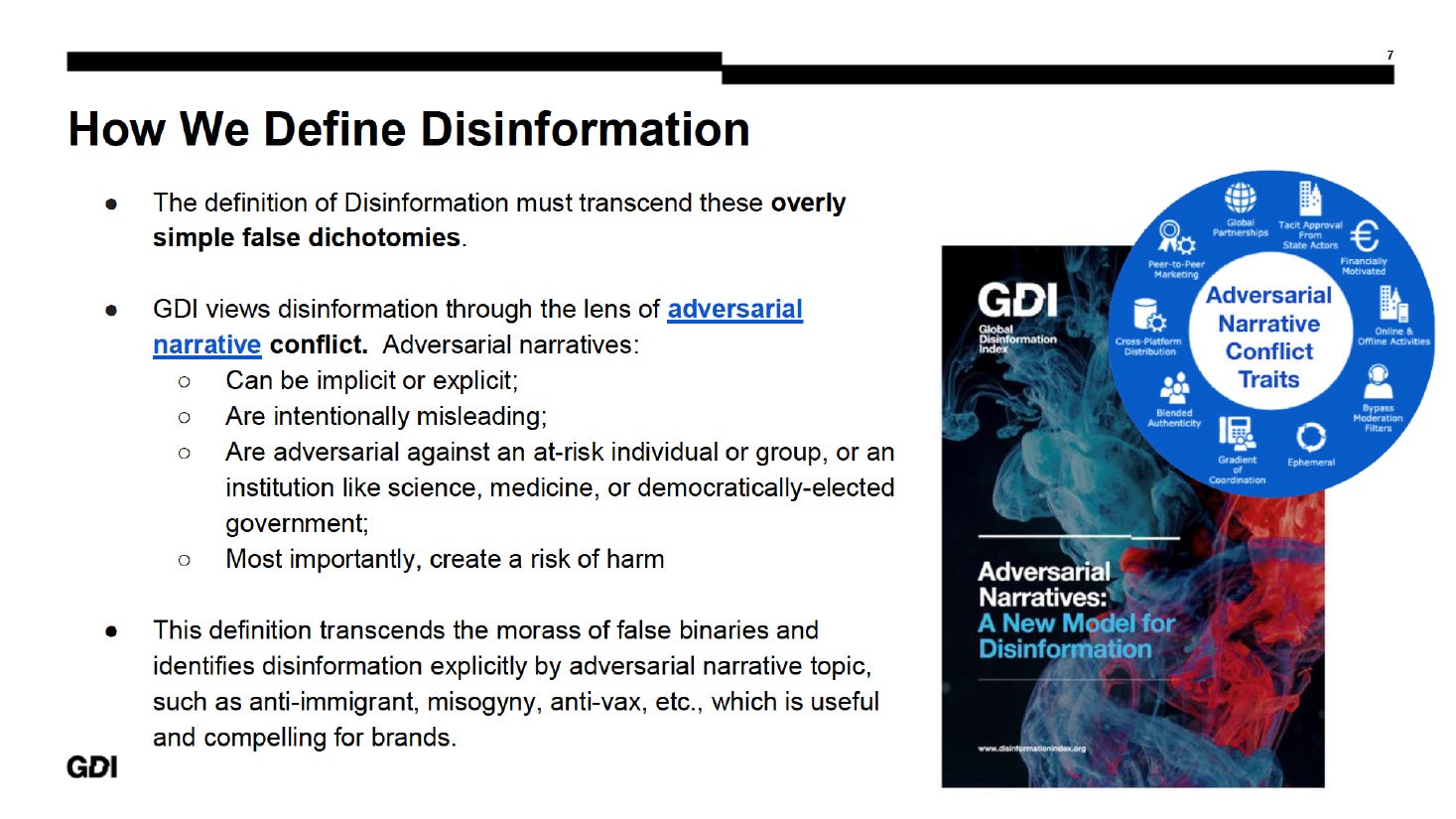
Rogers told the staff that true-or-false tests don't work. GDI looks for "adversarial narratives," which can be built from true facts.
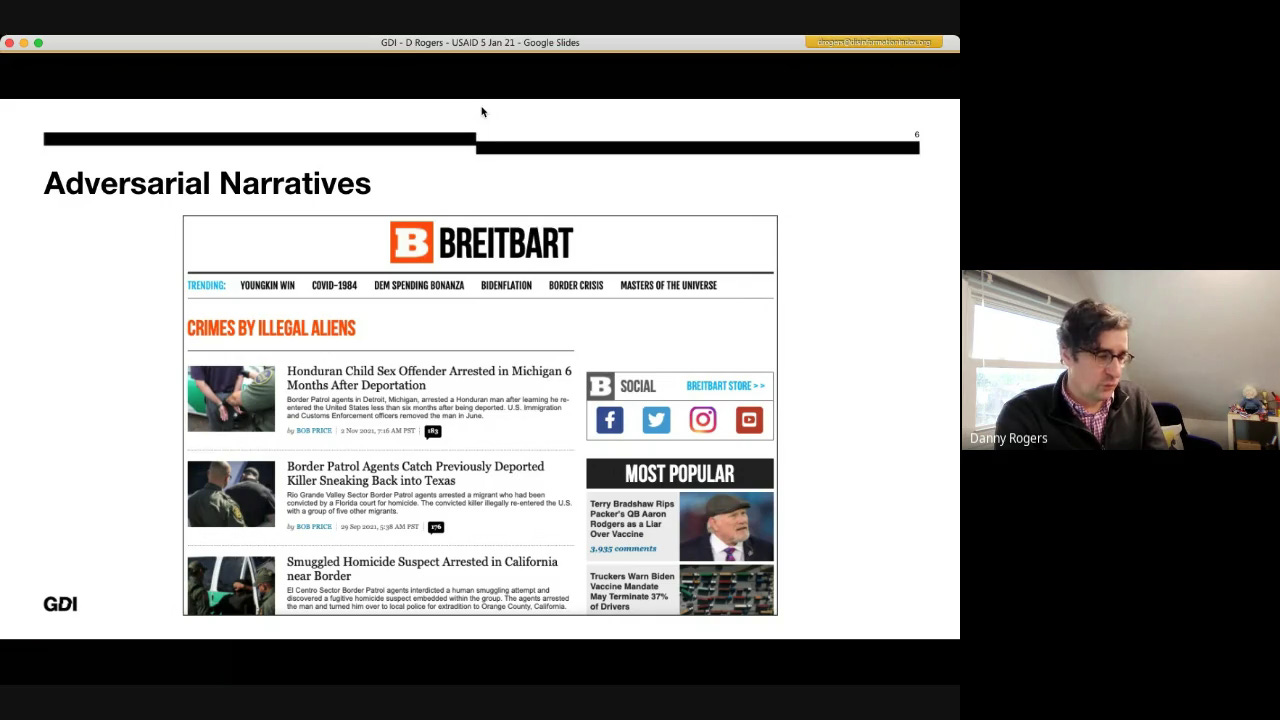
His first example was Breitbart, "widely considered in the community at this point to be a frequent peddler of disinformation ... certainly on our radar as the Global Disinformation Index is a high-risk outlet." Breitbart's section on crimes by illegal immigrants was made of stories that would "fact-check to be correct," he said, but added up to an "anti-immigrant narrative."
The definition lets GDI label content by topic: "Instead of saying this is disinformation, we say this piece of content is anti-vaccine or this piece of content is racist."
His slide spelled out who the narratives are "adversarial" against: "an at-risk individual or group, or an institution like science, medicine, or democratically-elected government." And it said why labeling by topic helps: it "identifies disinformation explicitly by adversarial narrative topic, such as anti-immigrant, misogyny, anti-vax, etc., which is useful and compelling for brands."
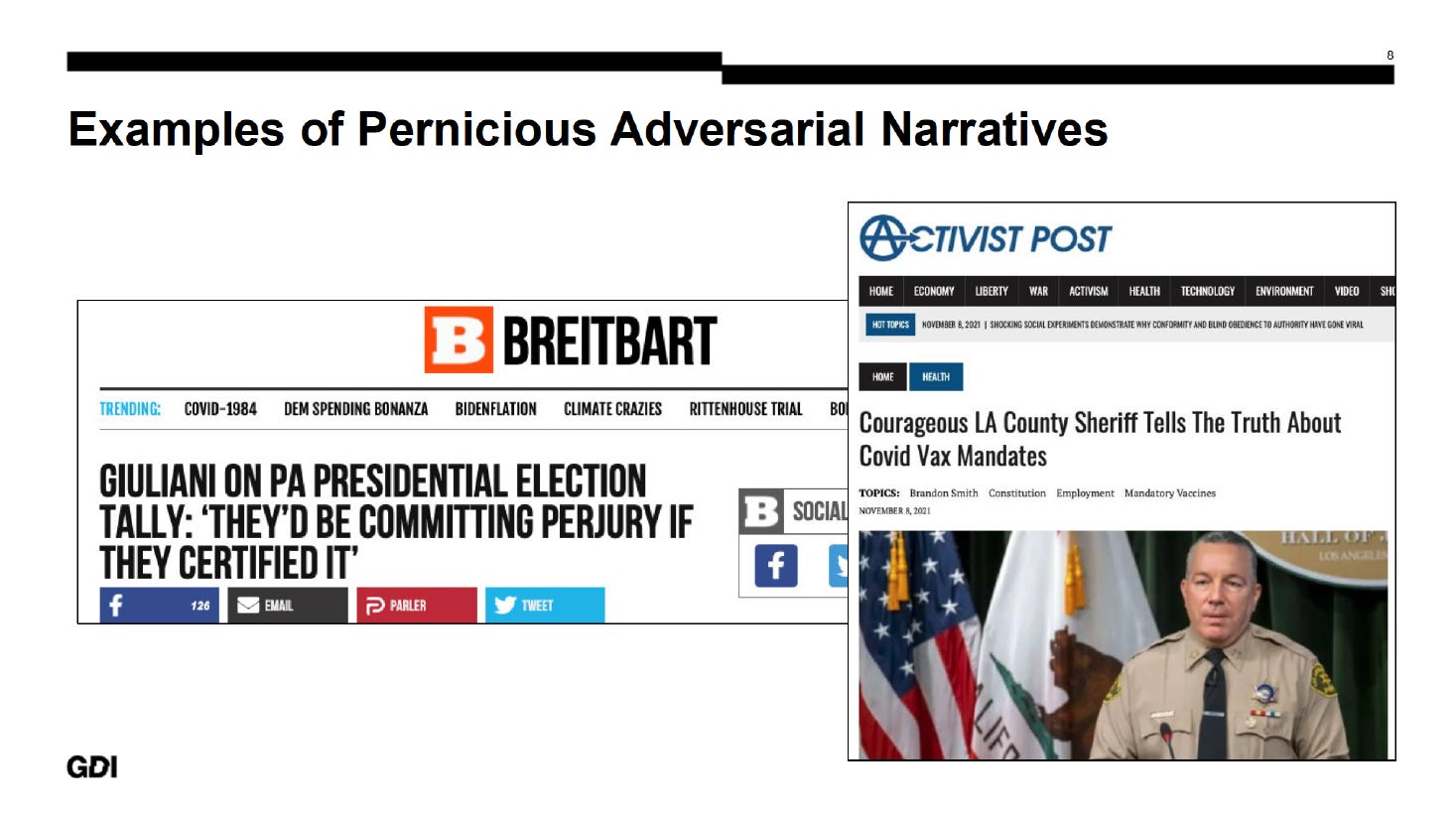
His next slide, "Examples of Pernicious Adversarial Narratives," showed two headlines. One was Breitbart quoting Rudy Giuliani. The other, from Activist Post: "Courageous LA County Sheriff Tells The Truth About Covid Vax Mandates." The sheriff had come out against the county's vaccine mandate for deputies. Rogers objected to the word "courageous."
The money
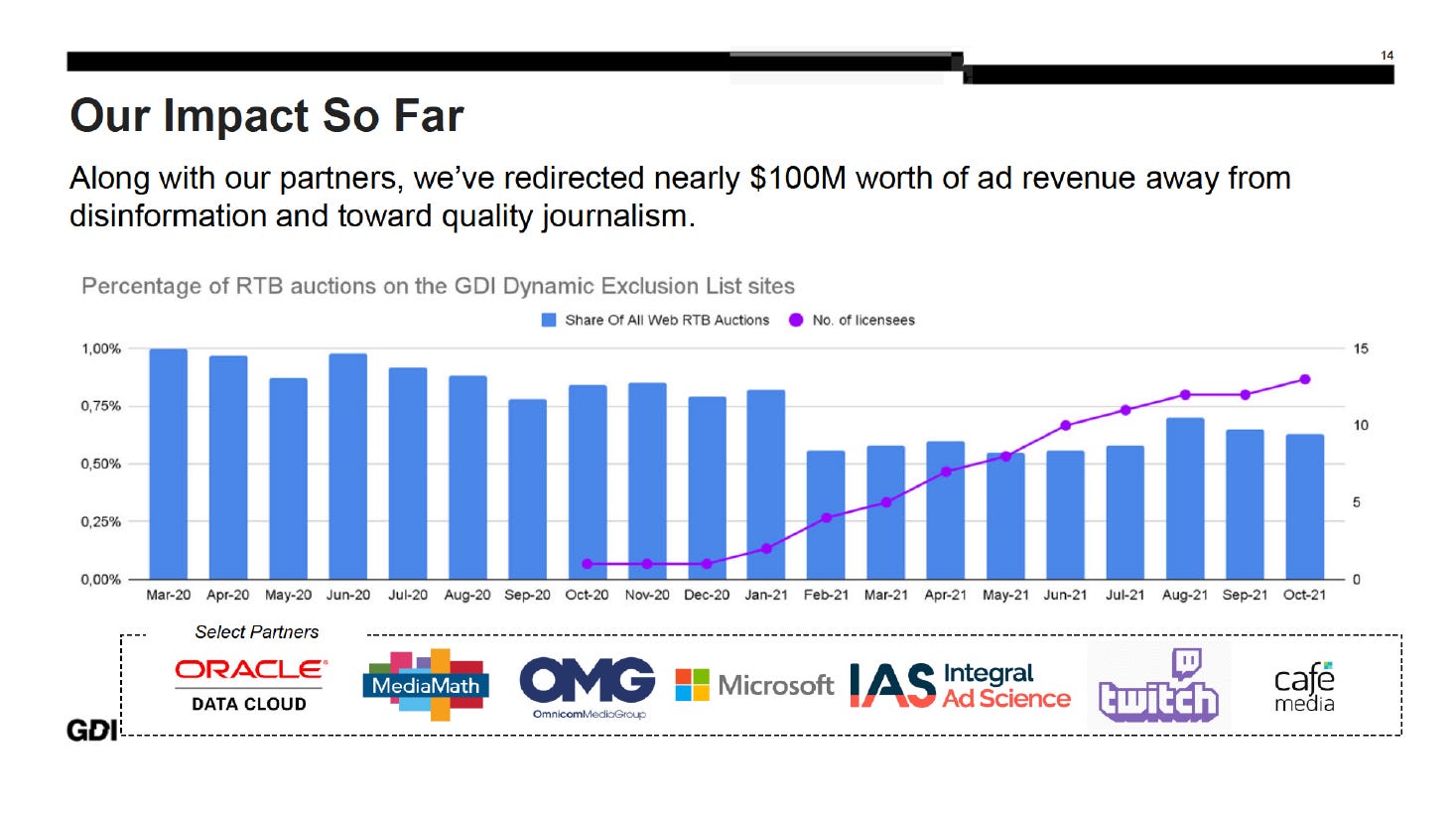
Rogers told USAID what the ratings do. GDI had estimated $200 million to $250 million a year in ads going to the sites it tracks as high risk:
"By our estimates have cut that funding in half. So what we say we've cut $100 million, still have another $100 million to go."
His slide: "Along with our partners, we've redirected nearly $100M worth of ad revenue away from disinformation and toward quality journalism." The partners shown include Oracle, Microsoft, Integral Ad Science and Twitch.
On his slide of "Disinformation Intervention Points," the counter-messaging column carried the logos of the CDC and "We Can Do This," the federal government's COVID vaccine campaign.
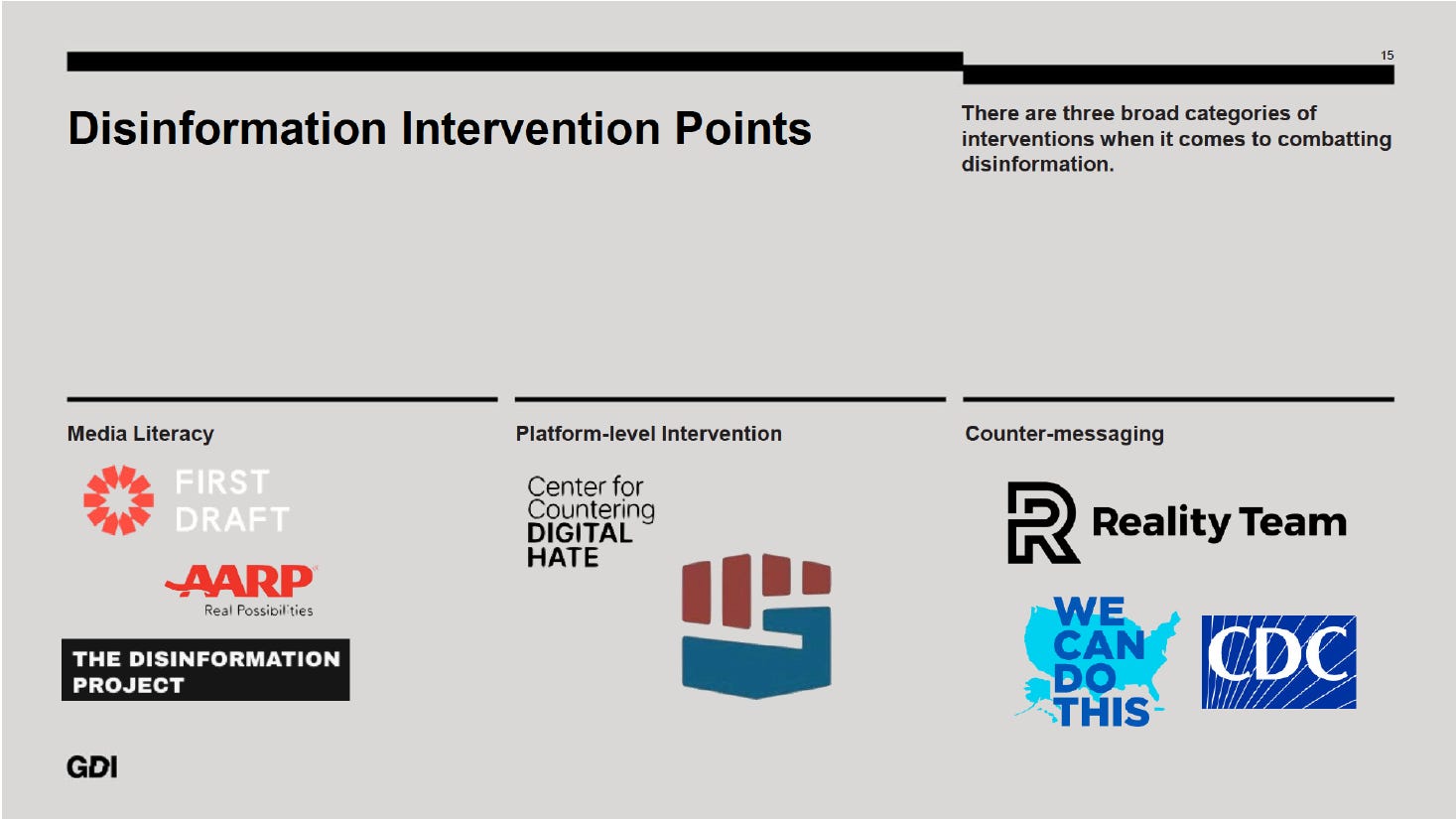
He put GDI in the same bucket as the activist group Sleeping Giants and the Center for Countering Digital Hate. That bucket, platform-level intervention, ranged from "knocking down content and kicking people off of the platform" to "structural" tech reform. His three policy goals: antitrust, privacy regulation and Section 230 reform, because the law "has given carte blanche to platforms."
Walsh agreed on that last point. What Rogers was describing, he said, was "rightly" an "increasingly widespread view that this total immunity under 230 is ridiculous or has at least passed its rightful time."
He also thanked Rogers: "The work you're doing is amazing."
Seven months later: "Defund. Downrank. Deplatform."
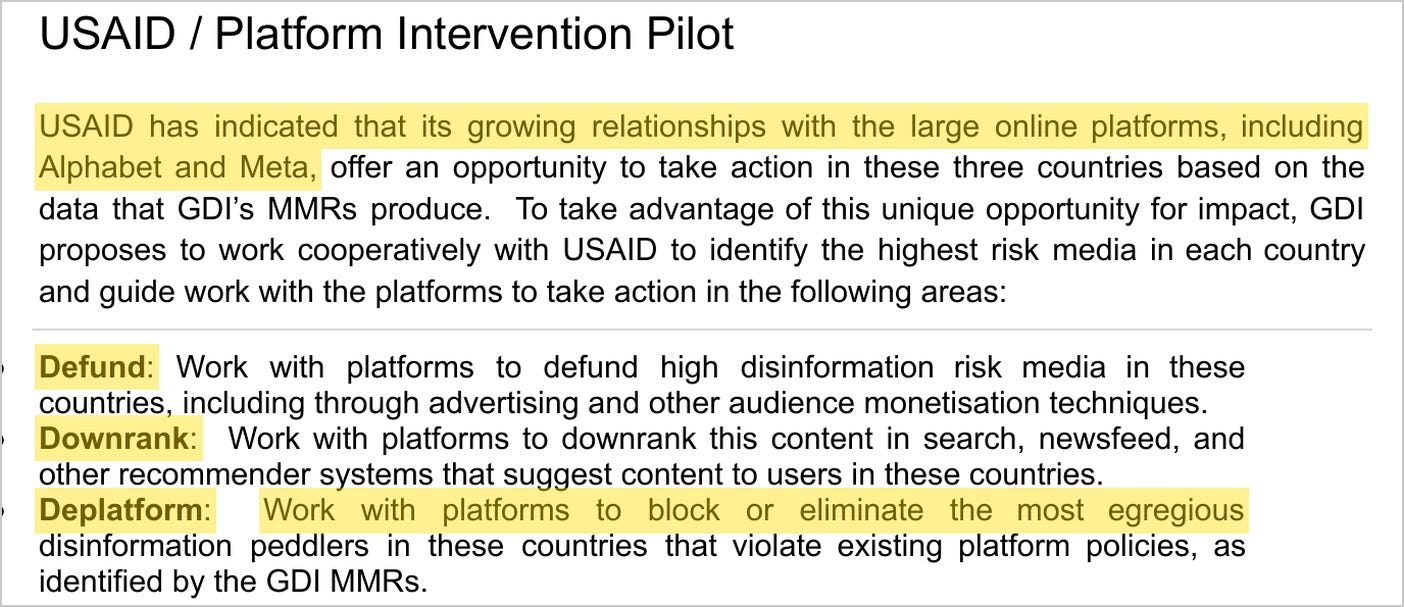
In August 2022, GDI sent USAID a concept note. It proposed rating the news media of Moldova, Zambia and Armenia, with the ratings "shared privately with USAID," and a "USAID / Platform Intervention Pilot":
"USAID has indicated that its growing relationships with the large online platforms, including Alphabet and Meta, offer an opportunity to take action in these three countries based on the data that GDI's MMRs produce."
The actions: "Defund," "Downrank," and "Deplatform: Work with platforms to block or eliminate the most egregious disinformation peddlers in these countries."
In December 2022, GDI published its U.S. ratings. All ten of its "riskiest" American news sites were conservative or libertarian, among them the New York Post, the paper that broke the laptop story.
In January 2023, a USAID team lead wrote that GDI "came in and met with us a few months ago - would be interesting to connect back with them again."
What we don't know
The files don't show that USAID paid GDI, or that the Moldova, Zambia and Armenia pilot happened. GDI did get other U.S. government money: grants through the State Department's Global Engagement Center and the State-funded National Endowment for Democracy. Sen. Chuck Grassley wrote to NED demanding answers about its GDI grants. The State Department said its award ended in March 2022, and NED said it would not fund GDI again. What these files add is the agency-wide platform USAID gave GDI's founder, the "weirdly fake" laptop line he delivered on it, and the pitch to use USAID's platform ties to defund and deplatform.
Sources
Video: "Information Disorder and Its Threat to Democracy (2022-01-05 at 10 00 GMT-8)," MP4, USAID Files. Our transcript: transcripts/info-disorder-2022-01-05.timed.txt. The key quotes were checked a second time on short audio windows.
agency-notice-for-sec-ddi-drg-speaker-on-jan-5th; gdi-d-rogers-usaid (the slides); gdi-usaid-concept-note-august-2022; re-gdi-redacted (Jan. 13-17, 2023)
GDI U.S. report, Dec. 16, 2022: https://disinformationindex.org/country-studies/2022-12-16-disinformation-risk-assessment-the-online-news-market-in-the-united-states
The laptop: Washington Post forensic review, March 30, 2022 (reprinted by Stars and Stripes): https://www.stripes.com/theaters/us/2022-04-02/how-analyzed-hunter-biden-laptop-5559736.html
The laptop at the gun trial: special counsel's filing (ABC7): https://abc7.com/post/hunter-biden-laptop-introduced-evidence-gun-trial-delaware/14858103/ ; FBI agent's testimony, June 4, 2024 (Washington Times): https://www.washingtontimes.com/news/2024/jun/4/erika-jensen-confirms-authenticity-of-hunter-biden/
GDI's federal grants: Grassley letter to NED: https://www.grassley.senate.gov/download/grassley-to-ned_-gdi-grant-funding?download=1 ; Daily Signal, Feb. 14, 2023: https://www.dailysignal.com/2023/02/14/state-department-grantee-attacks-conservative-media-but-could-get-more-tax-dollars/ (Dollar totals differ between reports, $330,000 to $665,000, so the article gives no figure.)