

On August 5, FDA approved MFLUSIVA, Moderna’s mRNA influenza vaccine, for adults 50 and older. The number in every headline is 26.6% more effective.
That number is real. It is also not efficacy, and the difference matters more than anything else in this story.
We read the full document set — the approval letter, the prescribing information, FDA’s 90-page briefing document to its advisory committee, and CDC’s own burden tables going back eight seasons. What follows is almost entirely FDA quoting itself. The agency approved this product while writing down, in detail, the reasons to be careful about it.
Start with what wasn’t tested
There was no placebo group.
Study P304 randomized roughly 40,300 people to either MFLUSIVA or Fluarix — an ordinary standard-dose flu shot. Every efficacy number you will read about this vaccine is a comparison between two vaccines.
That design choice is (historically) defensible. Once an effective vaccine exists for a population, running a placebo arm raises real ethical problems, and regulators routinely accept active-comparator trials for exactly that reason. We’re not going to pretend otherwise.
But it has a consequence that gets lost in the press release: nobody has ever measured this shot against no shot at all. “26.6% more effective” means 26.6% better than the thing it was tested against. It is a margin, not a measure.
Number one: the margin is 0.73 percentage points
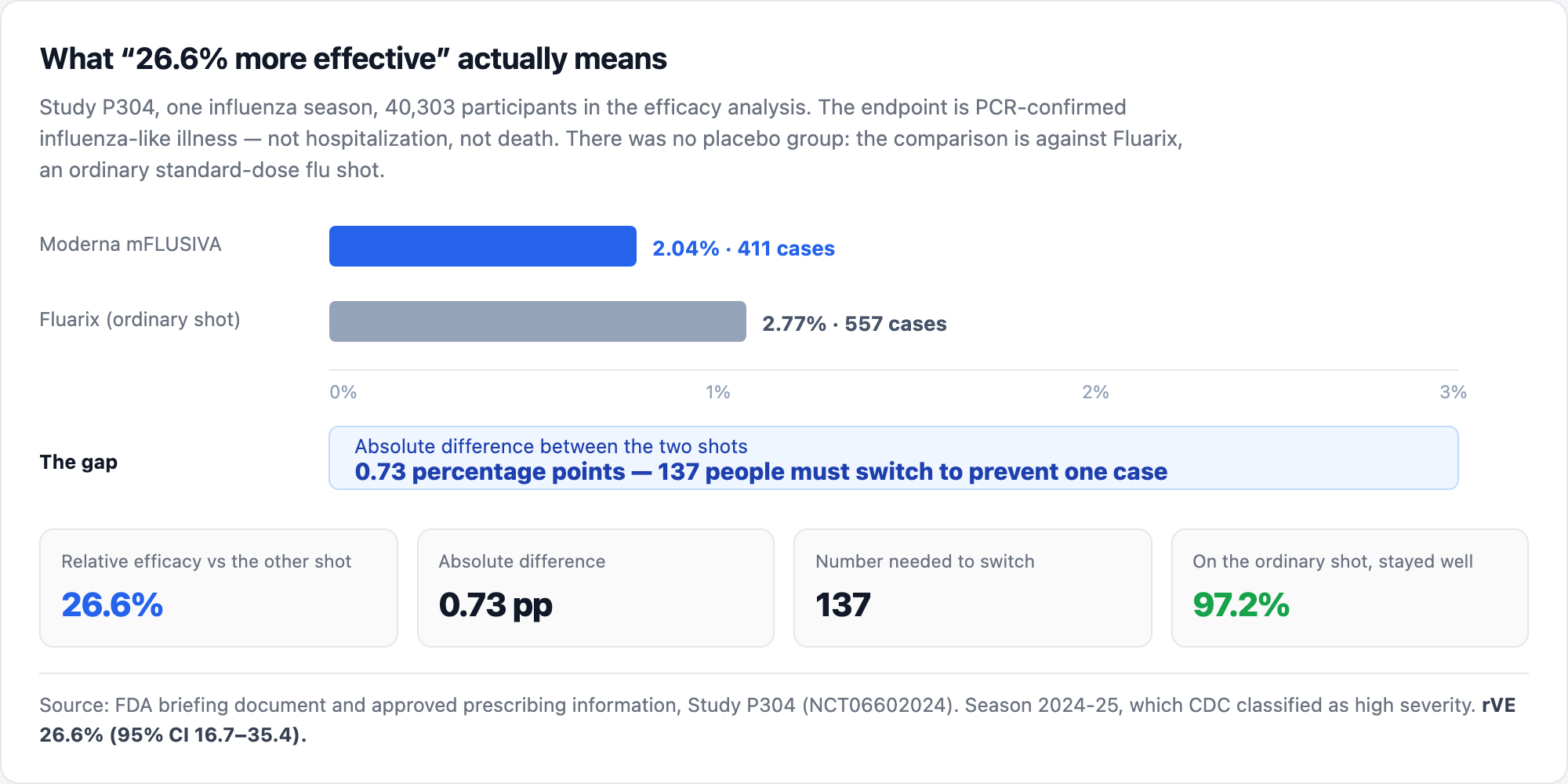
In the trial, 2.04% of the MFLUSIVA group caught PCR-confirmed influenza-like illness. 2.77% of the Fluarix group did. That gap — 411 cases versus 557 — is the entire finding.
In absolute terms it is 0.73 percentage points. Which means roughly 137 people have to switch from the ordinary flu shot to the mRNA shot to prevent one case of lab-confirmed flu-like illness over one season.
And note what happened in the comparator arm during a season CDC classified as high severity: 97.2% of people who got the ordinary, cheap, widely available flu shot did not get PCR-confirmed flu-like illness anyway.
The endpoint is also softer than most readers will assume. “Protocol-defined ILI” required one systemic symptom — which could be tiredness or a headache — plus one respiratory symptom such as a cough, plus a positive PCR test. It is not hospitalization. It is not death.
Number two: flu kills the old, and the old got the weaker approval
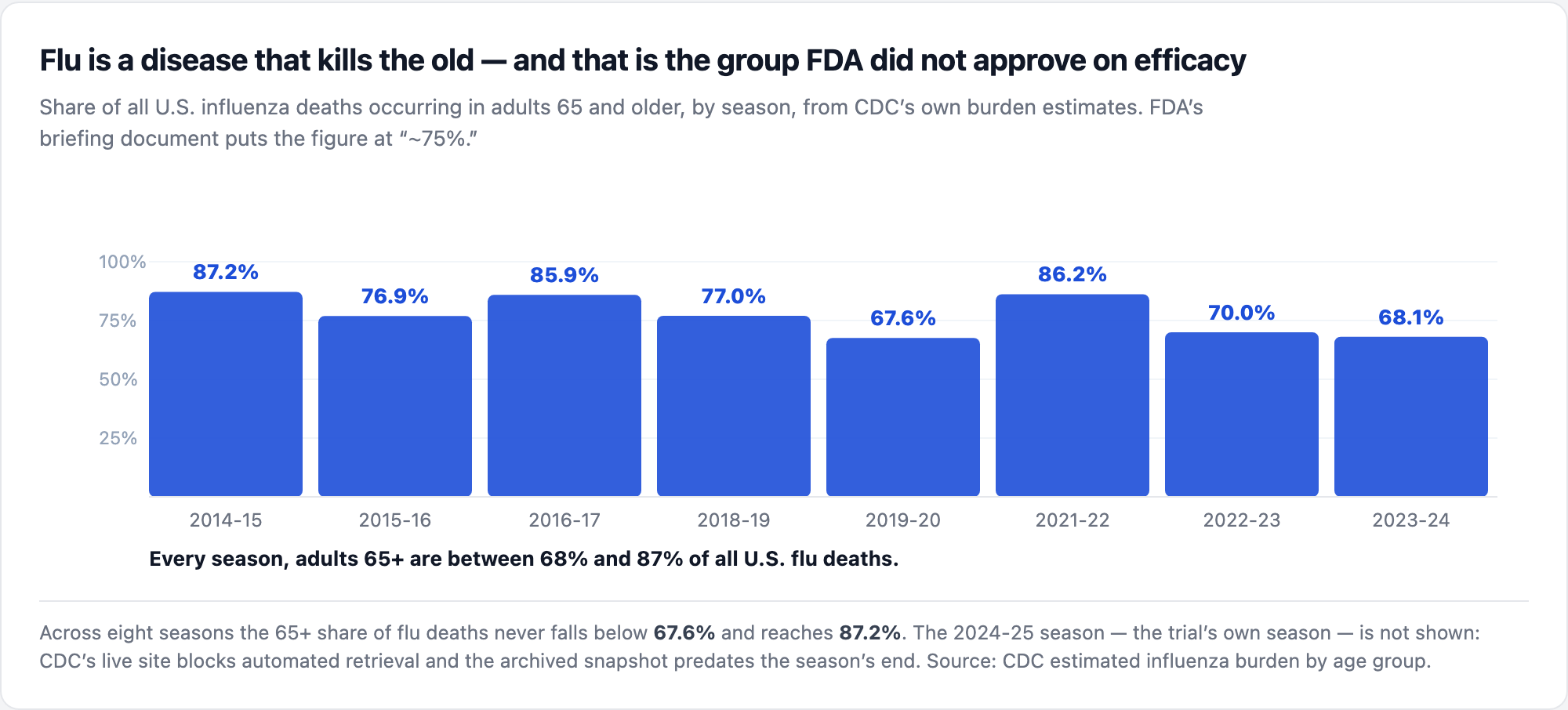
Influenza is overwhelmingly a disease that kills elderly people. We pulled CDC’s burden estimates for eight seasons. Adults 65 and older account for between 68% and 87% of all U.S. influenza deaths — every single season. FDA’s own briefing document puts it at roughly 75%.
That is precisely the group FDA did not approve on demonstrated efficacy.
Adults 50 to 64 got a traditional approval. Adults 65 and older got an accelerated approval based on antibody levels — hemagglutination inhibition titers and seroconversion rates — drawn from a different study, in a different season, using a different formulation than the product being licensed, bridged after the fact.
To be precise, because this is the sentence people will try to twist: seniors are approved. They are approved on a weaker evidentiary standard than everyone else.
FDA has required Moderna to run a confirmatory trial to find out whether the thing actually works better in that population. It begins August 31, 2026. The final report is due May 31, 2030. :/
For the group that supplies roughly three-quarters of America’s flu deaths, the answer arrives in four years.
Number three: FDA says the comparator was the wrong shot
This is the part that should end the “breakthrough” framing, and it is FDA’s language, not ours:
“For adults 65 yoa and older, high-dose (HD-IIV4), recombinant (RIV), and adjuvanted (aIIV4) influenza vaccines are preferentially recommended by the Advisory Committee on Immunization Practices (ACIP) over SD formulations. Accordingly, the SD comparator used in P304 is not the preferred standard of care in this age stratum.”
And:
the rVE “does not directly establish the magnitude of benefit relative to HD, RIV or adjuvanted vaccines — the vaccines most adults 65 yoa and older would otherwise receive.”
CDC tells people over 65 to get the high-dose shot. Moderna’s trial tested against the standard-dose shot.
Moderna beat the shot that seniors are told not to get.
FDA even cites ICH E10 — the international guideline holding that a control group should reflect actual standard of care — and then notes that it didn’t here.
Number four: the severe-outcome claim is twelve hospitalizations
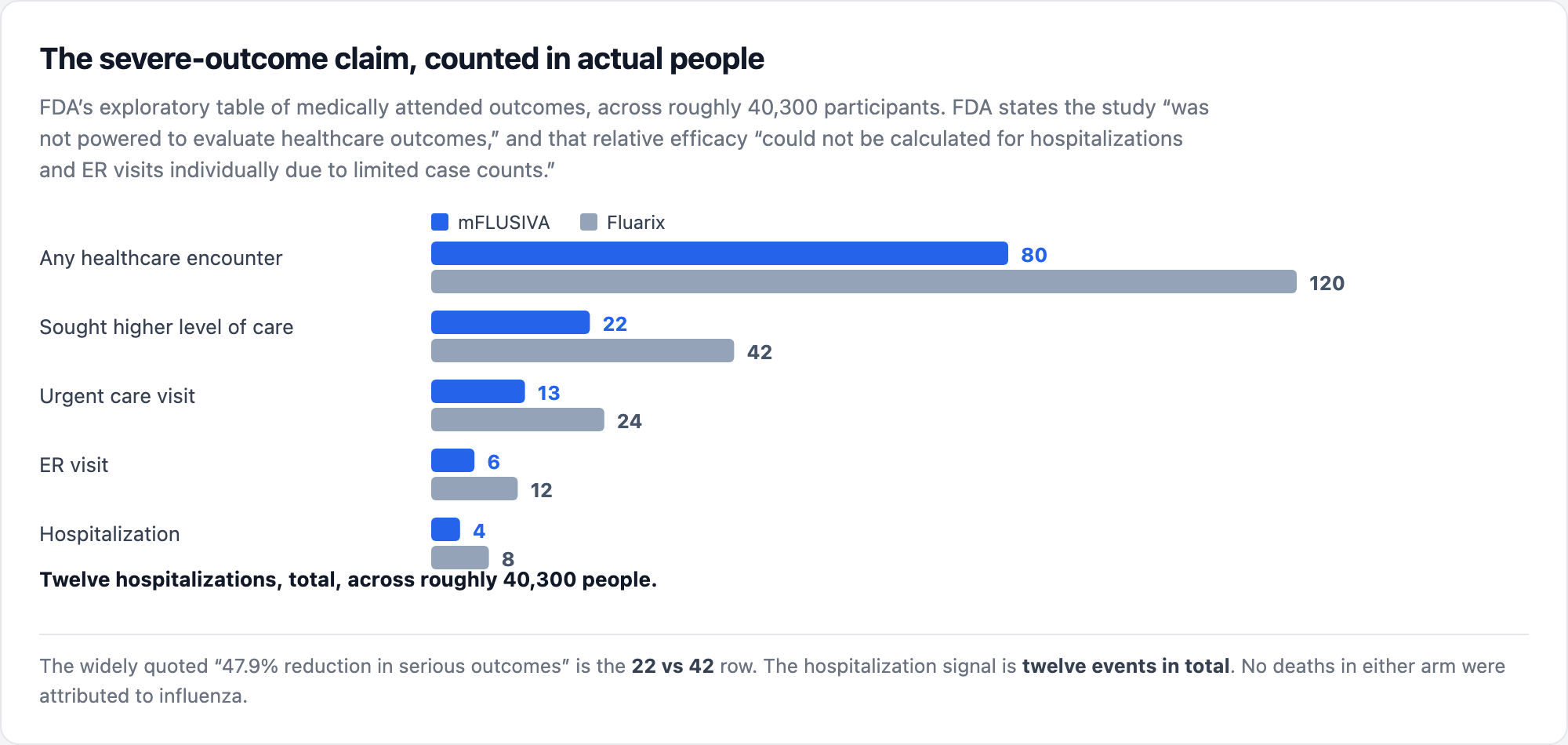
You will see “47.9% reduction in serious outcomes” quoted. Here is what sits underneath it, across roughly 40,300 people:
Twenty-two participants versus forty-two sought a higher level of care. Six versus twelve went to an emergency room. Four versus eight were hospitalized.
Twelve hospitalizations, in total, in a trial of forty thousand people.
FDA is explicit that this is not a finding to lean on: relative efficacy “could not be calculated for hospitalizations and ER visits individually due to limited case counts,” and the study “was not powered to evaluate healthcare outcomes.”
No deaths in either arm were attributed to influenza.
Where the effect holds, and where it vanishes
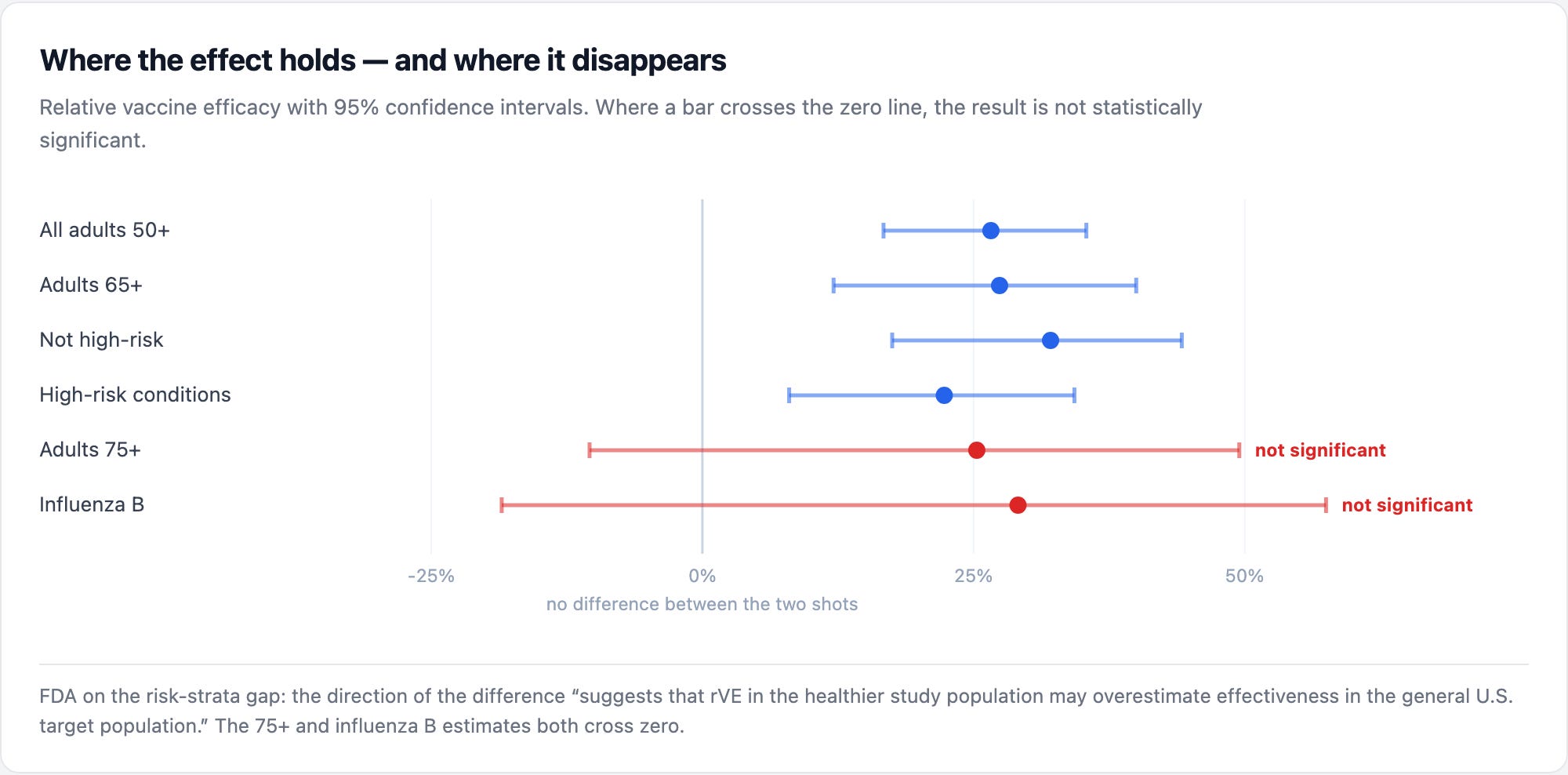
Break the result apart and the picture gets thinner.
In participants with high-risk medical conditions — the people who actually need protection — rVE was 22.3%. In healthy participants it was 32.1%. FDA’s own reading: the direction of that difference “suggests that rVE in the healthier study population may overestimate effectiveness in the general U.S. target population.”
In adults 75 and older, the oldest group actually enrolled, the result was not statistically significant: 44 cases versus 59, rVE 25.3%, confidence interval running from −10.4% to 49.5%.
Against influenza B, also not significant: 25 cases versus 35, confidence interval −18.5% to 57.5%.
And there is a specific problem with resting the senior approval on antibody titers. From the approved label: for B/Victoria, the correlation between antibody levels and actual illness “was not statistically significant; therefore, effectiveness against this strain cannot be reliably inferred based on HAI titers.” The surrogate endpoint doesn’t hold for that strain — and the surrogate is the whole basis of the 65+ approval.
The trial studied healthier people than the ones flu kills
Immunocompromised patients: excluded. Moderately or severely frail participants: under 1%. Nursing home or assisted-living residence: not even recorded. Median age: 64. Only 11.6% were 75 or older.
Fifty-seven percent of trial participants had at least one high-risk condition, against an estimated 78–93% in the real-world target population.
FDA’s conclusion, again in its own words: these exclusions limit “direct applicability of the efficacy data to a substantial portion of the intended patient population,” and the gap “is significant because these populations face the highest absolute risk of severe influenza-related complications.”
The trade nobody puts in the press release
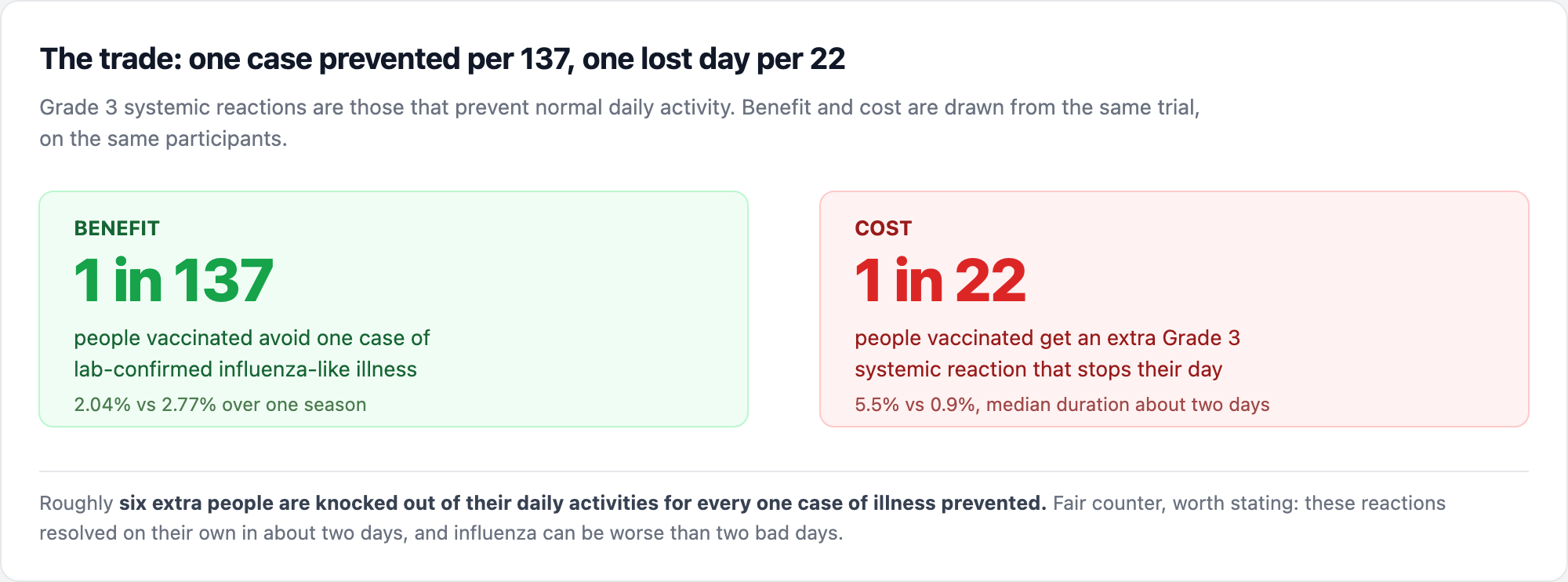
Grade 3 systemic reactions — the kind that stop your day — occurred in 5.5% of MFLUSIVA recipients versus 0.9% on the ordinary shot. Any systemic reaction: 58.0% versus 32.4%. Any local reaction: 67.5% versus 32.1%.
That excess works out to roughly one additional day-stopping reaction for every 22 people vaccinated, against one case of illness prevented for every 137.
Roughly six people knocked out of their day for every one case of flu-like illness avoided.
The fair counter, which belongs in print: those reactions had a median duration of about two days and resolved on their own. Influenza can be considerably worse than two bad days. But the trade is real, and it is not what “26.6% more effective” conveys to someone rolling up a sleeve.
What we are not claiming
Rational Ground’s brand is receipts, so here are the ones that cut the other way.
This was not rushed. FDA’s advisory committee voted 9–0 that the benefits outweigh the risks, for both age groups. FDA initially refused even to file the application. The review took eight months from submission to approval.
The death imbalance has an explanation. Across the pooled Phase 3 safety database of nearly 72,000 people, deaths of unspecified cause ran 23 in the MFLUSIVA arm versus 9 in comparators. That looks alarming, and FDA worked through it in detail: deaths within 28 days of vaccination were 3 versus 2, most occurred months later with no temporal clustering, and nearly all involved heavy pre-existing illness. FDA concluded none were vaccine-related. We think that assessment is reasonable. We would also note that no autopsies were performed on any of the mRNA-1010 deaths, so the conclusion rests on record review.
The safety database can’t answer the rare-event question either way. FDA states plainly that it “is insufficient to detect rare adverse events, including myocarditis, Guillain-Barré syndrome, and other neurological events of interest.”
And this may genuinely be a better flu shot. CDC’s own presentation to the same committee put existing vaccine effectiveness in adults 65+ at 31–37% against unvaccinated this past season — and noted that was “lower than recent previous influenza seasons.” Layer a 26.6% relative improvement on top and you land somewhere near 49–52%. That would be a real gain. It is also an arithmetic projection, not a measured result, because no trial has ever compared this product to no vaccine at all.
but… it’s still mRNA
Our concern with mRNA as a platform has never rested on the spike protein alone — it rests on what else is in the vial. Kevin McKernan, who ran R&D for the Human Genome Project's sequencing effort at MIT, found residual plasmid DNA in Pfizer and Moderna vials at levels far beyond regulatory limits, along with an SV40 promoter-enhancer sequence in the Pfizer product — an element used in gene therapy to drive DNA toward the nucleus, and one that regulators were never told about. That work has now cleared peer review.
Speicher, Rose and McKernan, writing in Autoimmunity in December 2025, tested 32 vials from 16 lots of documented Ontario provenance and measured total DNA at 36 to 153 times the regulatory limit for Pfizer and 112 to 627 times for Moderna. The most damning part is methodological. Regulators certify these products using qPCR, which counts only short, specific, amplifiable fragments — and by qPCR every Moderna vial passed. By fluorometry, which measures all the DNA actually present, not one did. The limit wasn't breached in secret; it was measured with an instrument that couldn't see it. What that DNA does inside a human being remains genuinely unresolved, and we won't pretend otherwise. But "we never looked properly" is not the same finding as "there's nothing there" — and after four years, the burden belongs to the people who picked the assay.
So, for myself and my family — we’ll pass on this shot, thanks!
Every figure above is drawn from FDA’s approval letter (STN BL 125869/0, August 5, 2026), the approved MFLUSIVA prescribing information, FDA’s briefing document to the Vaccines and Related Biological Products Advisory Committee for its June 18, 2026 meeting, Moderna’s briefing document, CDC’s presentation to that same committee, and CDC’s published influenza burden estimates by age group. One gap worth disclosing: CDC’s by-age burden table for the 2024-25 season — the trial’s own season — was not retrievable; CDC’s live site blocks automated access and the archived snapshot predates the season’s end. The eight complete seasons shown make the point without it.
Excellent breakdown of the math for us non-experts.
And of course, no long term data yet on side effects of an mRNA flu shot.
I quit flu shots years ago. I definitely wouldn’t get any mRNA shots. Or any vaccines for that matter.