

The database is now 725 findings from 84 documents. $56 gets you all of it.
Everything below came out of the Rational Ground COVID FOIA database — every quote checked against the source page, every page number recorded. This week it grew by fifteen findings, including nine from a brand-new release and six from diary pages that had no searchable text at all until we ran OCR on them and read them by hand.
That is what a membership pays for: somebody reading 270 pages of scanned lab email so you don’t have to, and then telling you honestly which parts hold up.
👉 Join at $56 and search the whole database at members.rationalground.com.
A new FOIA release shows an NIH lab chief suggesting a furin-like cleavage site in a bat coronavirus spike — two months before COVID surfaced. Here is exactly what that email says, and exactly what it doesn’t.
On October 15, U.S. Right to Know published 270 pages of email from the lab of Vincent Munster, chief of the Virus Ecology Section at NIH’s Rocky Mountain Laboratories in Hamilton, Montana. Lewis Kamb wrote the story. The documents are real, the reporting is solid, and one email in that batch is going to travel a very long way this week.
The Email
Sunday morning, October 6, 2019, 9:31 a.m. Mountain Time. Munster writes to his postdoc, Michael Letko. The subject line — carried over from earlier in the thread — is “Definitely on the right track.”
“So they focus on S rather than the receptor, but your work suggests more receptor activation, right?
You should be able to make S with a more broader cleavage signature (like furin-like) to enhance infectivity. You can include a motif like this R-X-[K/R]-R↓ Might be cool to get some synthesized
Are you using caco-2 cells as well, I think so but can’t remember out of the top of my head”
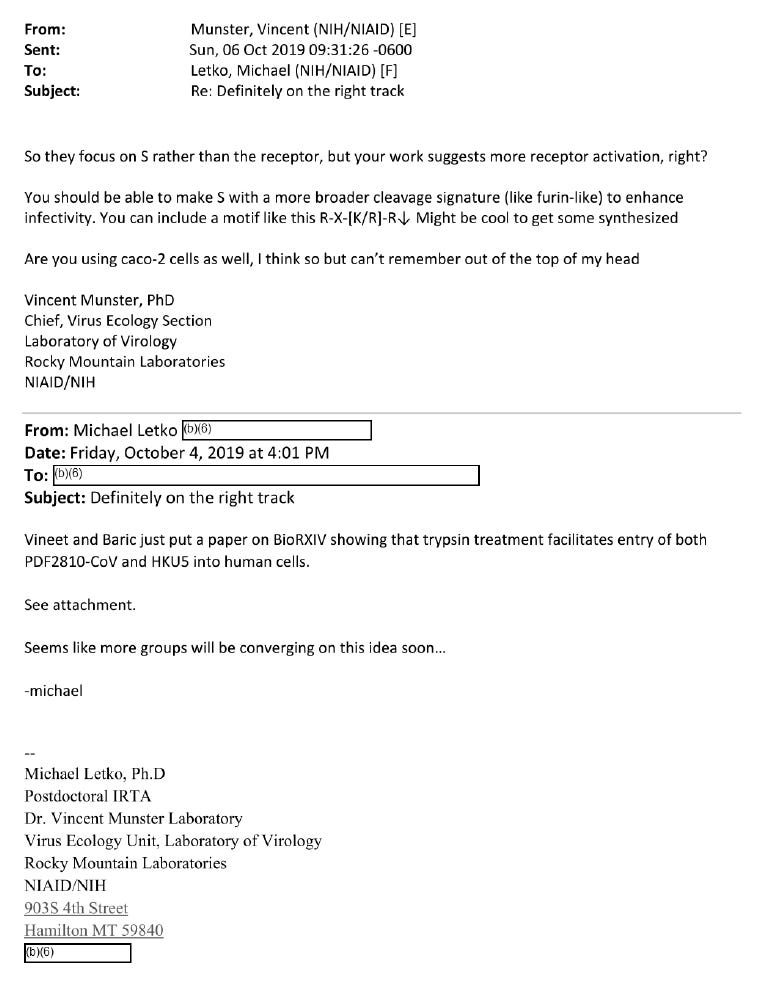
“S” is the spike protein. A furin cleavage site is the feature of SARS-CoV-2 most frequently cited in lab-origin arguments — the piece of the spike that isn’t found in its closest known relatives. Here is a senior NIH virologist, in October 2019, suggesting his postdoc engineer a furin-like cleavage signature into a bat coronavirus spike “to enhance infectivity,” and offering the motif to do it with.
That is a real sentence in a real government email, and nobody should pretend otherwise.
What Was Driving It
The thread starts two days earlier, and the context is not sinister. It is competitive.
Friday, October 4, 4:01 p.m., Letko writes to Munster:
“Vineet and Baric just put a paper on BioRXIV showing that trypsin treatment facilitates entry of both PDF2810-CoV and HKU5 into human cells. See attachment. Seems like more groups will be converging on this idea soon…“
Thirty-eight minutes later, Munster:
“Better get your stuff wrapped up! Maybe smtg on trypsin rich environments on mucosal surfaces?”
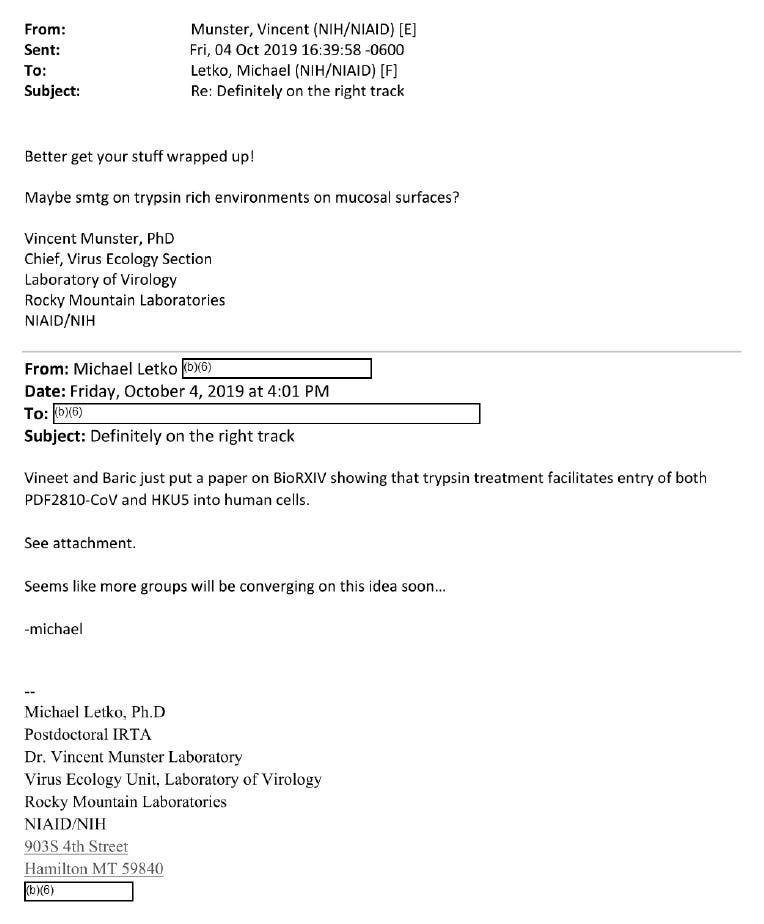
Then Sunday morning comes the furin suggestion. This is a lab racing a rival group to publish — Ralph Baric’s, as it happens — over a weekend. That framing doesn’t make the proposal harmless. But it does explain the sentence better than any theory involving a conspiracy, and the honest version of this story includes it.
Now the Part That Will Get Skipped
Here is what these documents do not show, and I’d rather you heard it from us than from a fact-check next week.
Nothing in the records shows Letko did it. No follow-up, no synthesis order, no results. USRTK says this in its own story. The suggestion sits there, unanswered in the file.
The lab was working with particles that cannot replicate. This matters more than anything else and it is the least likely detail to survive the next retelling. The lab’s own March 2019 abstract — also in this release — describes the platform:
“All 30 RBDs were synthesized and cloned into a construct we designed to make luciferase reporter viral particles… We then infected human cells with this panel of reporter particles and measured luciferase as a readout for cell entry.”
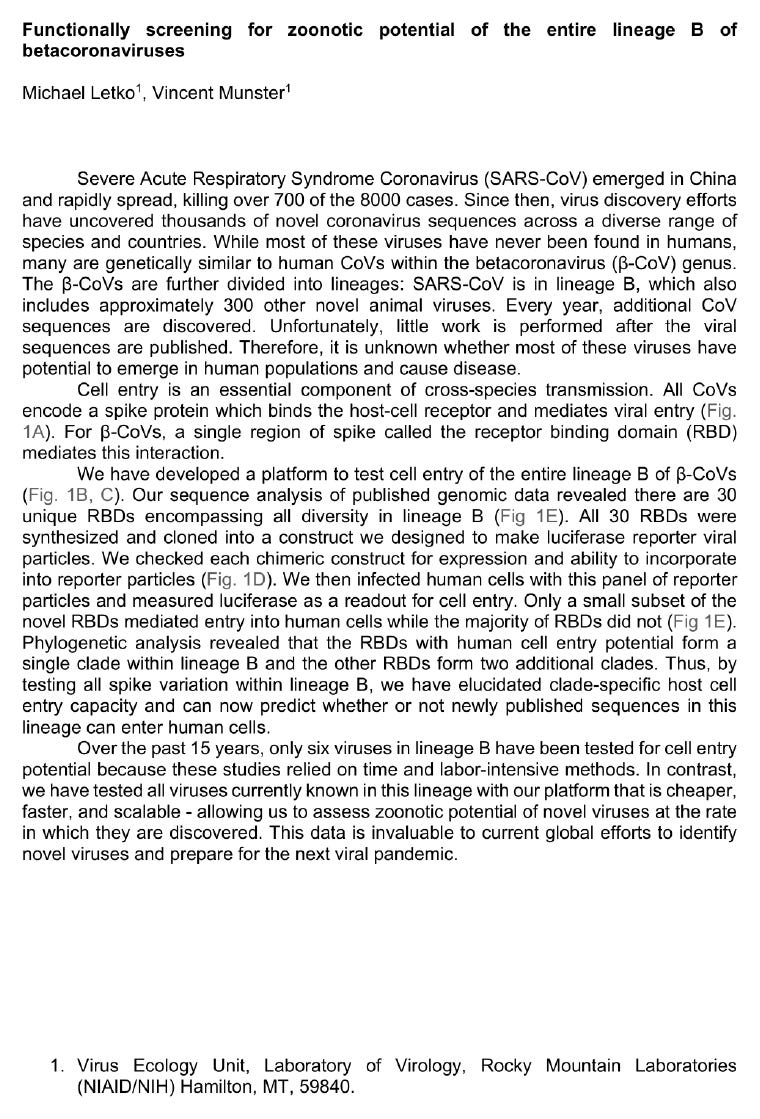
Reporter particles are not viruses. They enter a cell once, light up, and go no further. The stated purpose of the platform was screening — testing which of 30 known receptor-binding domains could enter human cells, so that newly discovered sequences could be triaged quickly. In the lab’s words, it was “cheaper, faster, and scalable,” and the result was that “only a small subset of the novel RBDs mediated entry into human cells while the majority of RBDs did not.”
The published platform swapped a different part of the spike. The abstract describes swapping receptor-binding domains. The email suggests modifying the cleavage signature. Those are different regions and different experiments — another reason the email reads as an aside rather than a description of work underway.
The motif isn’t SARS-CoV-2’s. USRTK reports that the furin site in SARS-CoV-2 differs from the motif Munster typed. We did not independently compare the sequences, and we’re telling you that rather than implying we did.
And nothing in the records shows this lab held SARS-CoV-2 or a close relative, or corresponded with scientists in Wuhan.
One more thing worth saying plainly: the headline verb — that Munster “proposed making a SARS-like bat virus better at infecting people” — is USRTK’s characterization. The email says “make S.” That means the spike protein, not a virus.
What the email genuinely establishes is narrower, and still worth knowing: in autumn 2019, inserting furin-like cleavage sites into SARS-like spikes was an idea circulating casually enough among American coronavirus researchers that a lab chief could float it in a Sunday email without a second thought. As molecular biologist Alina Chan told USRTK, “different groups of virologists were converging on the idea of inserting cleavage sites in the spikes of potentially dangerous coronaviruses.” The 2018 DEFUSE proposal had put the same idea on paper.
That is a story about a research culture. It is not evidence about the origin of a pandemic, and the two should not be welded together.
The Stronger Document Nobody Will Cover
Buried earlier in the same release is a cleaner, better-documented story.
On March 8, 2019, Munster emailed EcoHealth Alliance’s Peter Daszak, Kevin Olival and Simon Anthony of the PREDICT project:
“we are seeking additional, unpublished lineage B beta-coronavirus sequences to test in our platform.”
He asked them not to share the attached abstract, because the work was “still unpublished and quite competitive.”
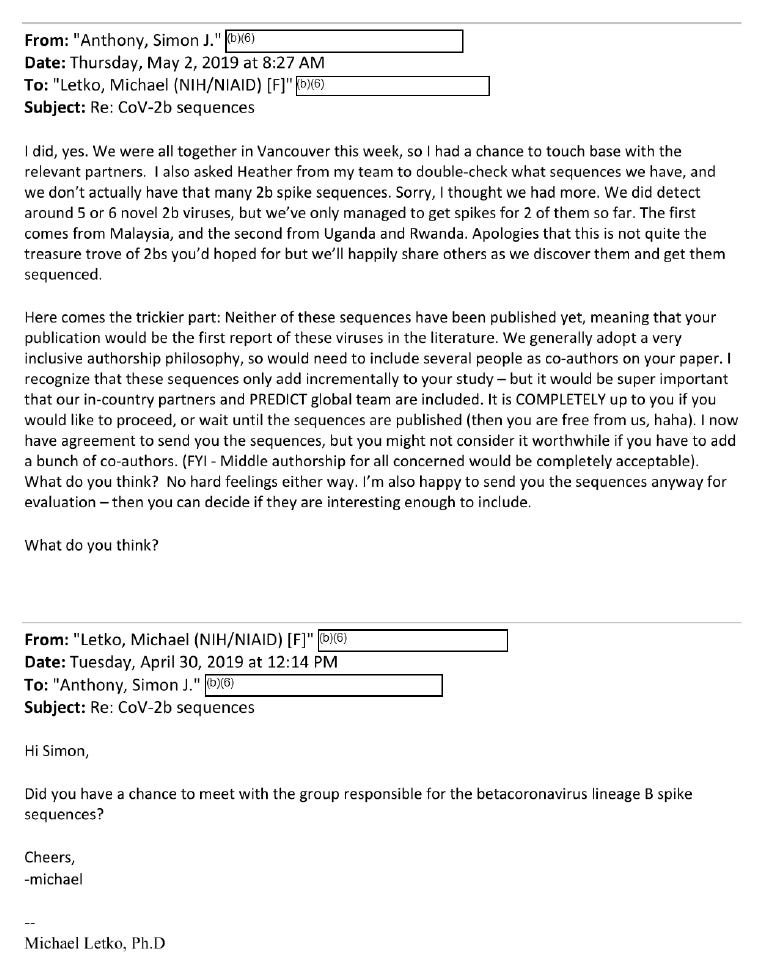
By April, Letko was thanking Anthony for agreeing, noting the sequences would “increase the impact of our story by providing a proof of principle with unpublished sequences.” Then on May 2, Anthony wrote back with what they actually had — and his email is the most human document in the batch:
“we don’t actually have that many 2b spike sequences. Sorry, I thought we had more. We did detect around 5 or 6 novel 2b viruses, but we’ve only managed to get spikes for 2 of them so far. The first comes from Malaysia, and the second from Uganda and Rwanda. Apologies that this is not quite the treasure trove of 2bs you’d hoped for…
Here comes the trickier part: Neither of these sequences have been published yet… We generally adopt a very inclusive authorship philosophy, so would need to include several people as co-authors on your paper… It is COMPLETELY up to you if you would like to proceed, or wait until the sequences are published (then you are free from us, haha).”
__IMAGE5__
Two days later he sent them. Munster: “Absolutely stellar! Will keep you posted on the results!”
Read it for what it is — an ordinary academic haggle over co-authorship credit. And note where the viruses came from: Malaysia, Uganda and Rwanda. Not China. USRTK reports they are too distantly related to SARS-CoV-2 to have given rise to it.
So why is this the better story? Because of what Simon Anthony co-wrote two years later. USRTK makes the point, and it’s theirs, not ours: Anthony was an author on a 2021 Cell review arguing it was implausible that anyone would construct a research system around an unpublished virus. In 2019 he was emailing unpublished virus sequences to a federal lab building exactly such a system, and negotiating the author list.
That is a documented inconsistency between what a scientist did and what he later said was unlikely. No inference required.
January 2020, Same Lab
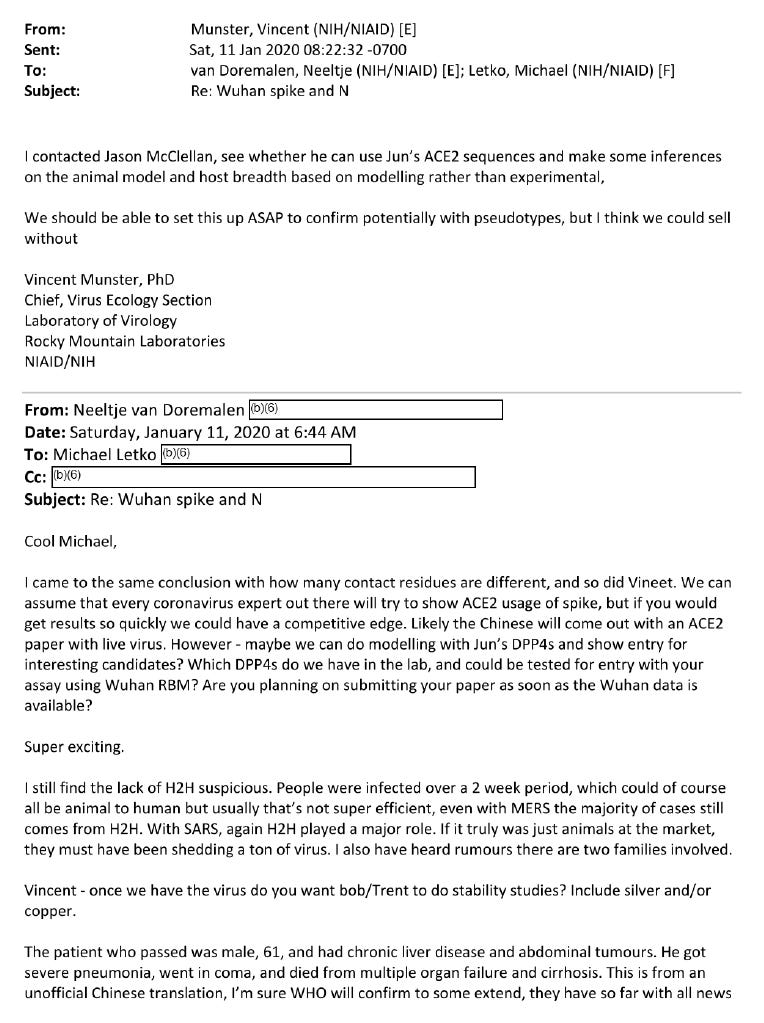
One last item, because the timing is its own kind of document. On January 11, 2020, in a thread titled “Wuhan spike and N,” Munster’s colleague Neeltje van Doremalen wrote:
“if you would get results so quickly we could have a competitive edge. Likely the Chinese will come out with an ACE2 paper with live virus… I still find the lack of H2H suspicious.“
__IMAGE6__
“H2H” is human-to-human transmission — which China was still publicly denying. A working virologist found that claim suspicious on January 11. The rest of us were told not to worry for another six weeks.
Munster’s reply was about moving fast: “We should be able to set this up ASAP to confirm potentially with pseudotypes.”
Why We Published It This Way
We could have run the furin email under a headline with a siren on it and collected the traffic. The reason not to is simple: the careful version survives contact with critics, and the hot version doesn’t. Every limitation above appears in USRTK’s own reporting — the outlet that broke the story put the caveats in, and anyone who strips them out is doing worse journalism than the people who did the work.
The email is real. The suggestion is real. The follow-through is undocumented, the particles couldn’t replicate, and the viruses came from Malaysia and East Africa.
All of that is true at once. Write it down that way.
$56 for the whole archive.
725 findings. 84 documents. Every quote checked against the source page. Including about 160 diary pages that had no text layer until we OCR’d them by hand, and 28 findings we quietly repointed this week after Senator Paul’s office replaced two diary files with redacted versions and the old links went dead.
Nobody else is maintaining this. $56 for the year keeps it running and searchable.
👉 Join at $56 — members.rationalground.com.
Documents: NIH FOIA 65118, released by U.S. Right to Know, Oct. 15, 2026 (270 pp.). Reporting by Lewis Kamb for USRTK. Page citations: furin email p.175; Oct. 4 thread p.176; Letko/Munster abstract p.2; sequence request p.1; Anthony reply p.241; sequences sent p.240; “Wuhan spike and N” p.169. Quotations verbatim, including original typos. The Alina Chan quotation and the characterization of the SARS-CoV-2 furin motif are USRTK’s.