

I‘ve walked the halls of Capitol Hill with Jay Bhattacharya. I’ve watched him endure years of attacks from the very institutions he’s now tasked with reforming. And I’m proud to call him a friend.
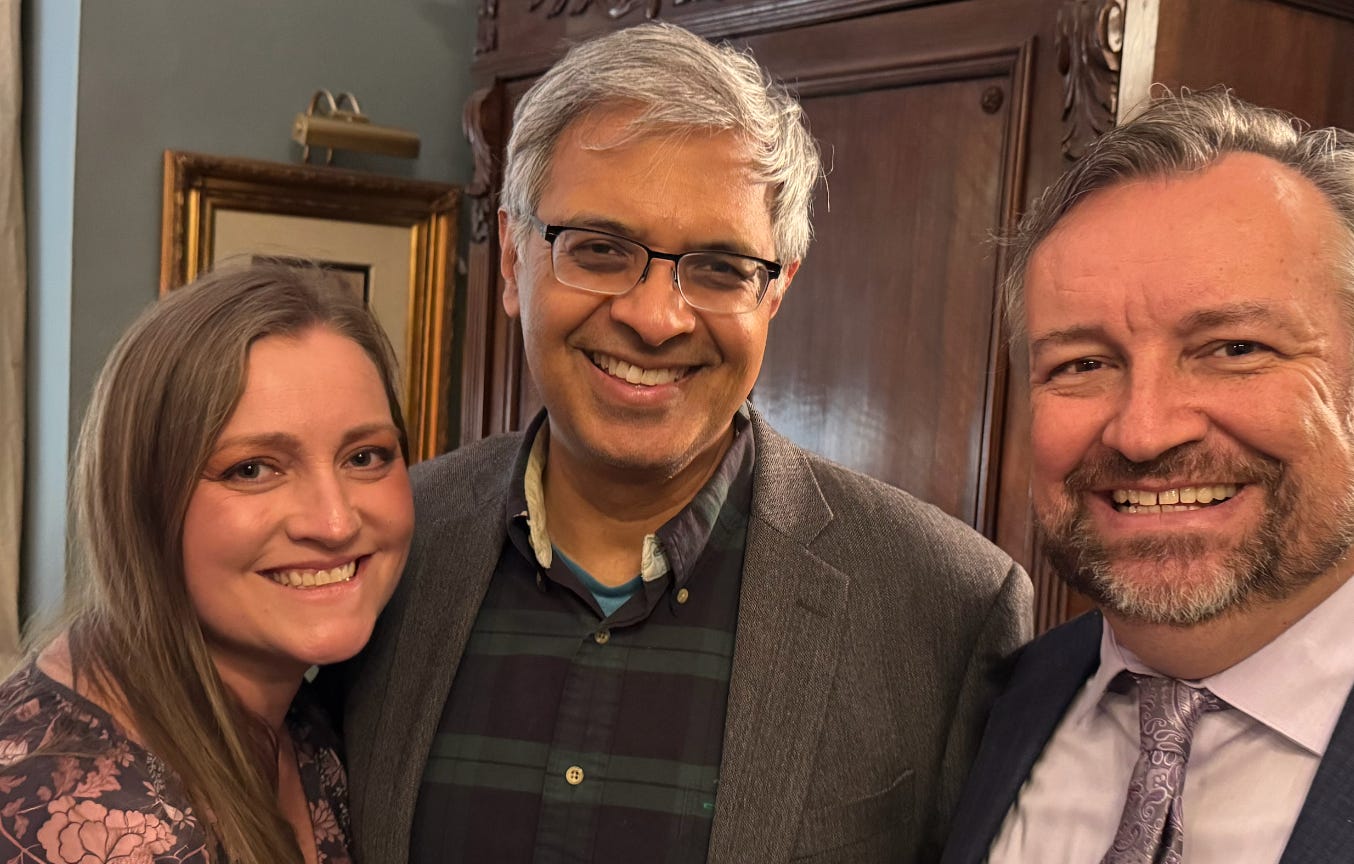
So when he sat down with the New York Times’ Ross Douthat for a wide-ranging interview, I paid attention. And you should too.
This interview is remarkable—not just for what Jay says, but for where he’s saying it. The New York Times. The paper of record that spent years dismissing people like us as cranks and conspiracy theorists.
Let me walk you through the most important moments.
“Fringe Epidemiologist” — The Badge of Honor
When Douthat asked about the attacks Jay faced for simply doing science, Jay didn’t mince words:
“At the N.I.H., the former head of the N.I.H. wrote an email to Tony Fauci in October 2020 calling me a ‘fringe epidemiologist’ — I love that term, by the way. It’s fantastic. It’s hopefully going to go on my grave.“
That’s my friend. Taking the slur they threw at him and wearing it as a crown.
But here’s what matters: Jay wasn’t wrong. His early seroprevalence studies showed the infection fatality rate was far lower than the doomsday projections. He thought the data would change minds.
“This is how naïve I was, Ross: I thought that that result would change everybody’s mind about how to manage the pandemic... Instead, I faced, essentially, attacks on my character, an attempt to destroy my career, questions about the integrity of my work that were completely spurious.“
We all learned that lesson in 2020. The establishment didn’t want answers. They wanted compliance.
Why They Couldn’t Allow Debate
Douthat pressed Jay on why public health closed ranks so completely. Jay’s answer cuts to the heart of the matter:
“What if you opened Pandora’s box? What would you do? You’ve unleashed hell on the world. And you’re responsible for it. What would you do?”
Jay believes—as do many scientists now—that Covid likely originated from a lab accident. And the people responsible for funding that research were the same people dictating our pandemic response.
“You do it, and it doesn’t work. It’s summer of 2020 and it’s very, very clear the disease is still there... And so you’re like: ‘Well, what went wrong? We just didn’t do it hard enough.‘”
Sound familiar? That was the playbook for three years. Lockdowns didn’t work? Lock down harder. Masks didn’t work? Mandate them everywhere. Schools closed and kids suffered? Keep them closed longer.
“And so what you do is you suppress speech, you suppress dissent, and you make sure that anyone who dissents, that their reputation is destroyed so that other people won’t speak up.”
That’s not science. That’s religion.
The Fundamental Break
Jay articulated something I’ve been saying since 2020:
“The idea that when there’s this kind of uncertainty, you must do this extraordinary draconian measure and you take away basic civil liberties at scale for nine months or however long until you get the vaccine, that, I think, is the end of civilization. If that is our paradigm for managing these kinds of risks, we can’t have at least a free civilization.”
Read that again. The end of civilization.
He’s right. If the template is “surrender your rights every time there’s uncertainty about a disease,” then we don’t have rights at all. We have permissions that can be revoked whenever the experts feel scared.
On Lockdowns Killing More Than They Saved
Douthat tried the standard defense: Maybe lockdowns kept old people alive until the vaccine arrived?
Jay wasn’t having it:
“I don’t think it would’ve cost more lives. I think ultimately lockdowns ended up killing more people than would’ve been killed had those lockdowns not happened.“
And he explained exactly how:
“People died at home with heart attacks in 2020 because they didn’t go to the hospital. But also, more broadly, the economic dislocations caused by the lockdowns certainly killed vast numbers of people.”
This is what we documented. This is what the data shows. The “cure” was worse than the disease.
The Vaccine Oversell
On vaccines, Jay was characteristically nuanced—which is exactly what public health should have been:
“In October 2020, when we wrote the Great Barrington Declaration, if you go read it, we actually have vaccines as one of the mechanisms of focused protection.”
But that’s not what happened:
“That wasn’t what public health authorities actually said at the time. I can show you examples essentially promising zero Covid, if only we can get the entire population — or some version of this — to take it. That was the problem. It wasn’t that they weren’t saying what they believed, it’s that what they were saying was false given what the data actually showed.“
The result? Trust collapsed. And now we have measles outbreaks because parents don’t trust any vaccines.
The Mission Now
Jay is now running the NIH. The same institution that tried to destroy him. And his mission is clear:
“I don’t want the public health authorities to be discredited permanently. I want reform of the public health authorities so that they become worthy of trust.“
He pointed to a devastating statistic:
“25 percent of Americans don’t believe that scientists have the best interest of the public at heart. One in four. And then people will come back to me — scientists — and say, ‘Well, look, 75 percent trust us.’ That’s too low a bar, Ross. It needs to be 100 percent.“
He’s right. Science isn’t politics. You don’t win by getting 50% plus one. If a quarter of the country thinks you’re working against them, you’ve failed.
The Second Scientific Revolution
Perhaps the most exciting part of the interview was Jay’s vision for fixing the replication crisis—the fact that huge portions of published scientific research can’t be reproduced:
“The replicator, then, is not just some unsexy thing — it’s fundamental for the scientific community in deciding what’s true or false. That’s the second scientific revolution.“
He’s creating a system where replication is honored, where negative findings can be published, where scientists get credit for verifying (or disproving) each other’s work.
This is how science is supposed to work.
The Bottom Line
Five years ago, Jay Bhattacharya was being blacklisted, censored, and smeared as a “fringe epidemiologist” for saying things that turned out to be true.
Today, he’s running the NIH and giving interviews to the New York Times about how to rebuild trust in science.
The arc of the universe may not bend toward justice on its own. But sometimes, with enough persistence, the outsiders win.
And this outsider happens to be one of the good ones.
Read the full interview. Share it. And remember: They can’t say they didn’t know anymore.
Jay, if you’re reading this—proud of you, my friend.
I strongly disagree with the notion that stricter lockdowns, mask mandates, or school closures were implemented out of genuine remorse or because certain actors were responsible for unleashing the virus on the world. In my view, those in power—particularly the Chinese Communist Party (CCP)—showed little concern over the virus’s origins in a Wuhan lab. The CCP has demonstrated time and again that it prioritizes control over human life; for them, the loss of elderly populations might even be seen as a grim efficiency, reducing demands on food, housing, and healthcare for those beyond typical life expectancy.
This wasn’t an accident—it was orchestrated. The timing is too suspicious: Just months before the outbreak, global elites simulated a pandemic response in Event 201, a high-profile exercise hosted by the Johns Hopkins Center for Health Security in October 2019. I believe this was no coincidence. It paved the way for exploiting the crisis to rewrite election rules, expand mail-in voting without safeguards, and tip the scales in favor of Joe Biden’s victory. That’s the real story here—one of premeditation, power grabs, and manipulation under the guise of public health.
The NYT will spin this into a hit piece they will never be honest.