

You’d think that after injecting billions of people with a brand-new genetic platform, somebody would at least double-check what was actually in the vials.
This past week, a small team did just that.
For the cost of a couple of plane tickets and a few consumables, Jessica Rose, Kevin McKernan, and Charles Rixey took unopened Pfizer and Moderna COVID-19 vaccine vials into a real lab and asked a very simple question:
Is there DNA in here, and if so, how much?
The answer, in plain English:
Yes, there is DNA. A lot of it.
Regulators have been measuring it in a way that was almost guaranteed to miss most of it.
And once you see how the trick works, it’s hard to believe it was an accident.
1. What was supposed to be in the vials?
The sales pitch for the mRNA shots was simple:
No virus.
No viral DNA.
Just a short-lived bit of mRNA wrapped in fat bubbles (LNPs) that tells your cells to make the spike protein for a little while, and then disappears.
Behind the scenes, though, that mRNA has to be manufactured. You don’t harvest it from unicorns; you make it from DNA.
The basic pipeline:
Start with a circular piece of DNA called a plasmid (think: a tiny genetic CD).
Use that plasmid as a template to crank out modified mRNA (N1-methylpseudouridine, in this case).
Destroy and remove the DNA at the end with an enzyme called DNase so only mRNA remains.
Package the mRNA in lipid nanoparticles and ship it as a “vaccine.”
Every regulator in the world agrees on one thing: leftover DNA must be vanishingly low. That’s why there are strict limits on “residual DNA” per dose.
What Jessica and Kevin’s team just showed is that:
DNA is not vanishingly low.
And the way regulators chose to measure it virtually guaranteed they wouldn’t see the bulk of it.
2. The short version of what they did
(video from their efforts)
Over two days at Medicinal Genomics, they:
Opened 8 vials (5 Pfizer, 3 Moderna).
Broke open the lipid nanoparticles so whatever was inside could be measured.
Ran three independent methods to look for DNA:
qPCR – counts specific DNA sequences by watching them duplicate in real time.
Fluorometry – uses a dye that glows in proportion to the total amount of DNA present.
Oxford Nanopore sequencing – literally reads the sequence of the DNA fragments passing through a tiny pore.
All three methods converged on the same conclusion:
There is a lot of DNA in these vials — far above what should be there.
One of the Pfizer samples was so loaded that the qPCR curve for DNA came up at Ct=9. For non-lab folks: that’s obscenely early. You don’t get a Ct of 9 unless you’ve got a huge amount of starting material.
For those of you who were with us in the trenches, you might recall that most PCR systems were set below 30 to detect Covid infections.
This isn’t background noise. It’s a foghorn.
3. How the cleanup step failed: DNA–RNA hybrids 101
So how did the DNA survive manufacturing?
Here’s the key concept, boiled down:
During production, the plasmid DNA is used as a template to make RNA.
Because of the way the system is designed — including the use of N1-methylpseudouridine, which binds more tightly than normal uridine — you can end up with DNA:RNA hybrids:
a strand of DNA stuck to a strand of RNA, like two zipper halves.
Nature knows these hybrids can cause trouble if they accumulate (they form “R-loops”), so our cells use a specific enzyme, RNase H, to get rid of them.
The manufacturers, however, used DNase I as their cleanup tool.
Problem:
DNase I doesn’t effectively chew up DNA when it’s hybridized to RNA. It’s like hiring a paper shredder that only works on loose sheets, not stapled bundles.
Result:
The unprotected parts of the plasmid (like much of the backbone) get chopped up.
The hybrid regions, including spike-related sections, survive and ride along into the final product.
When Kevin then re-treated the samples with an enzyme formulation that can destroy DNA:RNA hybrids (DNase-XT), the amount of detectable DNA dropped the way you’d expect if those hybrids were really there.
That’s not a fluke. That’s a mechanism.
4. Spike, Ori, SV40, Kan: what they actually measured
The team didn’t just vaguely wave a DNA wand over the vials. They looked for specific pieces of DNA, each with a different role:
Spike – the DNA sequence that encodes the spike protein.
Ori – the origin of replication, a key part of the plasmid backbone.
SV40 promoter/enhancer – a regulatory sequence originally from the SV40 virus, used to crank up gene expression. (SV40 elements are known to interact with p53, the famous tumor suppressor.)
Kan – the kanamycin resistance gene, also part of the plasmid backbone.
https://x.com/Kevin_McKernan/status/1988979150292676830
Here’s the punchline:
When they ran qPCR, they saw up to a 9-cycle difference (9 Cq) between spike and Ori. That’s more than a 100-fold difference in calculated quantity.
Spike DNA signal stayed strong even when DNase I was used, while Ori dropped off.
When DNase-XT — which can hit DNA:RNA hybrids — was used, the spike signal finally shifted the way you’d expect.
In other words: the spike region is being protected in these DNA:RNA hybrids; the backbone isn’t.
And that brings us to the regulatory shell game.
5. The regulatory sleight of hand
Regulatory documents, including submissions to the EMA, reveal something important:
Residual DNA testing for these products is based on a single qPCR assay targeting the Kan gene in the plasmid backbone.
That’s it. One little patch of DNA, in the most “chewable” part of the plasmid.
Meanwhile:
There exists a validated qPCR assay for the spike insert — the very region that tends to be protected in DNA:RNA hybrids.
But that spike assay is reportedly used only to confirm that the insert is present, not to actually measure how much DNA is there.
So we have:
Multiple validated assays available.
Huge differences (over 100-fold) in what they show.
Regulators choosing to report only the one that gives the lowest number.
If you only ever check the part of town where you already bulldozed the houses, you’ll conclude homelessness is under control.
This isn’t “we didn’t know how.” It’s “we chose not to look.”
6. Why this matters biologically
Let’s talk implications in normal language.
1. Foreign DNA plus LNPs is not a harmless combination
Lipid nanoparticles are fantastic at delivering genetic material into cells. That’s why the platform exists.
If plasmid DNA is riding inside those same LNPs:
It can be delivered into cells that were never supposed to see it.
That DNA can trigger strong innate immune responses.
In rare cases, DNA entering the nucleus can integrate into the host genome.
The whole point of the residual DNA limits is to keep that risk tiny.
Here, we’re seeing numbers that blow through those limits.
2. SV40 regulatory sequences
Some of the DNA they’re picking up includes SV40 promoter/enhancer regions in Pfizer lots.
No, that’s not the whole SV40 virus, but:
These regulatory elements can interact with p53 and other cell-cycle pathways.
They are precisely the sort of sequences you do not want casually showing up in random cells at pharmacological doses.
3. Inflammation and cancer pathways
To be very clear:
Nobody is saying, “You got one shot; therefore you get cancer.”
But if you:
massively scale exposure,
deliver DNA where it shouldn’t be,
via a system designed to punch genetic cargo into cells,
you are not in “zero concern” territory. You are in “we should be obsessively measuring and disclosing this” territory.
Instead, regulators chose a test that mostly measures the bit of the plasmid that gets destroyed best by their enzyme, and then declared the residual DNA problem “handled.”
7. The figure in one glance
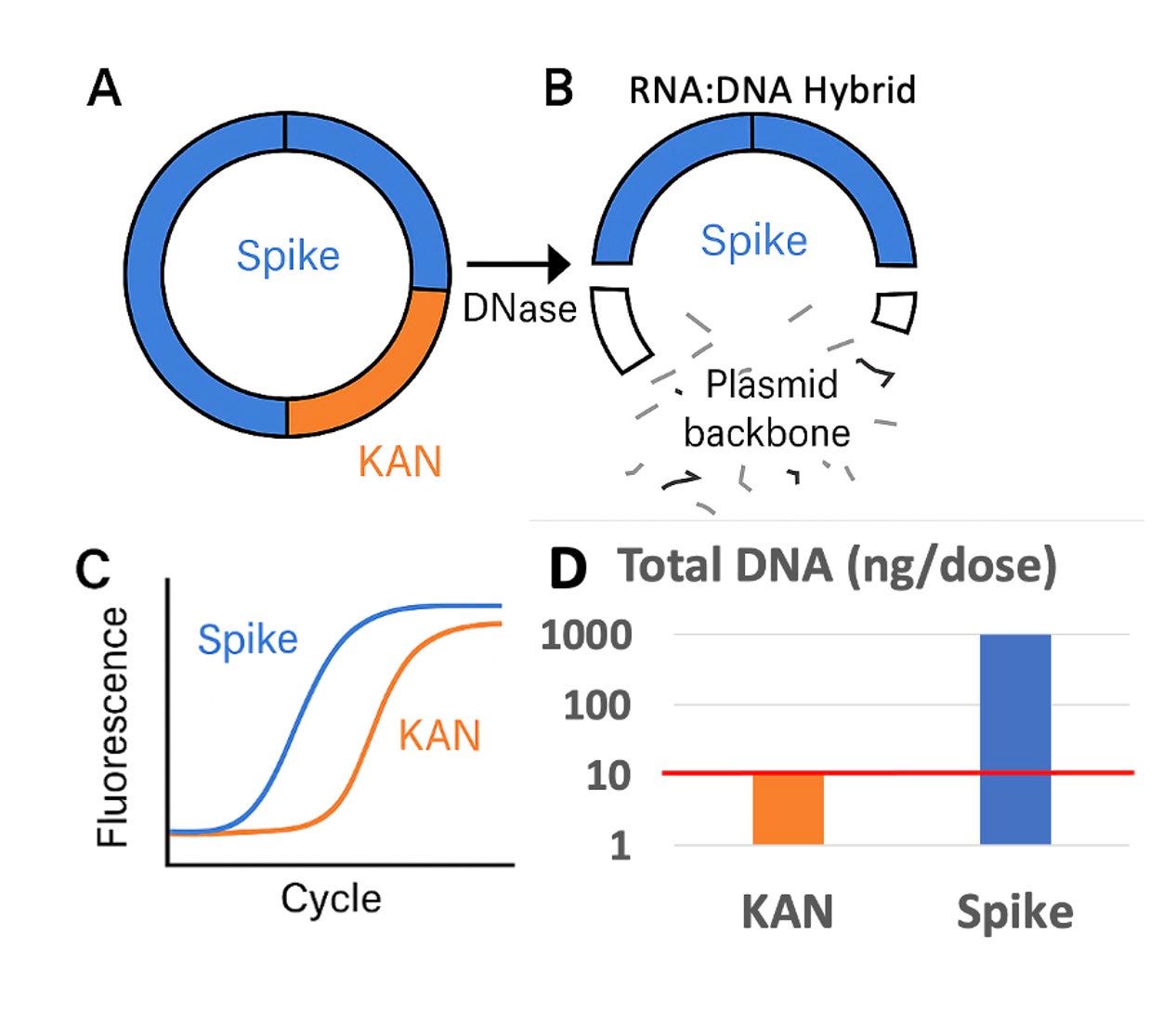
The schematic you’ve probably seen floating around (Spike and KAN on a circular map, curves, and a bar chart) is basically a cartoon of the whole story:
Panel A: The original plasmid with Spike (blue) and Kan (orange).
Panel B: DNase digestion “cleans up” the plasmid — but spike DNA in RNA:DNA hybrids (blue) remains, while a lot of backbone (including Kan) is sliced away.
Panel C: qPCR curves — Spike (blue) amplifies much earlier than Kan (orange). Earlier = more DNA.
Panel D: Bar chart — total DNA measured by Spike is huge; DNA measured by Kan is much smaller. Regulators are basing safety limits on the orange bar.
If you only look at the orange bar, the product looks fine.
If you look at the blue bar, it’s a different world.
8. The bigger issue: cost, time, and what this says about oversight
Maybe the most damning part of this whole story isn’t the technique; it’s the price tag.
This wasn’t a billion-dollar moonshot. It was:
A couple of scientists.
Off-the-shelf equipment that many molecular labs already own.
Two days of work.
In that short time, they:
Re-confirmed that there is substantial DNA in multiple lots of Pfizer and Moderna vials.
Showed lot-to-lot variation in how much DNA is present.
Demonstrated that DNA:RNA hybrids explain why the cleanup step and the official assay under-report contamination.
Replicated and extended the earlier findings that were waved away as “misinformation” when independent labs first raised this issue.
If this can be done in 48 hours by volunteers on a shoestring, what excuse do the manufacturers and regulators have for not doing it properly — or for not telling the public?
9. Where this goes from here
There are three separate questions that now demand honest answers:
Scientific:
Exactly how much plasmid DNA — including spike and SV40 sequences — is present across lots and manufacturers, and what are the realistic risk models for integration, chronic inflammation, and oncogenesis?Regulatory:
Who decided to rely on a single Kan-only qPCR assay for residual DNA, when:spike assays existed,
SV40 sequences were present,
and DNA:RNA hybrids are a well-known phenomenon that DNase I won’t fully clean?
Ethical/Political:
At what point does “we chose the test that gave the lowest number” stop being a judgment call and start looking like fraud?
Because here’s the uncomfortable truth:
A small group of outsiders, using tools every serious genomics lab already has, just showed that the official numbers are off by orders of magnitude — and that the underlying mechanism for how the DNA got there is both knowable and fixable.
They did the work that should have been done before the first vial ever left the factory.
MORE DETAILS HERE:

An irreversible horrific real world nightmare may be playing out globally as we speak. Those who were astute enough to reject COVID injection may have saved not only their well-being but perhaps even that of their future generations if the garbage DNA contaminating COVID injections is integrating in germinal cells.
Remember this is all for a disease which posed no meaningful risk of mortality for the vast majority (zero for healthy children) as was perfectly evident from infection fatality rate data available by mid 2020. Anyone with a reasonable grasp of grade school math could have sorted it out. Doing a little homework, while ignoring imbecilic politicians and their lapdog corporate media, can literally save your life amid the political lunacy afflicting our society.
My inner conscience and moral center wants to believe that all the corners were cut for profit and for the long-term financial benefits that the pharmaceutical corporations seek to gain with the emergence of mRNA-based technology as a new revenue stream. And that it's their blind greed for MORE that motivates them to ignore the terrible side effects and to use their regulatory capture to go against science and the quantifiable truth that should be the foundation of it. However, the more I read articles like this, the harder it becomes to deny that there may be far deeper and darker motives behind it all.