

Normally you cannot prove a redaction was abusive.
You see a black box. The agency cites an exemption code. That’s the end of it. You can suspect, you can complain, and you have no way to check.
Not this time. In four cases we now have both versions of the same page — the redacted release, and the same document later produced through litigation, a court case, or a congressional in-camera review. You can lay them side by side and read what the black box was covering.
In every single case, the withheld material is not an internal proposal, not a negotiating position, not a private phone number.
It is a scientist saying where he thought the virus came from. The redaction reason is obvious — CYA.
What the exemptions are actually for
Three FOIA exemptions matter here.
(b)(5) — deliberative process. Protects the internal back-and-forth of government before a decision is made, so officials can argue freely.
(b)(4) — trade secrets. Protects confidential commercial and financial information.
(b)(6) — personal privacy. Email addresses, phone numbers, personal details.
This is mostly about (b)(5) and (b)(4).
Case one: the pleasantry survived
On February 1 and 2, 2020, Anthony Fauci, NIH Director Francis Collins, NIH’s Lawrence Tabak and Jeremy Farrar of the Wellcome Trust ran an urgent email thread with the world’s leading virologists about whether SARS-CoV-2 had come out of a laboratory. Subject line: “Teleconference.”
The 2021 FOIA release contains that thread. It is redacted 21 separate times under (b)(5) — deliberative process. That one thread accounts for 5% of every (b)(5) redaction across the entire 3,234-page release.
The unredacted version came out later through litigation. Start with a single email, because it is the whole story in one paragraph.
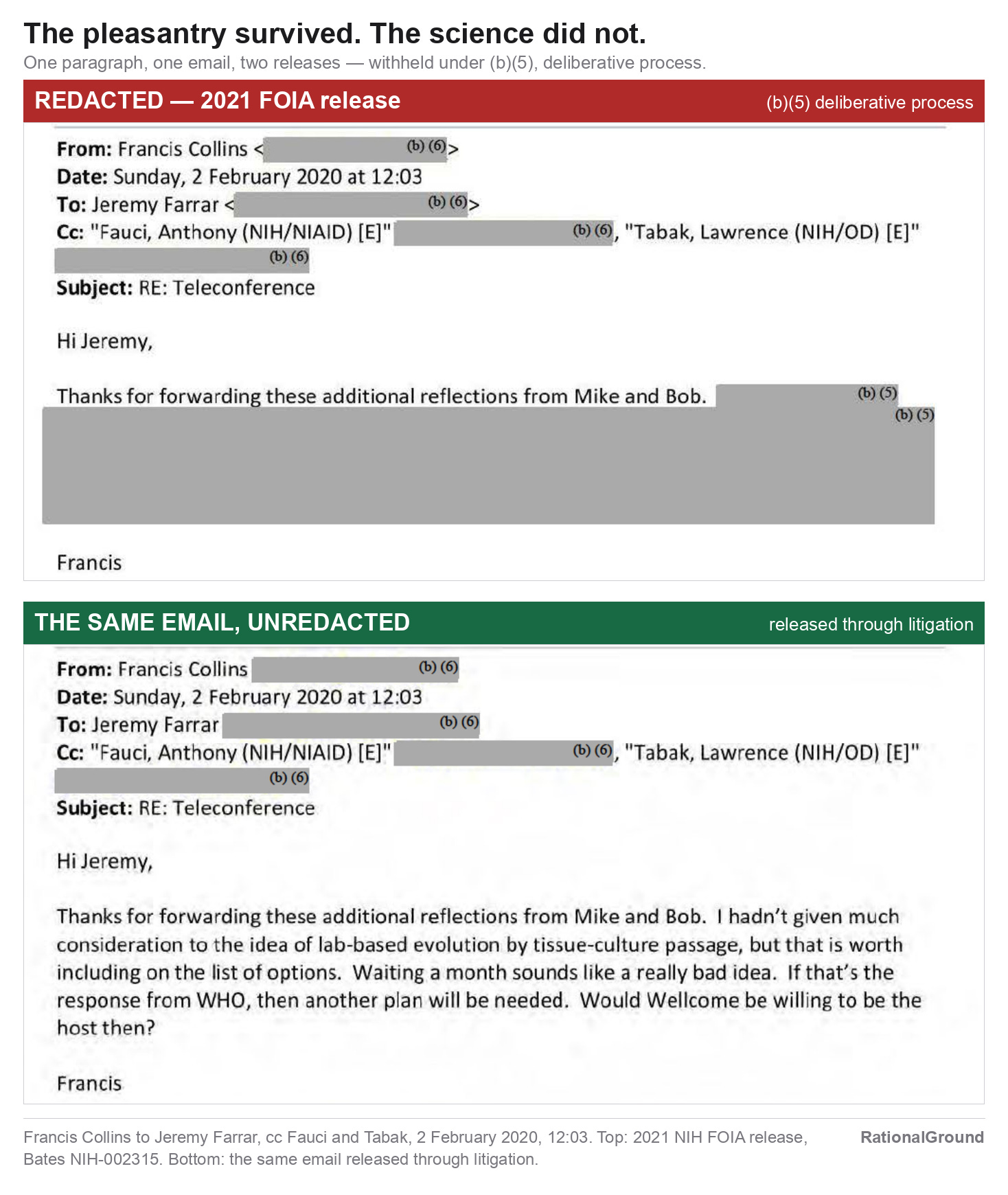
Collins writes to Farrar at 12:03 on February 2. The released version gives you the courtesy line — thanks for forwarding these reflections from Mike and Bob — and then a black box.
What the black box covered, in the very same paragraph:
“I hadn’t given much consideration to the idea of lab-based evolution by tissue-culture passage, but that is worth including on the list of options. Waiting a month sounds like a really bad idea.”
The Director of the National Institutes of Health, saying laboratory evolution belongs on the list of options. Withheld as a deliberative process. The thank-you was released.
It happens again in the same thread. In an email that morning, Collins’s flight schedule was released — “available any time today except 3:15 – 5:45 pm EST (on a plane).” The sentence above it was not:
“Though the arguments from Ron Fouchier and Christian Drosten are presented with more forcefulness than necessary, I am coming around to the view that a natural origin is more likely. But I share your view that a swift convening of experts in a confidence-inspiring framework… is needed, or the voices of conspiracy will quickly dominate.”
His plane time was public. His assessment of the origin of the pandemic was a state secret. Why? CYA.
What else was under the boxes
The same thread, same exemption:
Jeremy Farrar, head of the Wellcome Trust, putting a number on it:
“On a spectrum if 0 is nature and 100 is release — I am honestly at 50!”
Andrew Rambaut, the evolutionary biologist:
“From a (natural) evolutionary point of view the only thing here that strikes me as unusual is the furin cleavage site. It strongly suggests to me that we are missing something important in the origin of this virus.”
Michael Farzan, who discovered the SARS receptor, on how it might have happened accidentally — passaging SARS-like coronaviruses on human cell lines under BSL-2 conditions — and his own odds:
“I am 70:30 or 60:40.”
Robert Garry, who two months later would co-author Proximal Origin, the paper that publicly declared a lab origin implausible:
“I really can’t think of a plausible natural scenario where you get from the bat virus or one very similar to it to nCoV where you insert exactly 4 amino acids, 12 nucleotides, that all have to be added at the exact same time to gain this function… Of course in the lab it would be easy to generate the perfect 12 base insert that you wanted.”
And Ron Fouchier, arguing for shutting the discussion down — with a reason that is worth reading twice, because it isn’t a scientific one:
“further debate about such accusations would unnecessarily distract top researchers from their active duties and do unnecessary harm to science in general and science in China in particular.”
Incredible they thought they could hide this under redactions.
The tell
Here is what did survive the redactions across the whole thread. Every substantive released sentence:
“Do you have a minute for a quick call?” — “they need to decide today in my view.” — “Sorry that I took so long to weigh in.” — “Really appreciate us thinking through the options.” — “See thoughts overnight from others.” — “I’m available any time today except 3:15 – 5:45 pm EST (on a plane).” — “This is a very complex issue.” — “I suggest we don’t get into a further scientific discussion here, but wait for that group to be established.”
Scheduling. Pleasantries. Throat-clearing.
Not one scientific judgment survived.
A reviewer working carelessly produces a mess — some science through, some logistics blacked out. What’s here is the opposite of a mess. It is clean, and it is consistent, and it sorted the material by exactly one criterion.
The small absurdity that makes the point better than any argument:
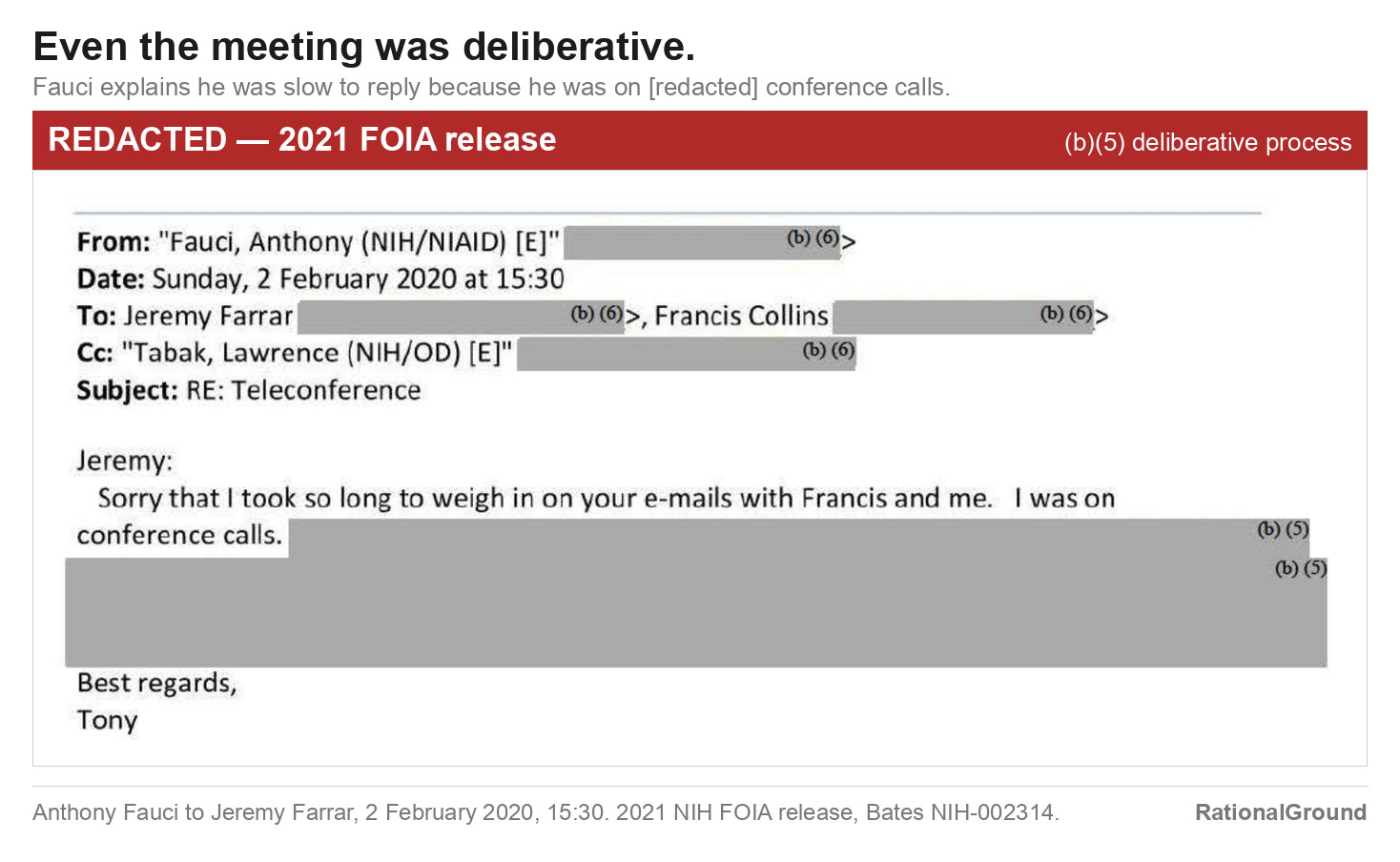
Fauci explains that he was slow to reply because he’d been on conference calls. The kind of meeting he had been sitting in was withheld as deliberative process.
Case two: fourteen words of “trade secret”
Two days later, the same men were still at it. This one wasn’t withheld under deliberative process. It was withheld under (b)(4) — trade secrets and confidential commercial information.
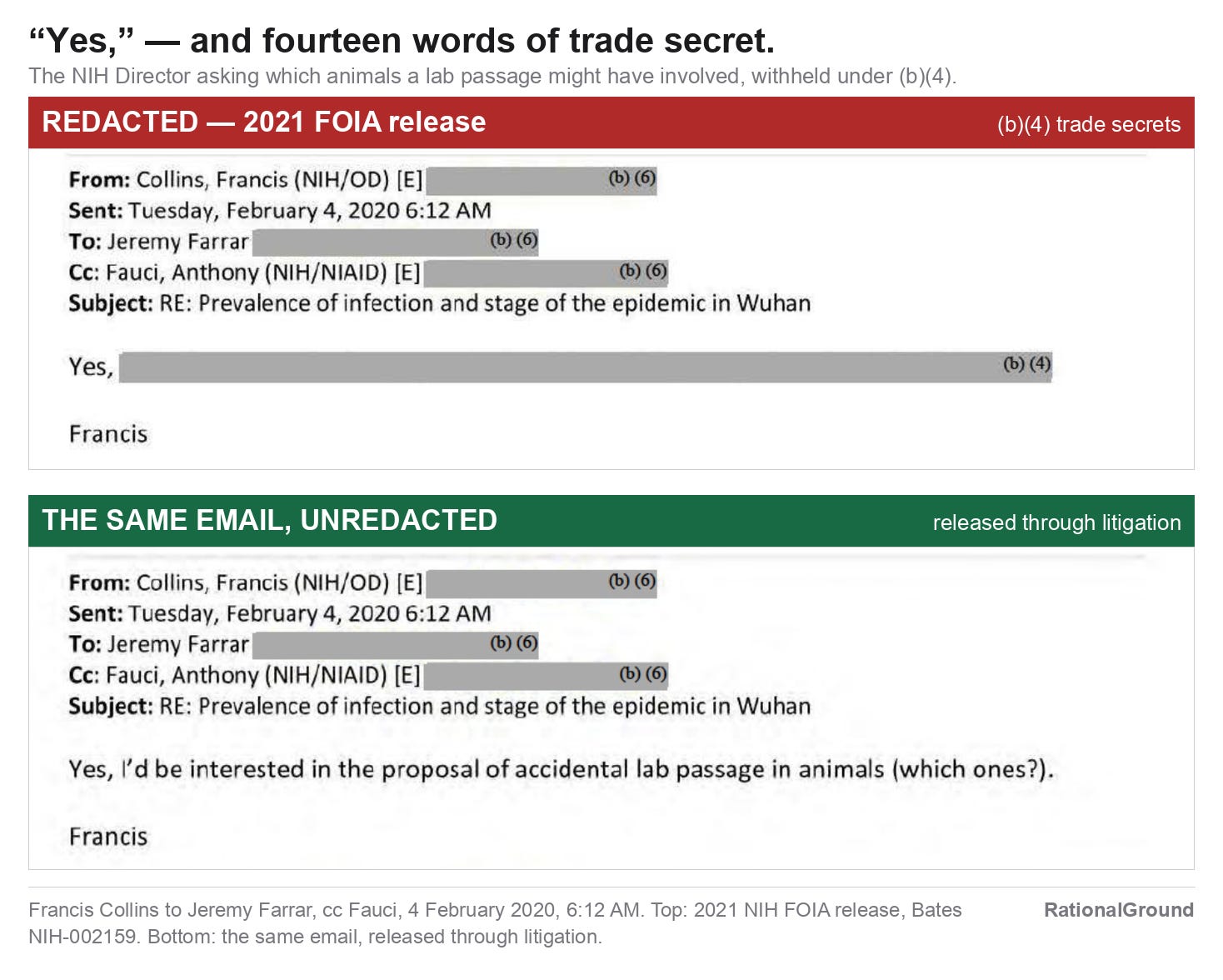
The released version is one word and a black bar. “Yes,”
The full sentence:
“Yes, I’d be interested in the proposal of accidental lab passage in animals (which ones?).”
Fourteen words. There is no product in that sentence. No contractor, no pricing, no formula, no commercial party of any kind. It is the Director of the NIH asking which animals a laboratory accident might have involved.
It was withheld under the exemption for trade secrets.
The message he was replying to was blacked out too — Farrar writing that “’Engineered’ probably not. Remains very real possib[ility] of accidental lab passage in animals,” noting Eddie Holmes was “60:40 lab side,” and adding: “I remain 50:50.”
Case three: the report that was blacked out whole
In October 2017 — two years before the pandemic — a NIAID official named Dr. Ping Chen filed a report on biosafety at the Wuhan Institute of Virology. It contained lines like this one:
“It is clear to me by talking to the technician that certainly there is a need for training support.”
When HHS released Chen’s report under FOIA, it redacted the entire document. Every word, citing privacy and deliberative process.
Senator Ron Johnson’s staff were eventually permitted to read the unredacted version in camera — in a room at HHS headquarters, no copies allowed. They transcribed it by hand and published both versions side by side in September 2023.
Johnson’s conclusion:
“In the public FOIA document, HHS redacted Dr. Chen’s entire report claiming that it contains privacy and deliberative information. Following my staff’s in camera review of the report, it seems apparent that the only reason that HHS redacted this information was to hide the report’s contents from the American people.“
Two details sharpen it. Chen had been named specifically in a June 2021 records request from five senators — HHS knew precisely what was being asked for. And it was still withholding her report two years after that.
Case four: the vocabulary that vanished
This one needs no side-by-side comparison. It’s a word count.
Across all 3,234 pages of the 2021 release, against the 208 pages of the later litigation release:
Term 2021 release (3,234 pp) Litigation release (208 pp) furin 0 38 passage / passaging 0 37 glycan 1 34 outbred 0 5 inbred 0 4
Zero. In three thousand pages.
The obvious objection is that these scientists must simply have been outside the scope of the request. They were not. They are all over the 2021 release: Fouchier appears 8 times, Garry 7, Rambaut 9, Marion Koopmans 12, Patrick Vallance 12, Farrar 82, Kristian Andersen 18.
The people are there. Their science is not.
The single surviving “glycans” is worth quoting for what surrounds it — Farrar to Fauci and Collins, February 5, 2020, on the WHO group that would investigate the origins:
“They have asked for names to sit on that Group - please do send any names… With names to be put forward into the Group from us and pressure on this group from your and our teams next week… they will add further comments on the glycans.”
The body that would investigate the origin question was being staffed from this circle, and the paper that would publicly settle it was being drafted — in the same email.
Case five: the number that ends the legal argument
The 2021 release invokes deliberative process 139 times and trade secrets 121 times.
NIH FOIA case 57534 — 7,386 pages of the same official’s email, released in 2026 — invokes deliberative process zero times.
Same official. Same kind of records. Twice the page count.
One release treated his internal correspondence as legally protected. The other withheld not a single line on those grounds.
The exemption was never a legal necessity. It was a choice, and a different administration made the opposite one.
What this proves, and what it doesn’t
We’re going to be careful here, because the case is strong enough that overstating it would be the only way to lose.
Documented and checkable by anyone: the (b)(5) redactions in the February 2020 thread covered scientific opinion while leaving scheduling intact. The trade-secrets exemption was applied to a sentence containing no commercial information. HHS blacked out Chen’s report in full. The word counts are the word counts. FOIA 57534 uses no (b)(5) at all.
Inference, and we’ll label it: that this reflects intent rather than an overzealous reviewer. It is a strong inference — line-by-line consistency across 21 redactions in one thread is difficult to produce by accident — but it is an inference. Senator Johnson states it as his conclusion. We’re comfortable quoting him.
What it does not prove: that COVID came from a lab. Nothing above establishes that. What it establishes is narrower and, frankly, worse: serious scientists privately considered a laboratory origin plausible in February 2020, and the American public was not permitted to watch them do it.
The exemption for deliberative process exists so that officials can think out loud without fear. It was used here to make sure nobody found out that they had.
Not a national security interest. Not a commercial secret. Not privacy.
Cover for the people who would have to answer questions.
Sources: the 2021 NIH FOIA release of Anthony Fauci’s email (3,234 pp), the later litigation release of the same February 2020 correspondence (208 pp), Senator Ron Johnson’s September 2023 publication of Dr. Ping Chen’s 2017 report alongside the redacted version, and NIH FOIA case 57534 (7,386 pp, released August 2026). Comparison images show the same email from two releases; the grey bars remaining in the unredacted versions are ordinary (b)(6) privacy redactions applied in both. Nothing here was unmasked or reverse-engineered — the unredacted pages come from later official releases. Every quotation is citable to a Bates-numbered page.
These people who hid so much to protect Big Harma deserve our eternal condemnation and then damnation in the flames for their vile and despicable acts towards hundreds of millions, which led to billions of their fellow humans, all because they loved money more than God and had zero fear of the Lord. They shall pay forever with severe interest. Horrible human beings.