

Senator Rand Paul’s office released twenty-six pages this morning: Anthony Fauci’s private diary and the NIAID email traffic around it, covering about two weeks in March 2016.
The subject is an experiment almost nobody outside biodefense has heard of. In 2015, at the Army’s lab at Fort Detrick, researchers took an Ebola vaccine, vaccinated monkeys with it, and then exposed them to Ebola virus rendered into a fine aerosol — engineered to reach deep into the lungs, which is not remotely how Ebola spreads in nature. The animals died anyway. And the lungs of the vaccinated animals looked worse than the unvaccinated controls: necrosis, inflammation, fibrin.
NIAID helped design that study. NIAID paid for it. Fauci found out from a White House briefing.
The documents are worth reading carefully, and I am going to be careful with them — because the most interesting thing in this release is not the line everyone is quoting.
“Stupid experiment”
Start with what Fauci actually wrote, in full, because the full sentence matters:
“What idiots those guys at USAMRIID are. This should have been a classified experiment that never should have been done in the first place.”
Then, two days later, where he has more room:
“The DOD has never considered such experiments to be classified. That is a big mistake.… In fact, they have previously published these experiments, again, which I think was a mistake, since I believe that they should have been classified since they could indicate a vulnerability.… Again, I believe all of this is important for bio defense, but has little to do with naturally emerging Ebola outbreaks.”
Read that again. He is not shutting the program down. He calls the work important for bio defense. He objects to the experiment being unclassified — including the ones already published, years earlier. And his stated reason is not that live-Ebola aerosol work is dangerous to run. It is that the results “could indicate a vulnerability.”
That is a national-security framing applied to a vaccine safety finding. And it is the framing that drove what he did next.
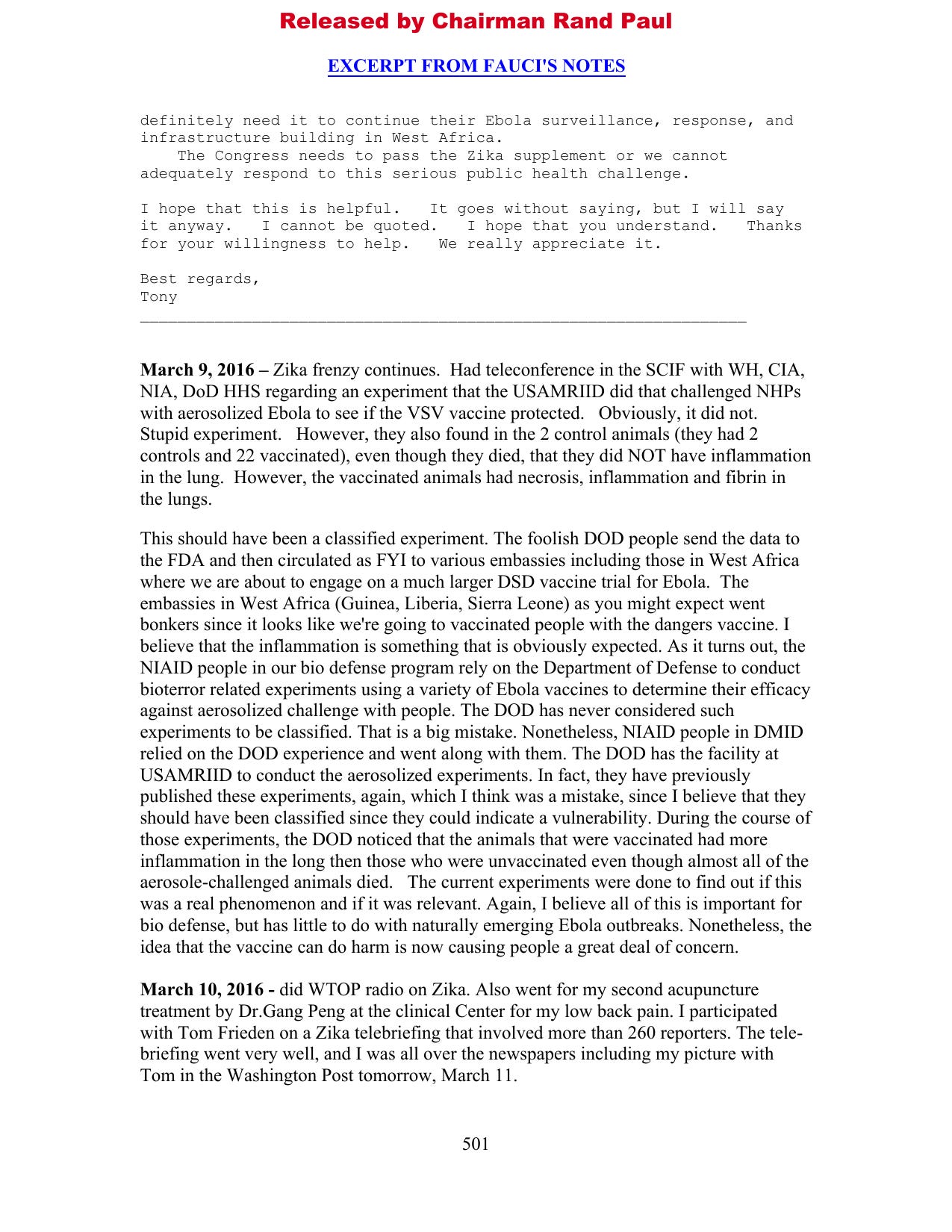
Fauci’s diary, March 9, 2016. Released by Chairman Rand Paul.
What He Actually Did
Two days later, writing to his deputy Cliff Lane, Fauci describes the National Security Council meeting:
“The DoD folks said that they wanted to publish the data. I said that I thought that it should be classified and the NSC people blew them out of the water and said that they agreed with me.“
That is the director of NIAID, in his own words, describing going to the NSC and successfully arguing to keep a federally funded study’s results from publication. Not “we discussed it.” Blew them out of the water.
And in the same thread, the detail that makes it worse:
“When the DoD people presented the data and the NSC White House people asked them who funded the study, they said that they did together with NIAID!!!! No one followed up on that, but I almost fell off my chair.”
Four exclamation points. The head of NIAID learned that NIAID had co-funded a live-Ebola aerosol experiment by hearing it said out loud in a White House briefing.
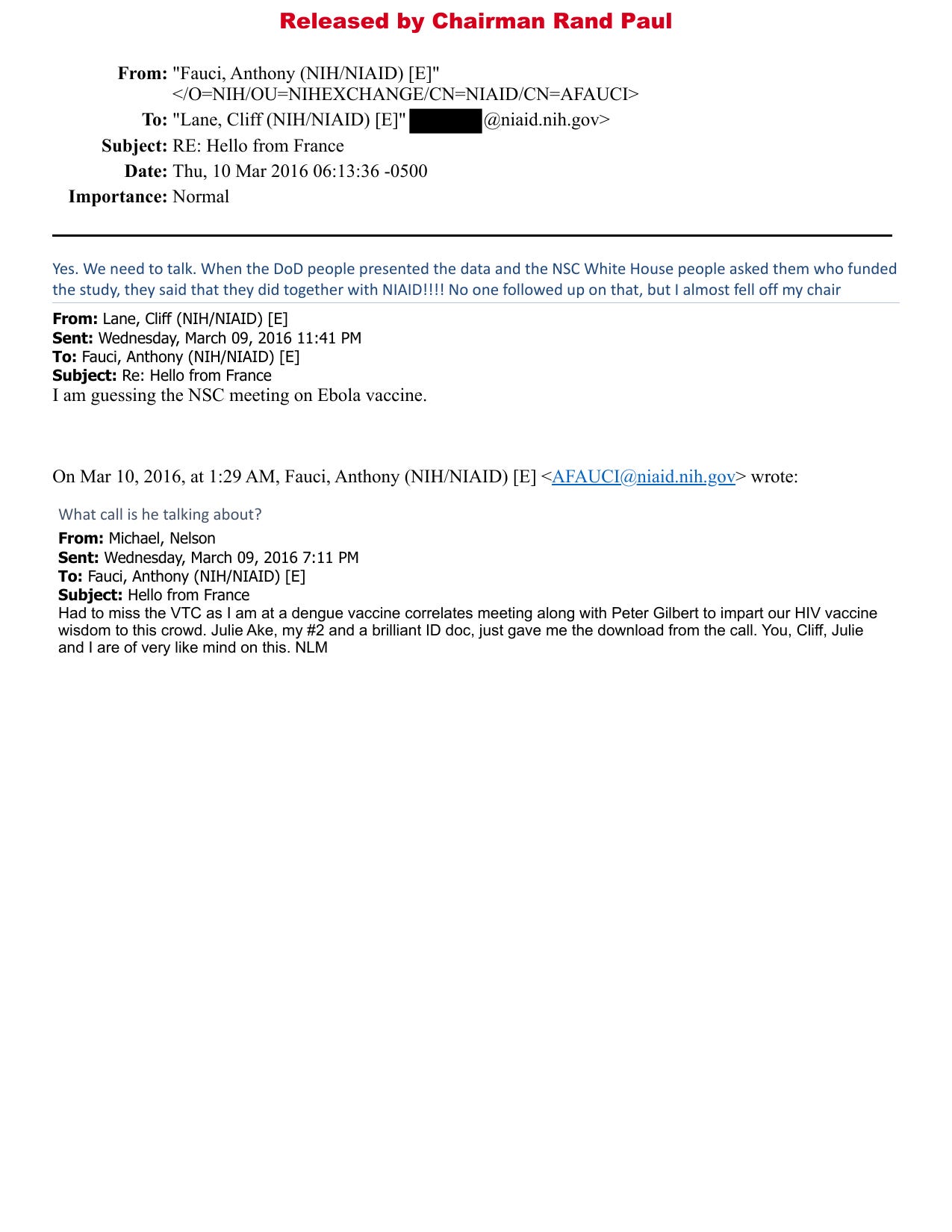
Fauci to Cliff Lane, March 10, 2016.
Was he right that he didn’t know? The internal review he ordered answers it directly. Question two of five: Did any NIAID money at all go into the performance of the aerosolized challenge studies?
“NIAID OD should confirm, but the DOD Medical Research and Materiel Command Interagency Agreement (MRMC IAA) workplan from 2013 suggests that NIAID funded the aerosol studies. For the 2015 aerosol study, NIAID provided funds.“
And on design: “The study design was crafted with input from NIAID and MCS-JVAP, and was conducted at USAMRIID.”
Funded it. Helped design it. Didn’t know.
The Best Line in the Release Isn’t Fauci’s
Here is the part I did not expect, and the reason this release is more interesting than the headline.
Fauci’s own Director of BioDefense, Michael Kurilla, took the classification argument apart in writing — to Fauci, days after the NSC meeting:
“The more I ponder this issue, the more I have come to the conclusion this has nothing to do with ‘revealing’ a vulnerability.
In the 1st case, we are not deploying a vaccine because there is no licensed vaccine, so what exactly is vulnerable? If we kept this finding a secret would DOD seriously consider deploying a vaccine that doesn’t perform as intended?”
That is the whole thing in two sentences, from inside the building. You cannot reveal a vulnerability in a defense you have not deployed. There was no licensed Ebola vaccine. The only thing secrecy protects is the reputation of the program.
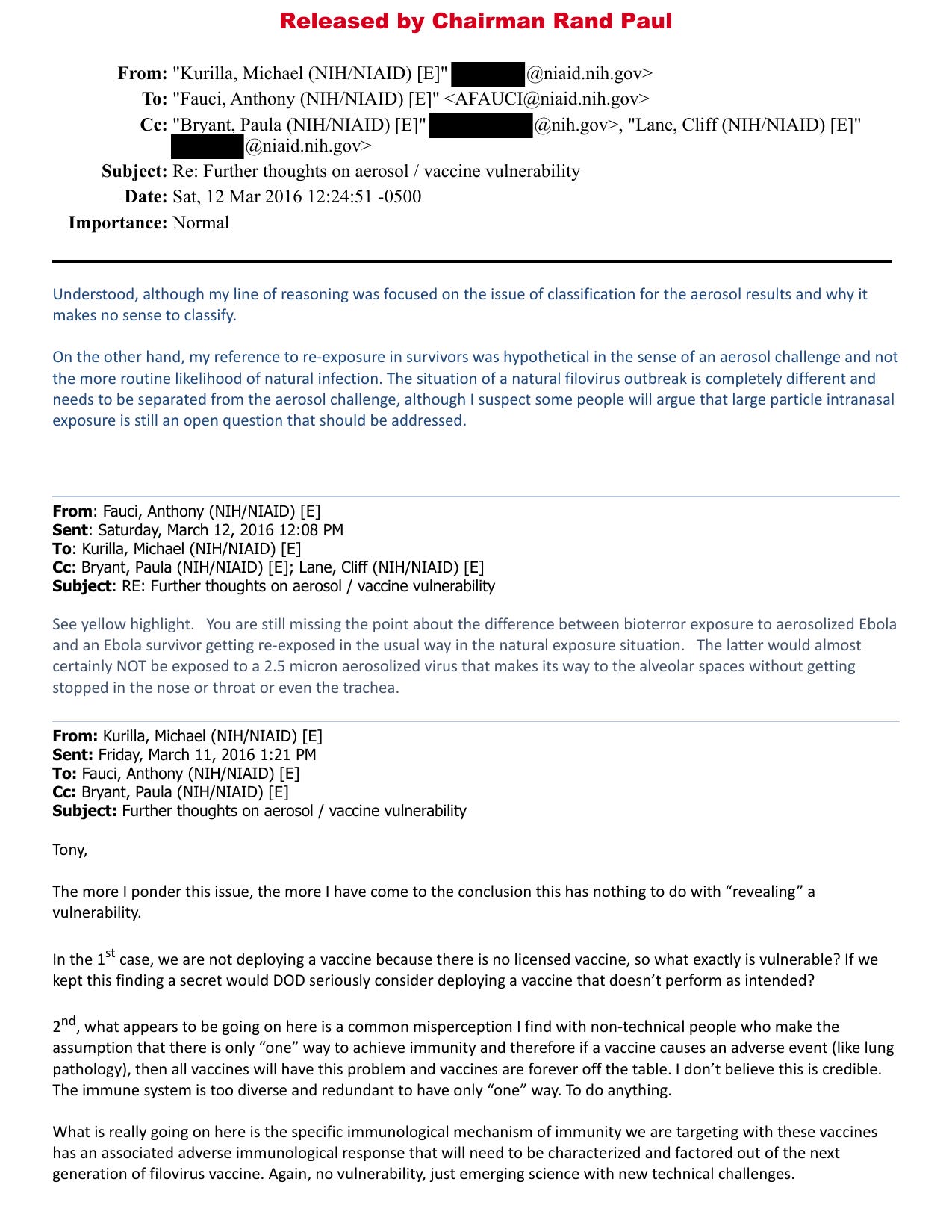
Michael Kurilla to Fauci, March 11, 2016.
Fauci pushed back on the science — and to be fair to him, his scientific point was legitimate. He argued that a 2.5-micron engineered aerosol reaching the alveolar spaces tells you almost nothing about a survivor re-exposed naturally, who “would almost certainly NOT be exposed to a 2.5 micron aerosolized virus that makes its way to the alveolar spaces without getting stopped in the nose or throat or even the trachea.” That is a real distinction and it is correct.
But it is an argument about what the data mean. It is not an argument for classifying them.
Twelve Days
By March 22, Kurilla wrote to Fauci and Lane:
“The short answer is that I don’t have a problem with aerosol exposure data being shared publically. The classification issue appears to be a red herring at least from multiple, albeit second-hand sources within DOD. In addition, some aerosol data has already been published.”
Twelve days from “it should be classified and the NSC agreed with me” to “the classification issue appears to be a red herring.” The justification did not survive three weeks inside Fauci’s own agency.
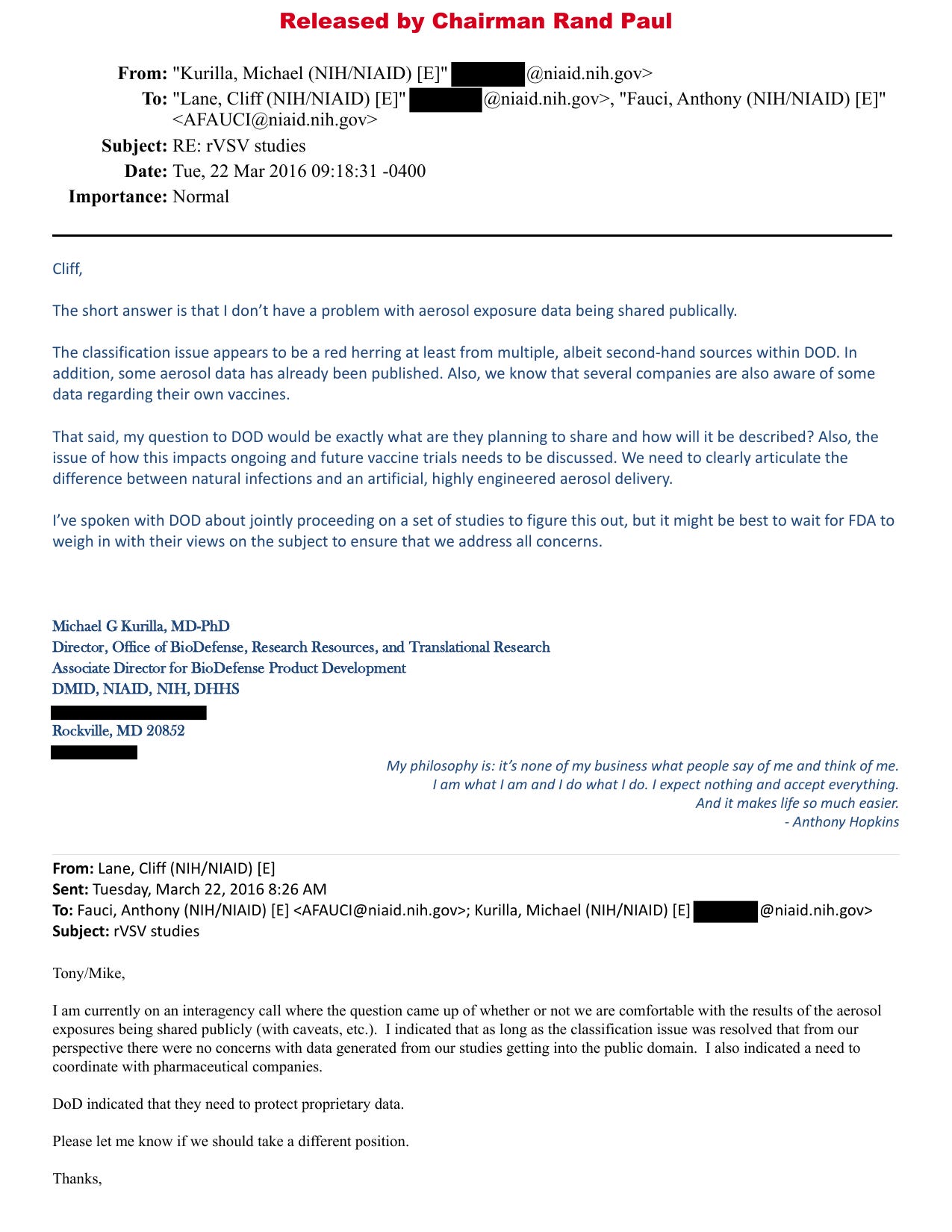
Kurilla to Lane and Fauci, March 22, 2016.
And the review Fauci commissioned reached the same place. Its answer to question five — did anyone not realize these would likely be classified? — is flat:
“At no time during any of these discussions detailed above was the issue of classification of sensitive material raised. All discussions were conducted outside of secure facilities and no required security clearance were ever requested by DOD or passed to security personnel. All current and historical aerosol data had been previously shared with vaccine manufacturers and in some cases had been published.”
Nobody thought it was classified. It had already been published. It had already been handed to the manufacturers.
The Dual-Use Fight, Told Straight
There is a version of this story where Fauci’s scientists rise up and demand oversight. That is not what the documents show, and I would rather tell you what they actually say.
Cliff Lane raised it, and raised it carefully:
“I would not move forward on any experiments in this area until a bit of dust settles (if it does). One might consider this dual use research. Please do not get into discussions outside the two of you until we have a chance to talk.”
“Dual use research of concern” — DURC — is the category that triggers extra federal oversight for experiments that could be misused. But NIAID’s own filovirus veteran, Peter Jahrling, pushed back hard against that label:
“if this is dual use research then the entire DTRA portfolio which calls for aerosol challenge against MCM for BioDefense pathogens is dual use. If the bioterrorist threat involves an aerosol attack I don’t see how anyone could criticize us for asking the question. As an aside, I have serious concerns about the RIID experiment and its interpretation.“
And four days later, blunter:
“I will keep the rest off Email, but if aerosol challenge studies are considered DURC then the entire MCM development paradigm is gutted.“
That is not a scientist asking for review. That is a scientist warning that review would end his field — and then saying he will take the rest of the conversation off email.
Which is, in its own way, the more revealing document. The oversight category existed. Two senior people looked straight at it, and the institutional reflex was to argue their way out of it.
What the Monkey Data Does and Doesn’t Show
I want to be honest about the science, because the loudest version of this story is going to overstate it.
The finding that vaccinated animals had worse lung pathology is real and it is in the record. But NIAID’s own filovirus expert thought the underlying study was too weak to carry the weight being put on it. Jahrling again:
“Clearly someone needs to attempt to repeat the USAMRIID study using all the appropriate controls which are sorely lacking from the piecemeal composite picture which is being drawn.”
Kurilla’s review adds the other half: these same vaccine candidates, challenged by the ordinary intramuscular route, “have displayed clear, unambiguous protection without evidence of lung pathology.”
So: an artificial exposure route, a study its own funders called uninterpretable in composite, and a result that does not appear when the virus is delivered the way it actually spreads. This is not evidence that the Ebola vaccine used in West Africa was harming people. Anyone telling you it is has skipped the file.
Be careful with the animal counts, too. Fauci’s March 7 entry says “2 control animals died and 16 of 20 vaccinated animals died.” His March 9 entry says “2 controls and 22 vaccinated.” The internal review describes the 2015 study as four vaccines in groups of four. Those are three different numbers, and the diary is a man writing quickly at night, not a data table.
So What Is the Story?
Not “the vaccine was dangerous.” The documents don’t support that, and the people who ran the program said so at the time.
The story is the reflex.
A study surfaced an uncomfortable safety signal. The head of the agency that helped pay for it did not learn about it through his own chain of command — he heard it at the White House. His first move was not to order the study repeated with proper controls, which is what his own virologist wanted. It was to go to the National Security Council and get publication stopped, on a rationale his own biodefense director demolished in writing within two weeks.
And when the category designed for exactly this situation came up — dual-use research, extra oversight, outside eyes — the institutional response was to explain why it couldn’t possibly apply, and to move the conversation off email.
That is why Paul is pointing at his Risky Research Review Act, which would put an independent board in front of experiments like this instead of an internal review commissioned after the fact. You can argue about the bill’s drafting. It is harder to argue with the sequence of documents released today, in which every safeguard that was supposed to operate here operated only because one person happened to write an honest email.
The classification push failed, in the end. Not because a law stopped it. Because Michael Kurilla sat down and wrote the words “what exactly is vulnerable?”
That is a thin thing to rely on.
Source: “Chairman Paul Releases Documents on NIAID-Funded Risky Ebola Research Experiments,” Senate Homeland Security and Governmental Affairs Committee, September 28, 2026 — 26 pp., Fauci diary excerpts, NIAID email chain, and the internal NIAID review. Available at paul.senate.gov. All quotations above are verbatim from that release.
Why do we give money to these people who play God?
Fraudchee needs a hanging…nothing less..his coharts too