

We spend most of our time here on documents — emails, depositions, subpoenaed records, black boxes. This week the argument moved somewhere else.
It moved into the peer-reviewed literature.
Three papers, four years, one Springer journal. Together they say something that until recently you could not say in public without being throttled for it: that the science underneath the COVID vaccination program was not rigorous, and that the machinery built to catch exactly that kind of failure did not catch it.
Start with the dose
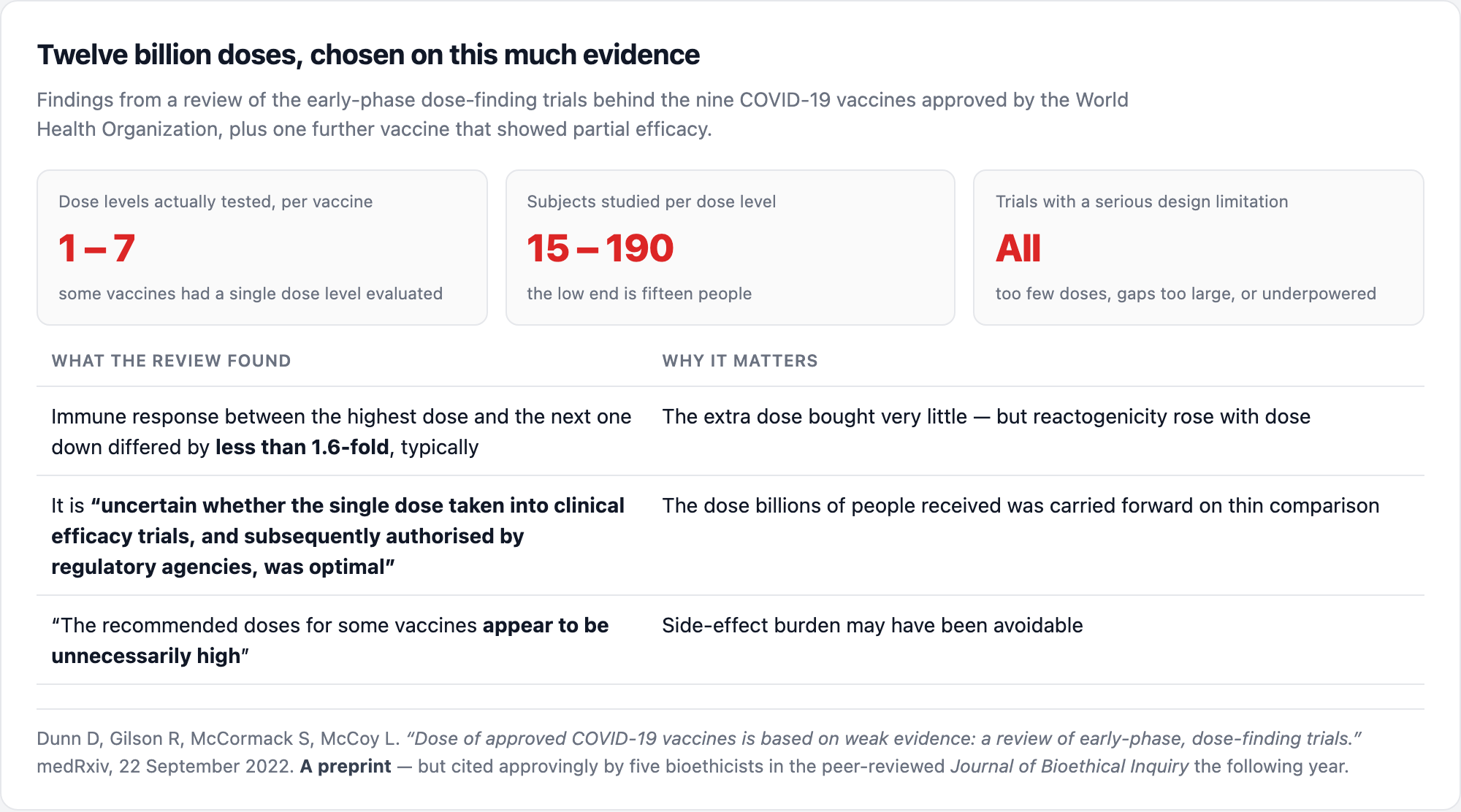
In September 2022, four researchers — David Dunn, Richard Gilson, Sheena McCormack and Laura McCoy — did something obvious that nobody had done. They went back and read the early-phase dose-finding trials for the nine COVID-19 vaccines approved by the World Health Organization, plus one more that showed partial efficacy.
Dose-finding is the unglamorous part of drug development. Before you run the big efficacy trial, you test several dose levels in small groups to work out which one gives you the best balance of immune response and side effects. Then you carry that dose forward, and eventually a regulator authorises it, and eventually people get it in their arms.
Here is what the review found.
The number of dose levels actually evaluated ranged from one to seven depending on the vaccine. The number of subjects per dose level ranged from 15 to 190. At the low end, that is fifteen people.
Higher doses did tend to produce better immune responses — but the difference between the top dose and the one below it was typically less than 1.6-fold on both binding antibody concentration and neutralising antibody titre. Meanwhile reactogenicity — the fevers, the aches, the lost day — rose with dose, as it always does.
And the finding that should have been a scandal on the day it published:
All of the trials had at least one important design limitation: few doses evaluated, large gaps between adjacent doses, or an inadequate sample size.
All of them.
Their conclusion, in careful academic register:
it is “uncertain whether the single dose taken into clinical efficacy trials, and subsequently authorised by regulatory agencies, was optimal.”
And more pointedly: “the recommended doses for some vaccines appear to be unnecessarily high.“
Over twelve billion doses have been administered worldwide. The amount in each of them was selected by comparing, in some cases, a single tested level — sometimes in groups of fifteen — with gaps between dose levels too wide to distinguish between them.
It means nobody established that it was right, and the people who eventually checked found the evidence base underneath one of the largest medical interventions in human history was thin enough to fit in a paragraph.
One honest note, which we’d rather make ourselves: the Dunn review is a preprint. It has not been through peer review.
Then the bioethicists picked it up
In December 2023, the Journal of Bioethical Inquiry published a paper by five academics who are about as far from the fringe as this subject gets: Wendy Lipworth and Ian Kerridge at Macquarie, Cameron Stewart at Sydney Law School, Diego Silva at Sydney Health Ethics, and Ross Upshur at the University of Toronto’s Dalla Lana School of Public Health.
Their subject was what happens to science when you speed it up. Their conclusion was that the rush to produce and apply pandemic research “created opportunities for unscrupulous actors” and — the phrase to remember —
“compromised the methodological, peer review, and advisory processes that would usually identify sub-standard research and prevent compromised clinical or policy-level decisions.”
To wit: the systems that exist to catch bad science before it reaches your arm were themselves degraded by the emergency. Compromised. Bypassed.
They give examples. The modelling studies used as the basis for policy on isolation, vaccination and treatment “were biased and used poor controls, inappropriate inclusion and exclusion criteria, and poor statistical analysis.” Studies of the antiviral molnupiravir overstated the benefit.
And on vaccines specifically, this:
“some early phase studies to determine vaccine doses were heterogeneous and underpowered”
The citation on that sentence is Dunn et al.
So the preprint we flagged thirty seconds ago is carried into the peer-reviewed literature by five senior bioethicists who evidently read it and agreed with it. That is how a preprint is supposed to earn its keep, and it is worth more than a citation count.
We’re going to be careful here, because the distinction matters and someone will check. Lipworth and colleagues did not publish a general verdict that COVID vaccine science was poor and biased. Their “biased and poor controls” language is about the modelling behind policy. Their vaccine-specific claim is narrower and sharper: the dose-finding was underpowered. Anyone quoting them as having condemned vaccine science wholesale is overreaching, and we’re not going to do it.
What happened in between
Between the 2023 paper and this week, we published a fair amount of what those compromised advisory processes looked like from the inside.
A CDC that drafted a national Health Alert Network advisory about myocarditis in teenage boys in May 2021, and never sent it — downgraded to a webpage after the FDA objected, with the line telling doctors to keep those kids off the field deleted along the way.
Three officials privately agreeing in January 2021 that fever after the second dose “theoretically could be associated with miscarriage in the 1st trimester” — while the CDC was sending Facebook and Twitter decks with “infertility” on the misinformation list, and following up to check the posts had come down.
A 2021 FOIA release in which the deliberative-process exemption blacked out every scientific judgment in the February 2020 origins thread and released the flight schedules.
And this month, an mRNA flu vaccine approved for the population that supplies three-quarters of flu deaths on antibody levels rather than efficacy, against a comparator the FDA itself conceded in writing “is not the preferred standard of care in this age stratum.”
Lipworth et al. described a mechanism. We have been documenting it running.
And then yesterday
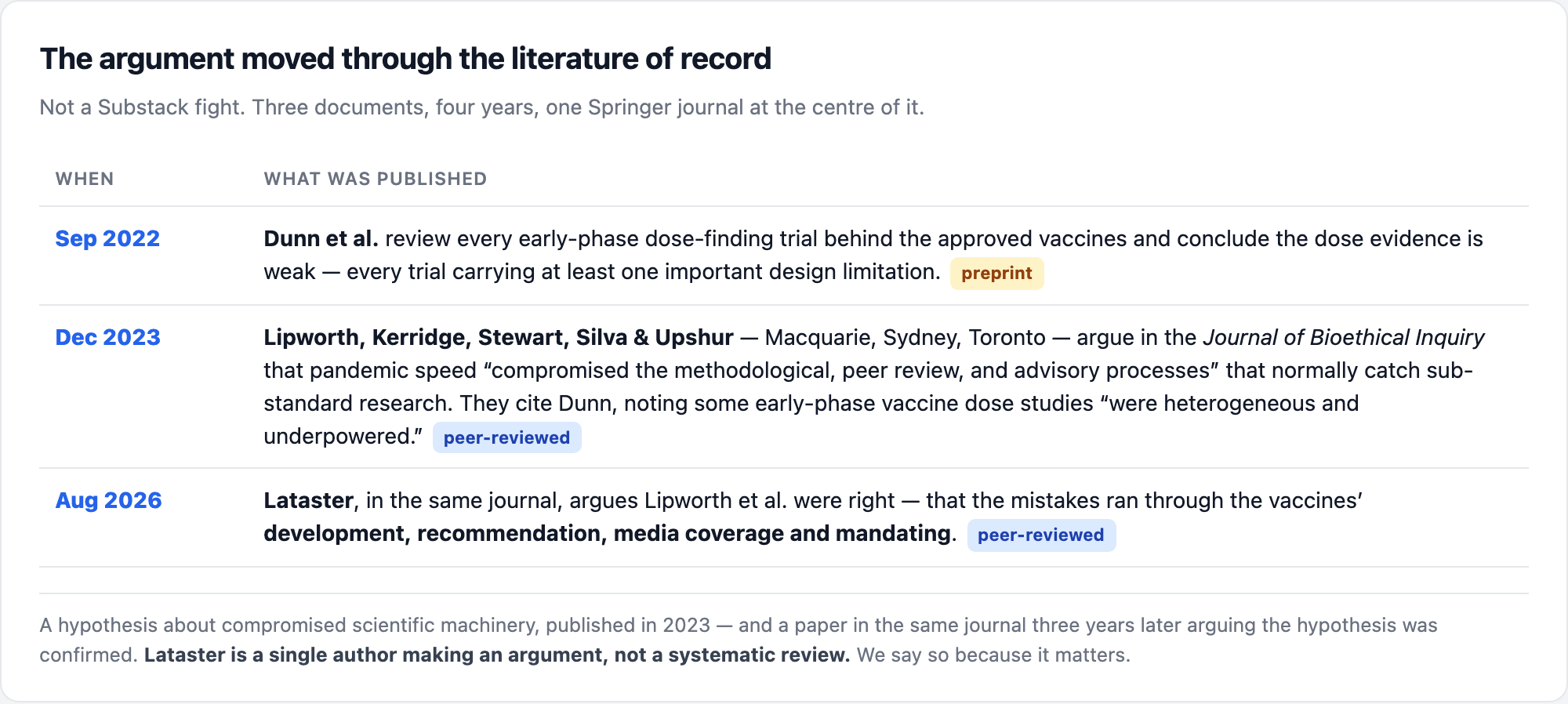
On August 11, 2026, the Journal of Bioethical Inquiry published “Lack of Rigour on COVID-19 Vaccines” by Raphael Lataster of the University of Sydney.
The argument is a direct reply to the 2023 paper. Lipworth and colleagues hypothesised that sped-up science had produced a multitude of mistakes. Lataster examines the more recent evidence and concludes they were right — and that the mistakes ran through the vaccines’ development, recommendation, media coverage, and mandating.
Four domains. Every one of them is a place where this newsletter has receipts.
Now the caveats, because we would rather list them than have them listed for us. Lataster is a single author advancing an argument, not a systematic review or a consensus statement. He also wrote the Substack post that brought this to wider attention, which means the “experts say” framing circulating today is partly an author describing his own work. None of that makes him wrong. All of it is worth knowing before you cite him.
Why this matters more than another document dump
Because of where it is.
For five years the standard move against anyone raising these questions was not to answer them. It was to place the person outside the boundary of legitimate discussion — a conspiracy theorist, an anti-vaxxer, a spreader of misinformation. That boundary was enforced, as we have documented at length, with the direct participation of federal agencies working through private platforms.
The boundary does not hold when the argument is inside a Springer journal, made by professors of bioethics at Macquarie and Toronto, resting on a review of the dose-finding literature by researchers at University College London and the MRC.
You cannot deplatform the Journal of Bioethical Inquiry.
The dose was never properly established. The processes that should have caught that were compromised by speed. And the peer-reviewed literature now says both of those things out loud.
It took four years, and it should not have taken a Senate subpoena, a FOIA lawsuit and a change of administration to get here. But here we are.
Sources: Dunn D, Gilson R, McCormack S, McCoy L, “Dose of approved COVID-19 vaccines is based on weak evidence: a review of early-phase, dose-finding trials,” medRxiv, 22 September 2022 (preprint), doi:10.1101/2022.09.20.22276701. Lipworth W, Kerridge I, Stewart C, Silva D, Upshur R, “The Fragility of Scientific Rigour and Integrity in ‘Sped up Science’,” Journal of Bioethical Inquiry 2023;20(4):607–616, doi:10.1007/s11673-023-10289-w. Lataster R, “Lack of Rigour on COVID-19 Vaccines,” Journal of Bioethical Inquiry, online ahead of print 11 August 2026, doi:10.1007/s11673-025-10548-y. Prior RationalGround reporting as linked.
“Science!” the mRNA cultists say. More like junk science. Stay away from the mRNA.
Well done