

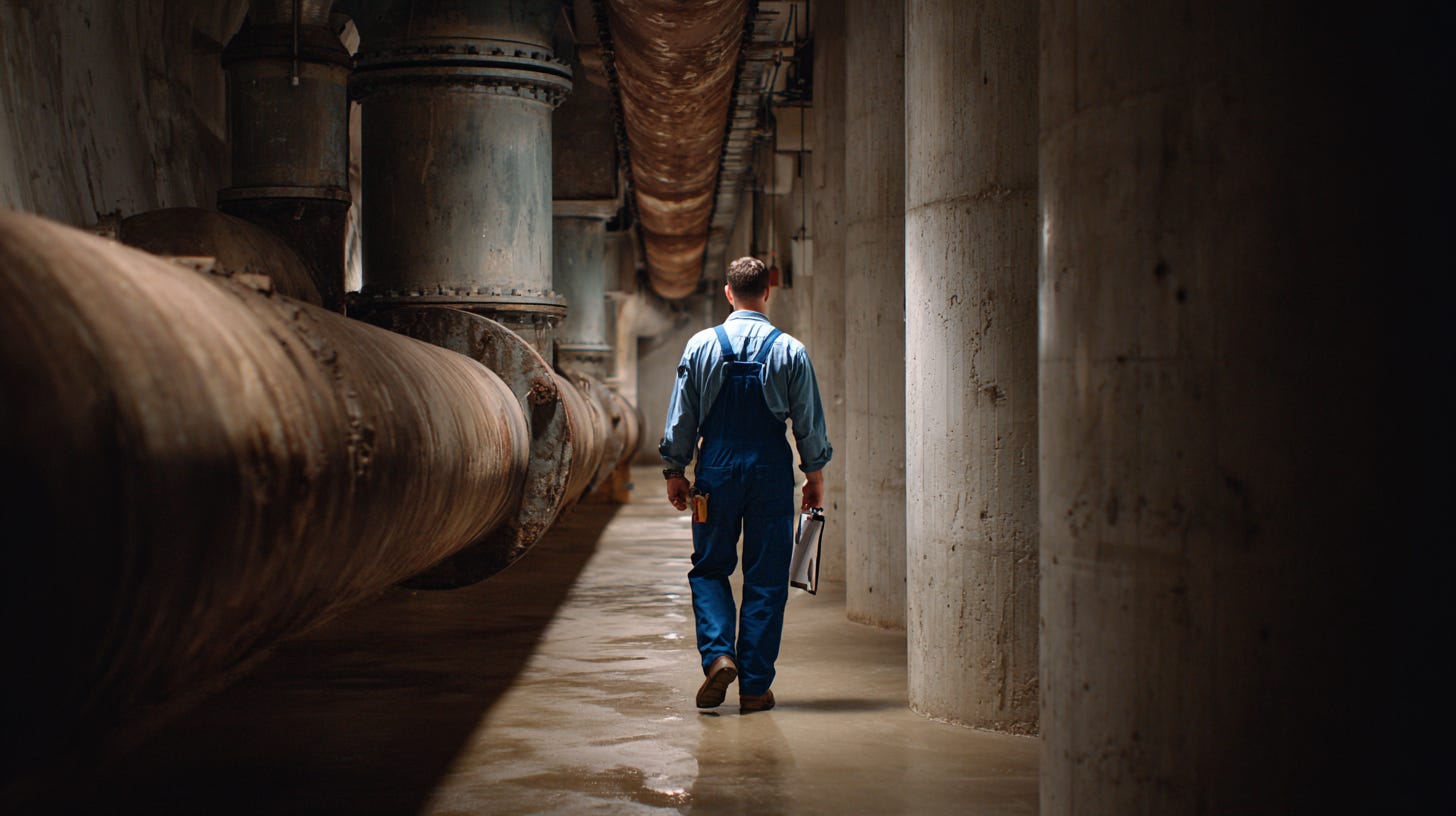
This is the third chapter in a continuing series. The first took you inside the Directorate, where decline is managed like inventory. The second walked Maple Street, where an extra bedroom became permission again. This chapter goes below the streets—to a European city built for more people than it has—where men are hired to imitate pressure so the pipes won’t confess the truth.
The pumps at Waterworks Oderstadt South hum with the patience of old men. Their housings are painted municipal green, their bolts torqued to numbers written in a ledger that has outlived two accounting systems and one currency.. From the mezzanine Erik Weiß watches gauges settle and watches a map where blue lines pretend to be veins. Oderstadt was designed for one hundred and twenty thousand. Today, it holds sixty-eight. The system remembers the difference more clearly than the citizens do.
The order to mimic load came after a summer everyone can smell when they think about it. First the basements near the canal—linoleum rippled by what rose from the sewers. Then six blocks where the air learned the word egg-gas. A nursing ward shower coughed instead of rinsed. A photo in the paper: a stroller afloat in a laundry room, which looked like theater but it was only physics. The city did not have enough citizenry to water its waterworks.
Committees met; numbers were shown. “We cannot right-size the network,” the finance man said, smiling the way a press release smiles. “This is capital we don’t possess. We will preserve function by preserving behavior.” The phrase went on a flip chart and into every policy brief from that time foward. Preserve behavior meant this: hire men to go door to door in empty flats, run taps, run showers, flush the loos, water the floor drains, and keep the water moving as if a larger city were still here.
Erik did not argue the hydraulics. After reunification, consumption fell like a taut rope—half in some districts—and the scouring force that keeps pipes honest fell with it. The textbooks say flow; the meters say drift. If velocity slips below the limit of deposition, things that should travel settle, and if they settle they rot, and if they rot they bite the concrete that holds them.
No one designed for so little. The men were hired to pretend the city still met its design.
His crew is older every season. Gerd (64) carries a key ring heavy enough to count as exercise. Marek (61) knows a starving riser by leaning his ear to a wall. Lothar (59) remembers when these towers smelled of new plaster and Saturday bread. On Mondays, they collect S-72 work orders—every fixture that sleeps must be woken every seventy-two hours—and sort them by stairwell and weather. They move through the city like custodians of absence.
A stairwell, four flights, twelve doors. Seven with nameplates that still mean something. Five with tape over a keyhole. Cold tap two minutes until the temperature holds. Hot tap until the return line stops lying. Shower from spray to stream. Toilet twice, wait, twice again. Floor drain topped up—seals dry, and then the city’s breath comes up through them. Sign water changed and the time. Check the meter. Close up. Move. They do this all morning, all week, all quarter, so the water behaves like a city that still has beginnings every year.
The city had always trusted the oldest engineer of them all—gravity. Networks were laid so water would fall downhill, sparing the expense of endless pumps. Pressure was free so long as people lived at the top to turn a tap, flush a cistern, rinse a plate. But the ancestral tree inverted itself: branches that should be heavy with descendants thinned and snapped, while the trunk, gray and thick, sagged under its own years. No one remained at the progenitor end of the faucet. The irony was bitter—designing for gravity, a force that never changes, and yet watching the system break under the weight of a society that ignored the one imperative it was really built to serve: go forth and replenish the earth.
By noon each day they reach a concrete row along a salt-scarred street that was meant to connect to more streets. The lift died last winter and was not revived because four tenants can climb. The city sent a letter asking for patience. Patience is what cities ask for when they do not have money; patience is what tenants spend when they do not have choices.
“Start with 4B,” Erik says. The log shows three weeks empty, and one visit missed when snow locked the vans. Marek turns the key. The air inside is colder than policy. The cold tap coughs, then threads, then runs noticeably warm in a room without radiators. “Warm line alongside,” Marek says. “Bleeding heat.” He writes insulate chase twice, hard. Warmed “cold” water is exactly the kind manuals worry about, and manuals worry for reasons that are not theoretical.
They open a hydrant at the end of a cul-de-sac that was supposed to get another block and never did. Rust slurs into the gutter like a confession, then clears; the sound deepens to something the city recognizes. Marek closes a quarter turn and listens. “Good,” he says, which means “not yet hopeless.”
On the mezzanine that evening they coil hoses. Lea (27), the new hire, asks the question systems people ask when they’re still generous with solutions. “Why not install automatic flushers?”
“Because the devices cost money we don’t have,” Erik says, “and because this isn’t a hotel empty for a season. This is a city learning to live at half its intended cadence. Control boxes don’t talk to caretakers. They can’t tell a neighbor a leak will ruin her cabinets by Thursday. They don’t hear a radiator that clanks like a verdict.” He doesn’t sneer at devices. He believes in attention.
The monotony is not only faucets and time. It is meaning filed to a dull edge. Wives and partners ask about shifts and learn to accept the answer again. Men who spend the day fighting stagnation come home and delay the first child the way the city delays capital works—next year, after the audit, when the line carries more. They say there’s nothing less satisfying than kicking against the pricks, as the good Book has it, or climbing a down escalator. The older ones have one child who moved away; the younger ones have intentions that will not become dates. Lea hears the jokes and goes quiet, not from surrender—only inventory.
The hallway moment arrives where moments like to: between 9A and 9B, sallow lights, a corridor that smells of envelopes and old soap. Gerd passes Erik with his toolbox low and says it without theater:
“Boss, when I go, put me on the schedule. Flush me every three days so I can pretend I still live here.”
He walks on. Erik does not.
The sentence lands and stays. It is not a joke and not a plea. It is policy—as epitaph. He sees his calendar as a straight road with no exit, S-72 stamps marching past his retirement date like conscripts who haven’t heard the armistice. He had kept a private superstition that there would be a project that finished. A district retired honestly. A trunk line abandoned with ceremony. In that corridor he understands the assignment: delay rot with routine; keep the city from smelling like the sum of its postponements; repeat until a valve fails in him first. He steadies himself on the jamb and feels the building exhale through steel into bone.
The city communications office asks for a quote because communications offices exist. “Why do we pay men to flush toilets,” the spokesperson says, “instead of investing in smart pipes?” She holds a card ready for the line that will be the headline.
“Because flow is cheaper than fantasy,” he says. “Because water stagnates in real time, and we must act in real time. Because we are keeping faith with what we own until we can afford to own less.”
She writes keeping faith in tidy capitals and smiles the way a press release smiles. It will go on the city website by dusk. It will be true and insufficient.
The rounds continue. A door they cannot open and a chain that gives. An apartment at the precise temperature of neglect. A letter from a daughter who last wrote at Easter. Lothar replaces the chain out of a reflex that makes no sense. They flush what must be flushed and call it in. Water does not negotiate with grief; it carries it if you let it sit. The forms will be filed. A landlord will be located. A notice will find a bulletin board. The city will act humane because people decide to be.
Spring adds a line to the work orders: Activation rather than imitation where possible. In a margin some urbanist has written Try the Bellwether approach in a round hand. At Number 9, second floor, the cold tap coughs and then the building answers with a sound no maintenance team can manufacture: a laugh in the stairwell, a voice to a child, the quick sink-tap of someone rinsing a cup. Lea smiles into the tile. Marek signs occupied with a small flourish and draws a line through S-72. The line looks like mercy and is only ink. Still, the meter spins like it means it.
Back at Waterworks South, screens line their numbers in a calm font. Pressure by district. Complaints by hour. Consumption by quarter. A lab note about H₂S uptick on the North trunk—“watch, not panic.” Erik enters totals. Flats visited: 63. Fixtures flushed: 221. Hydrants bled: 3. Anomalies: 5. A memo from Planning: Network conversion postponed. Asset life extension: proceed. Communications: emphasize reliability and stewardship.
Stewardship is the word you use when you are doing almost enough.
He writes his own memo, the kind that systems ignore until they don’t.
Subject: From Imitation to Invitation
Proposal: Pair S-72 rounds with activation visits: a flyer left in every flushed flat listing a leasing office, the bakery that hosts homework, an evening language class, a small subsidy to insulate chases so cold lines stay cold, a number for the van that comes when the weather turns on old bones. Measure not just liters moved, but people returned. Cost: less than crumbled gaskets, corroded mains, and court papers when we pretend water without people is neutral.
Verdict: Pipes run on pressure. Cities run on delayed beginnings.
The men keep moving. Erik buys better insoles and a calendar without pictures. Gerd learns a new trick for stubborn valves and pretends he always knew it. Marek trains his ear on Lea’s shoulders until she hears what he hears. Lothar writes “insulate chase” three more times than he writes his own name. Their lives are filled with the noise of use in rooms where no one lives.
The irony sits with them at lunch and never pays. They are hired to imitate the flush of children who were never born, to keep a civic body alive that has lost the will to replenish itself. Each day they rehearse family life; each night they return to quiet kitchens, postponed second bedrooms, city brochures about gentle density. It is a strange heroism: to keep turning the handle so the smell of surrender does not rise between floorboards.
In June, the spokesperson corners Erik again with a camera. “One more quote,” she says. “For the anniversary piece.”
He looks past her to the map. “Tell them this,” he says. “You can hire us to simulate the living. You cannot delegate the choice to live.”
She blinks, writes nothing, and asks if he’d mind saying it again into the lens. He doesn’t. She will use keeping faith. It fits better in a square.
On the mezzanine a small sign appears, hand-lettered and slightly ashamed of its italics: Beginnings are good hydraulics. No one claims it. No one takes it down.
A week later the team reaches a block they have visited for months without incident. In 3C, the cold tap runs warm again. Marek opens the chase and finds the insulation ragged as a tired argument. Lea phones the superintendent and doesn’t hang up when he tries to arrive later. He arrives now. They sleeve the pipe and run the tap until the copper tells the truth. It is a small repair. The kind that keeps a lawsuit from being born and a building from being a headline. Not victory. Avoided failure. In this work, that is what triumph sounds like.
That night Erik sits at his kitchen table with the system map folded to District South and a blank page. He draws a short line between a hydrant and a corner bakery and writes noise in the margin. He draws another between a lift that died and a clinic van that still arrives in six minutes. He writes attention. He draws a third from a sallow corridor to an office where the press smiles. He writes truth and scratches it out and writes work.
He thinks of Gerd’s sentence in the hallway. He thinks of the stroller afloat. He thinks of Lea, who is twenty-seven and will either stay or go and how his city should be worthy of either choice. He thinks of the pumps, faithful and tired, and of the way a bell sounds when rung only to count.
He sends the memo.
Morning comes in on schedule, measured and precise, and finds the same things in the same places: a hydrant cap that gives without sulking; a stairwell that smells of envelopes and not of eggs; a key ring that has learned every door; a crew that is older and on time. The pumps hum. The gauges settle. Somewhere a child laughs into tile and a meter spins like it remembers its purpose.
Oderstadt does not roar anymore. It keeps its commitments in ordinary light: a tap run, a trap topped, a hydrant bled, a flat invited back to life. The world has many ways to explain its quiet. This is not one of them.
You cannot flush a people back to life. You can only keep the smell of giving up at bay—three days at a time—until someone decides to begin again.
Very interesting readng. In Finland the upper middle class can afford a summer cottage. These are used for 1-3 months of the year depending on the type of work the owners have or if they are retired. The rest of the year they are idle.
Many do not have running water and rely on a well or a lake and have a french drain or similar with a composting outhouse. However if the cabin is on a municipal road that carries a sewerage main the owner is pretty much obliged to connect tot he utilities. The cabin is still idle for 9-11 months of the year though.
Water in outdoor pipes and taps has to be drained before the frost. typically these days if there is electricity a small heat pump is installed to maintain air circulation and dehumidification so the structure last longer. Drain traps and toilets are anointed with oil to prevent them from evaporating dry. This is a common chore for those rich enough to have an idle cabin or apartment. Landlords pay the caretaker to hire a facilities management company do the same with empty apartments in the way you describe I expect.
A few decades ago in Finland large apartment owners realised that they could install water meters on a per appartment basis in conjunction with needed plumbing upgrades. The extra cost of a meter was not so big when all the pipes were being changed anyway and running individual pipes was an option to have the meters in the service area in the basement where they could be read conveniently and economically.
This seemed like a great idea to milk those who were wasteful with unmetered water.
So this was done (and is done on all new renovation and build because water as a service is profitable) and a few things were observed. First those who wasted water used less after they were told that the water was now going to be metered, it was communicated after the meters were monitored for a while, for educational purposes. What was interesting is that those who were thrift with water usage ALSO reduced their consumption. This kind of proves that we all waste free resources even if we are nice people.
But what turned out to be a problem was that the sewers mains would block more often because there was less water flowing in the drains because people wasted less water. The city had to open taps at the very end of the sewer lines to keep water flowing to make up for the reduction of water that the tenants had stopped wasting.
In the end the city gained nothing by encouraging water saving. The landlords and letting agencies gained a new tool to bully tenants and the real cost of provisioning housing went up a little as meters have a cost and reading and billing has a cost (remote reading these days but even so).
The end result is that the man in the street is less well off.