

This is the second chapter in a continuing series. The first took you inside the Directorate, where policy is written in euphemism and decline is managed like inventory. This chapter shifts the lens to Maple Street—an ordinary block, an ordinary set of houses—where the arithmetic of falling birthrates shows itself in emptier classrooms and extra bedrooms. The Directorate speaks in ledgers; Maple Street speaks in lives. Both are true, and both will decide what kind of beginnings we will welcome.
The swing set on Maple Street squeaks more from wind than from children. Morning light comes in on schedule, measured and precise, and finds the same things in the same places: the cracked basketball hoop over Number 12, the porch flags that never learn to fade, the mailboxes that open like tired mouths. The school bus still rolls through at 7:40, but it carries fewer knees against vinyl, fewer foggy drawings against the windows; most of the kids now ride across town to Summit after Bellwether’s consolidation.
The driver waves at habit. Habit waves back.
Caleb and Nora live at Number 18, a modest 1954 box house with three bedrooms on a lot that once assumed a bigger noise would follow. They have made peace with two rooms and a hallway of framed vacations. The third room holds the overflow of a careful life: a treadmill that folds upright, a crib still in its cardboard, a stack of banker’s boxes labeled Files and Someday. The door to that room closes softly because there is nothing in it that demands to be heard. A room is a ledger. This one is a legion of postponements.
They are not cruel to themselves. They have jobs that run late and finances that run later, and parents who live two states out and call on Sundays. They grew up on a street that couldn’t count its strollers; they do not remember a block party that needed a permit. They will have children, they say—just not now, not until the promotion, not until the kitchen, not until the city decides whether a family is supposed to be a line item or a public good. They say it kindly and frequently. Time hears and keeps walking.
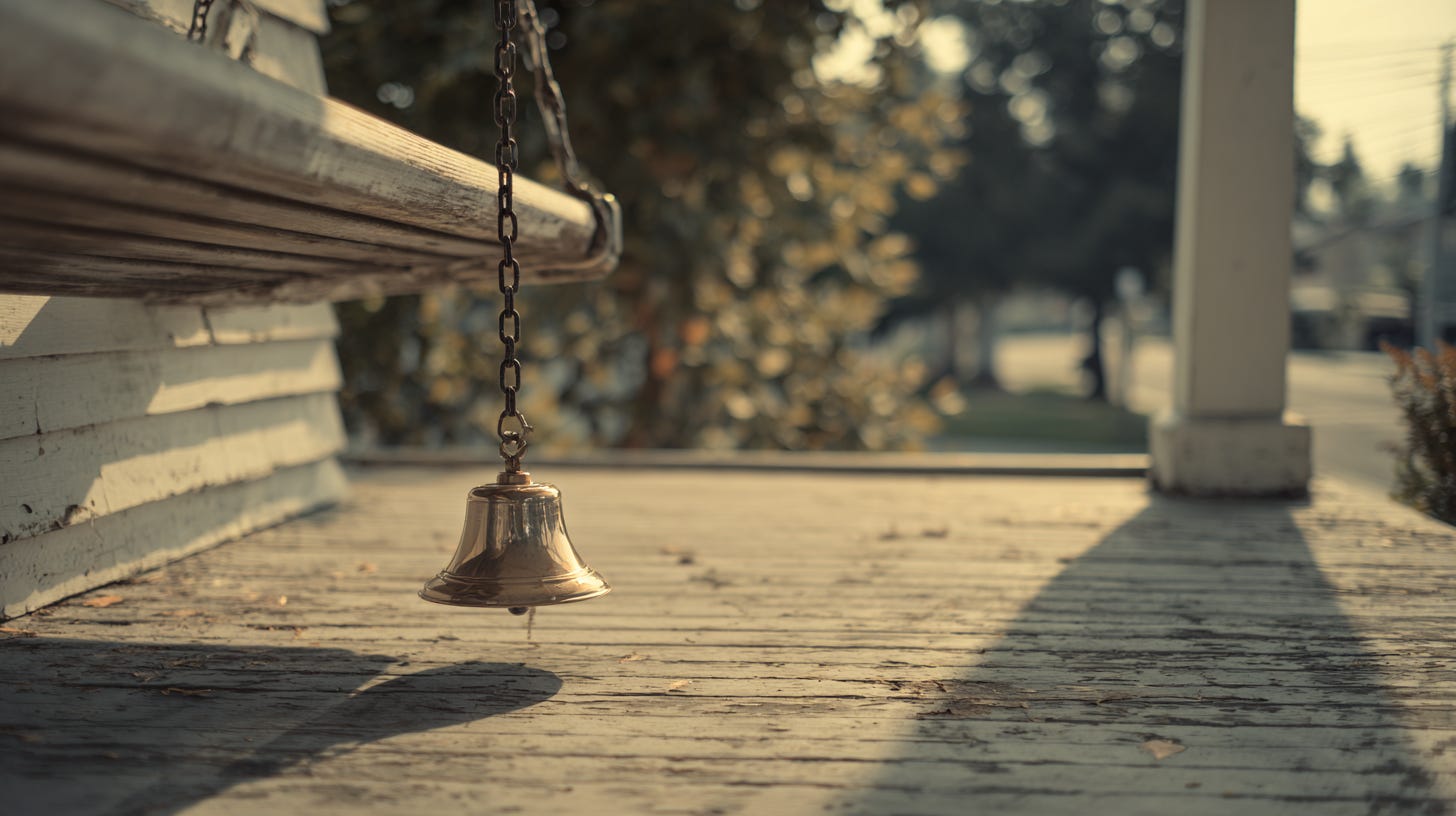
Across the way, Mabel Ortiz keeps a tidy house with a front step that expects visitors. She is eighty‑three and has three grown children who text emojis from airports. She knows everybody’s trash day and everybody’s first name. She can still lift the storm window into place. Some afternoons she sits on the porch with a bell in her lap, a small handbell from a classroom she taught in before the district found better words for less. When the wind moves the swing, she rings the bell. It just seems right to do so.
The city posts a notice for a Route Optimization Hearing in the church basement two blocks away. The flyer says the word “right‑size.” DeShawn Carter, the budget director, arrives with a map and numbers that he does not apologize for but it’s clear someone is owed an apology. Everyone recognizes that.
Empty buses cost. Fixed headways do not serve thin demand. The new plan reduces two routes to one and replaces the other with on‑demand vans that stage from the old Bellwether lot. He does not sneer. He does not smirk. He speaks like a man who knows what can be paid for and what can only be wished at.
A woman behind Caleb mutters that she liked it better when problems kept quiet. A man at the mic says his mother takes the bus because she does not take chances. DeShawn hears them and does not argue with their lives. “If the map cannot move,” he says, “then the people will have to. I would rather the vans move.” He gives his email like a promise and leaves with the map rolled tight. Prudence is a virtue until it isn’t. A city has to choose when that is, but usually, it loses.
On Saturday, Amina and Yonas Tesfaye sign a lease for the tiny storefront at the corner: Daylight Bakery in the morning, Little Daylight in the afternoon. Their daughter is two. Amina bakes rolls that let steam out like relief. Yonas paints a sign that says Evening Homework Here, letters straight as rule lines. They bring noise with them the way a new kettle brings steam: not recklessly loud, but honest and present.
After coffee one Sunday, Caleb stops in the third room and dusts the top of the boxes. He stands in the middle and turns a slow circle, measuring without a tape. “We should make it a guest room,” he says.
“For who?” Nora asks from the doorway.
“For the life we keep expecting to arrive on time,” he says, and the joke does not need a laugh to be true.
They go to the Permit Counter on Monday with a set of sketches printed from the internet and the seriousness of people who have decided to do something small and real. The clerk smiles or maybe not, it’s unclear. He slides across a trifold titled Gentle Density Options. Junior ADU, it says. Conversion of existing space. There are fees. There are inspections. There is a checkbox for Intended Use: Family / Non‑Family that sounds like a riddle.
“Who will live there?” the clerk asks.
“A person with plans,” Nora says. “Maybe us. Maybe someone we should have met already.”
The clerk stamps a date and assigns a number that will be called by a speaker that never rushes. “Congratulations on investing in the future you want to see,” he says, and the sentence is clean and empty all at once.
Work begins. A contractor named Luis frames a closet and opens a wall; he listens more than he talks. Caleb learns the weight of one‑by‑threes. Nora learns the cost of a small window that meets code. Plywood leans against the hall like bread line. Their savings account steps down the stairs like a careful person. On the second day the breaker trips and the house goes quiet in a way that sends them outside to the porch to breathe. On the third day Mabel brings lemonade and says the smell of cut wood is better than a sermon. Her bell sits beside the pitcher. “Every house on this street was built for a bigger life than it holds now,” she says. “It isn’t the lumber’s fault.”
At the bakery Amina counts receipts and calculates how many children can sit at three small tables without being managed, only guided. She posts a flyer at the Family Work Center in the old Bellwether building: Evening English 6–8, Childcare Available. The flyer uses spare words and a clear font. A city is a machine that either helps a mother read the letter that decides her job or does not. She does not ask permission to be useful.
Mabel’s youngest son, Rick, arrives in a rental car one Thursday and looks at the roof as if he can see the bill for it through shingles. He stays the night and leaves with a list. Three weeks later, there is an ambulance. Martha Kim—retired ICU nurse, now a home‑health supervisor—meets it at the curb with a bag packed for the kind of night that tests schedules. Mabel’s face has the set of a person who knows her body’s opinion. A neighbor calls the on‑demand number and the mobile clinic van that stages at Bellwether is at the curb in six minutes. Mabel rides to the hospital with the bell in her purse. She does not come back.
The estate sale is clean. A sign reads For Sale, By Adult Children because that is the truth. The living room smells of lemon oil and competence. There are cards on a table with prices that match sentiment badly. A boy from Summit buys a set of World Book encyclopedias for five dollars and carries the whole alphabet out in two trips. Rick signs papers with a notary on the porch and leaves the key on a ring that clinks too loudly for a street this large.
Across town, the city approves twelve demolition permits in neighborhoods that were not built to be empty; none of them are on Maple Street, yet. Investors leave notes on Mabel’s door with numbers that do not confess what will happen to the house once an LLC buys it. Amina tapes a typed letter to the porch rail asking if the family would consider renting to them first. She signs it with her phone number and a line that reads: We will keep the garden. She means it.
The third room passes inspection on a Wednesday. A city employee with a quiet pen checks boxes and photographs a window, it’s unclear why but he thought it was the right thing to do. He thanks them for improving the housing stock. He leaves a sticker that says Approved in a shade of green that governments believe signals calm. Caleb and Nora stand in a room that finally has a bed and a lamp and air that expects to be breathed. It looks like a promise you can sleep in.
They post a listing with three photos and eight words: Quiet room. Maple Street. Families welcome. References needed. Two replies arrive in an hour. One is long and spells every word like it matters. My name is Hiwot. We are expecting in September. We work days. We need a place that wants us there. They meet on the porch. Hiwot has a hand on her stomach like an oath. Her husband, Dawit, speaks of bus schedules and the way a city can be either difficult or deliberate. They do not ask for its history. They ask for its lease.
At the same time, the city schedules the Route Optimization vote for the council. The gallery holds a crowd that wants the old map to hold because it held them when they were stronger. DeShawn reads numbers, and numbers do what they do: they hold when narrative slumps, they sag when used for cover. “We can keep frequency where there are riders,” he says, “and we can keep access where there are people. We cannot keep a bus where there are neither.” This seems obvious albeit devestatingly unfortunate. The vote passes 5–2. The vans stay. The map tightens. The gallery exits with the quiet churn of a machine that has run too long without maintenance.
September arrives. Hiwot and Dawit move into the third room with two suitcases and one framed photo. The door to the new kitchenette sticks the first day and yields the second. Amina brings bread that lets steam out like relief. Yonas hooks a small shelf to the wall and says a blessing under his breath that involves nails and hands and good noise. The street feels different in a way that is not measurable until you try to fall asleep and someone else’s footsteps exist, and you are glad for them.
Mabel’s house does not go to the LLC. Rick reads Amina’s letter and decides the price of the garden is more than the difference between offers. The lease is signed on the hood of a car with a pen that has already signed a burial permit. The key stays on the ring. The bell remains in a drawer in the kitchen until Amina hangs it by the back door the way you hang a memory that deserves air.
The baby arrives on a Tuesday in late rain. Hiwot texts Nora from the clinic: He is here. Three words. Enough. Dawit appears on the porch that night with a bag and a look that knows both gratitude and logistics. The on‑demand van picks him up at 5 a.m. without asking for proof of what kind of day this is. When he returns, he carries the carrier into the third room and sets it down as if the floor were thinner than it is. Caleb stands in the hall and understands suddenly why a house was built with three bedrooms in a decade when men came home from war and women were tired and hopeful and lumber was cheap. It strikes him suddenly that this room was permission to start a family but he can’t afford to carry those emotions.
There is a first‑month check‑in with the permit office where a different clerk asks if there have been any noise complaints. “No,” Nora says. “Not the kind that matters.” The clerk smiles in a way that does not typically belong to people and stamps COMPLIANT. Wonderful. If a city could be saved by stamps, archivists would be our kings.
On the last Saturday of the month, Little Daylight hosts a First Birthday for the block. The actual birthday belongs to a boy named Mikael, but the event belongs to the street. Folding tables go up with the efficiency of remembered practice. The old bring chairs with arms. The young bring plastic cups that tip easily. That seems fine by everyone. Someone puts a bus map on the wall and uses it as a tablecloth. It is the best use of that map anyone has found all year.
At four o’clock a patrol car rolls by slow and curious. The officer lowers the window and asks about permits as if he is asking the weather whether it intends to hold. Amina hands him a copy. “Food service,” she says. “Noise is voices before ten.” He nods and stays for a cupcake. The city is not an enemy when it remembers it is ours.
The bell by the back door is rung once. Not as an act of defiance. As an act of counting. The sound moves down Maple Street and into Number 18 and out again. The swing set squeaks at the right time for once. Mabel’s porch, now Amina’s porch, holds a cake with a candle that refuses to intimidate anyone. Jonah from the church says a blessing without using words that make anybody choose a team. DeShawn arrives late because he had to stay for a procurement question; he does not bring a map; he brings a folding chair and sits where the shadows start. He watches the vans pull up and pull away full and thinks that perhaps prudence without beginnings is just a service plan.
Caleb and Nora stand at their gate with the easy posture of people who have chosen a direction and decided to endure its costs. Inside, the third room holds a crib that is not in a box. The treadmill is in the garage with the paint cans. The banker’s boxes have been thinned to what records must legally be kept and what a conscience cannot file away. The door to the room no longer closes softly because something inside expects to be heard. Even Caleb wants to hear that noise.
Later, after the street has gone back to its usual exactness and the powded sugar from Amina’s pastries has left the air, Nora sits at the small table under the small window and writes a line on a card she leaves taped by the light switch: Beginnings are what make prudence a virtue. It is not a policy. It is an invitation.
Maple Street does not roar anymore. It keeps its commitments in ordinary light: a room repurposed, a lease signed, a van routed to where a baby is, a bell rung once. The world has many ways to explain its quiet. This is not one of them.
Homes are promises kept and invitations accepted.
Setting the stage. Thanks.
Wow. This is a perspective that is new to me, but seems right. Thank you!