


I’m a third-generation Californian raising a fourthgeneration of kids in the Golden State (Jenny’s family goes back 3 more generations!), but it’s getting harder and harder to ignore the warning signs of a failed state.
The latest warning is not subtle. A CBS News investigation reports that Los Angeles County hospice fraud indicators are not shrinking after crackdowns. They are spreading. If this holds, we are not looking at isolated misconduct. We are looking at a systemic governance failure in end-of-life care.
The Math That Should Alarm Californians
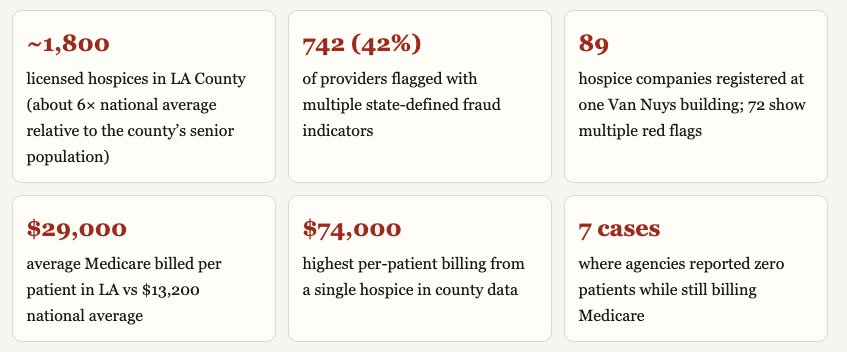
hese are not marginal anomalies. They are pattern-level signals. California’s own 2022 state audit already warned about this environment, citing a 1,500% increase in LA hospice companies since 2010 and an estimated $105 million in Medicare overbilling in one year.
A Human Story Behind the Spreadsheet
CBS highlighted Lynn Ianni, a 69-year-old pickleball player who said she discovered she was listed in hospice care when Medicare denied physical therapy coverage after an injury. Her Medicare number had allegedly been stolen and used for fraudulent enrollment.
“They said, ‘you’re in hospice.’ And I said, ‘what? What are you talking about? Are you kidding me? Do I look like I’m in hospice?’”
That is what system failure looks like in real life: not a hearing, not a press release, but a legitimate patient locked out of care because fraud data entered the system first.
Ghost Hospice, Clustering, and the Accountability Lag
CBS reports nearly 500 hospices operating within a 3-mile radius in LA, with 137 on Van Nuys Boulevard alone. One building listed 89 registered hospice companies, while the owner reportedly said only 12 were active tenants, raising concerns about so-called “ghost hospices.”
Even more striking: the investigation found overlap in key personnel, including one medical director listed across 45 hospices and 75 people simultaneously tied to five or more companies. State auditors have explicitly described this type of overlap as a fraud warning signal.
California says it has revoked 280 licenses. The attorney general says more than 100 defendants have been targeted in criminal hospice fraud cases. Those actions matter. But they also underscore the core problem: accountability arrives after losses and after patient harm.
This Pattern Is Familiar to Californians
Many Californians already know this policy rhythm from 2020–2021: warnings emerge, institutions reassure, harms mount, and serious accountability comes late.
Different policy area, same structural failure mode:
Detection without fast intervention
Public messaging without transparent scorecards
Enforcement after damage, not before
We don’t have a red-flag identification problem. We have an enforcement velocity problem.
What Real Reform Would Look Like
Ownership transparency: public beneficial ownership records for every hospice entity
Real-time anomaly triggers: auto-escalation when billing/staffing/clustering thresholds are crossed
Rapid suspension authority: temporary operational holds when multiple fraud indicators stack up
Public provider scorecards: clear risk and enforcement records for families and referrers
Agency accountability: mandatory performance review when warning clusters persist
Love of State Means Refusing to Normalize Decline
I love California. That is exactly why this matters. You don’t ask more from a place you hate. You ask more from a place you still believe can work.
If fraud can scale in end-of-life care years after official alarms and reforms, this is not a one-off crime problem. It is a governance problem. And governance problems only improve when consequences become faster, clearer, and unavoidable.
Sources:
CBS News project: https://www.cbsnews.com/projects/2026/hospice-fraud/
CBS News video: https://www.cbsnews.com/video/cbs-news-investigation-hospice-fraud-in-california/
California State Auditor Report (2022): https://information.auditor.ca.gov/pdfs/reports/2021-123.pdf
Make Accountability Great Again
I will do everything in my power to remain at home when I am old. Trying to figure out where I can go in TJ, Mexico, if I need a hospital.