

On Dec. 1, 2020, Scott Atlas resigned from the White House.
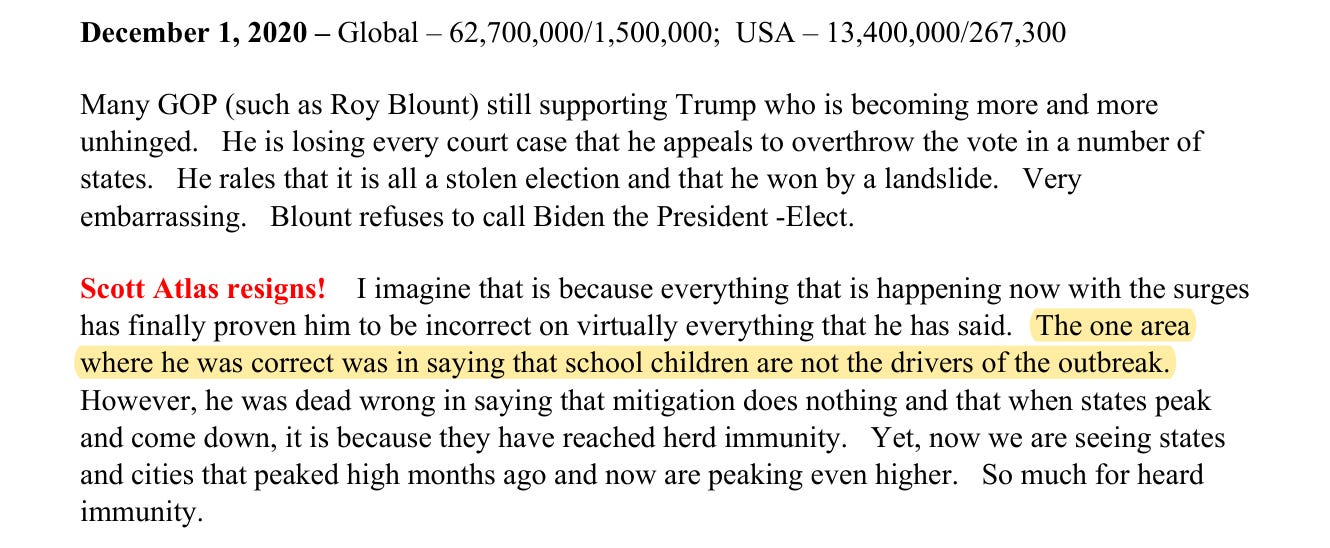
That night, Anthony Fauci wrote about it in his diary. Atlas, he wrote, had been proven "incorrect on virtually everything that he has said."
Then he added one more sentence:
"The one area where he was correct was in saying that school children are not the drivers of the outbreak."
Read that again.
In December 2020, with many of the country's schools still closed, the most powerful public-health official in America conceded, in writing, the central point of the man he had spent the fall trying to push out. Seven weeks earlier, the same diary records a "long talk tonight with Jared Kushner asking his help in getting rid of Scott Atlas."
That line about school children sat in a private journal for almost six years, until Sen. Rand Paul released Fauci's diaries this July.
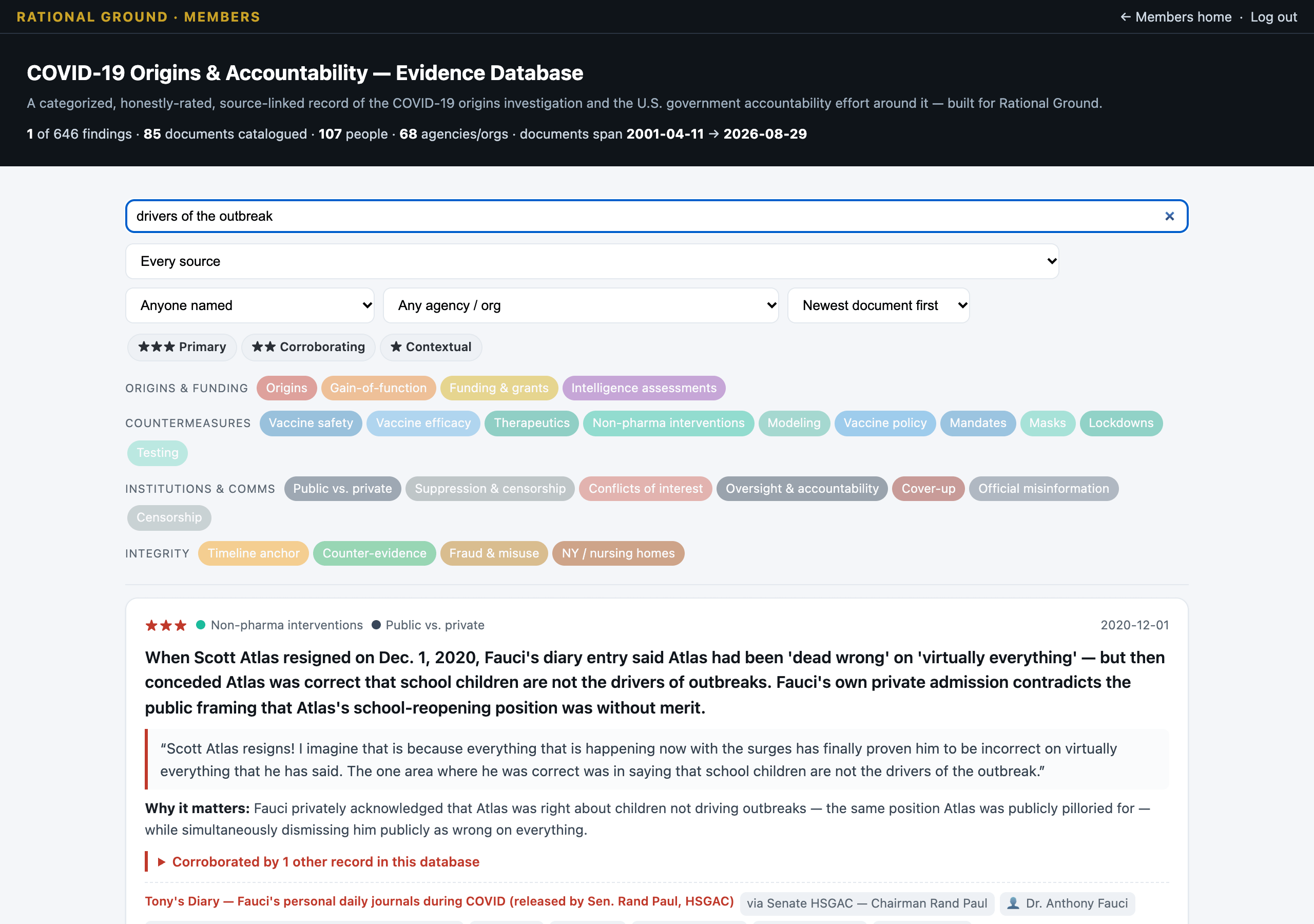
It's one finding. The database has 645 more.
What's new since June
When we opened the COVID FOIA Database in June, it held 239 findings. Today it holds 646, drawn from 81 compilations and naming 101 people. Anthony Fauci appears in 268 of them.
Much of the new material only became public this summer:
Fauci's personal diaries, released by Sen. Rand Paul in July.
Texts from Fauci's government iPhone, released by Sens. Ron Johnson and Rand Paul in August.
The intelligence community's declassified COVID files, released by Director of National Intelligence Tulsi Gabbard in June.
Testimony from a CIA whistleblower, James Erdman III, given under subpoena in May.
NIH's Ebola files, released by Sen. Paul on Sept. 28.
Plus the Proximal Origin authors' private Slack messages, Ralph Baric's transcribed interview, the full Fifth Circuit record in Missouri v. Biden, and hundreds of newly unredacted Fauci emails.
A confession, because you deserve one: from June until this week, members were still looking at the June copy. The research kept going. The members site didn't keep up. That's fixed, and it can't happen again: one build now updates both at the same time.
Six new receipts
1. The CIA changed its answer. Nobody can say why.
James Erdman III is a senior operations officer at the CIA. In May, he testified under subpoena before Sen. Paul's Homeland Security Committee. His written testimony walks through how the intelligence community handled the origins question. One line stands out:
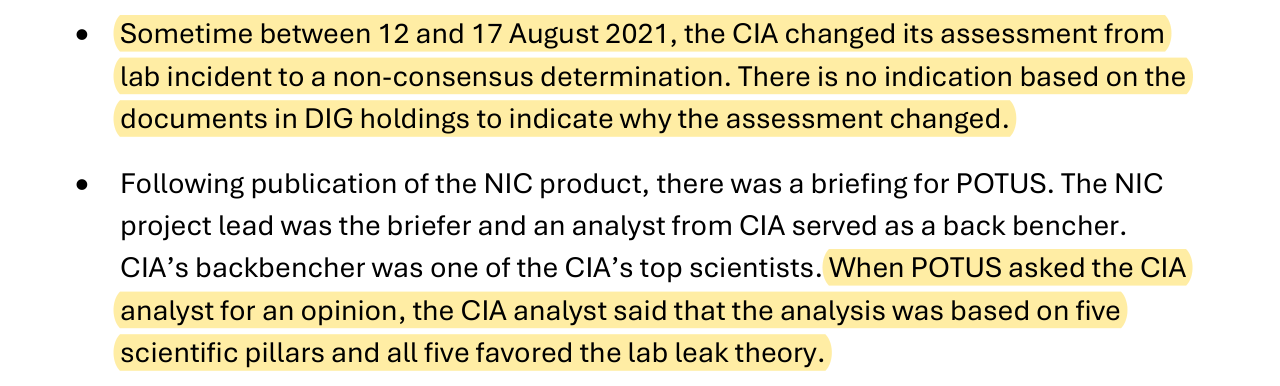
"Sometime between 12 and 17 August 2021, the CIA changed its assessment from lab incident to a non-consensus determination. There is no indication based on the documents in DIG holdings to indicate why the assessment changed."
Then came the briefing for the President:
"When POTUS asked the CIA analyst for an opinion, the CIA analyst said that the analysis was based on five scientific pillars and all five favored the lab leak theory."
The same testimony says a Department of Energy national lab concluded in May 2020 that "all of the prerequisite conditions for a lab leak were present" at the Wuhan Institute of Virology. That report "was not included in any of the IC products in 2020."
2. Fauci helped choose who the spies would ask.
In May 2021, President Biden ordered the intelligence community to study COVID's origins in 90 days. The declassified files show that in July, the official running that study wrote that "Dr Fauci recommended that the IC reach out to the below individuals who were coauthors of the attached paper."
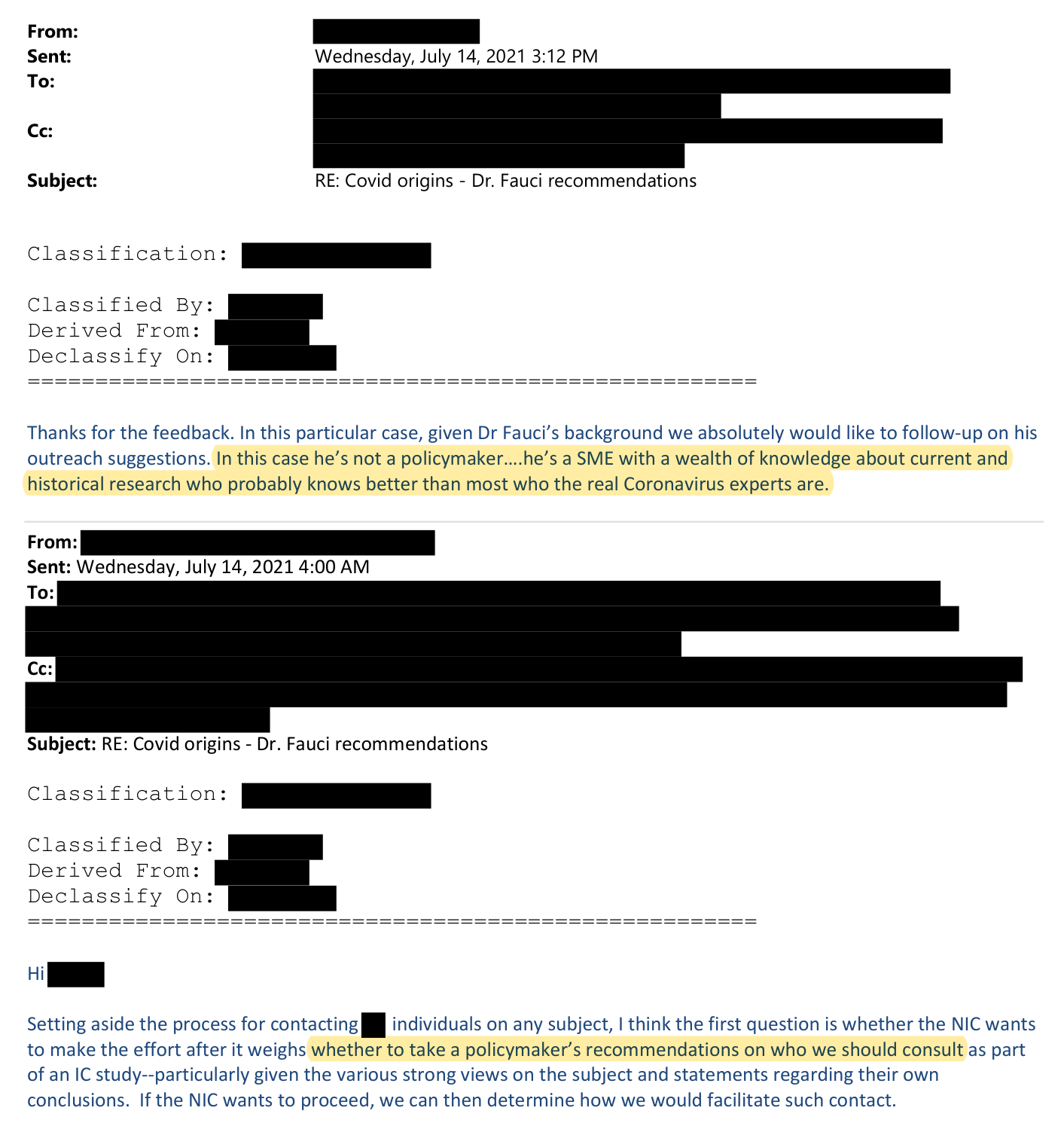
An intelligence official objected in writing. Should the National Intelligence Council "take a policymaker's recommendations on who we should consult as part of an IC study — particularly given the various strong views on the subject"?
The answer came back the same day:
"In this case he's not a policymaker...he's a SME with a wealth of knowledge about current and historical research who probably knows better than most who the real Coronavirus experts are."
The man whose agency funded research in Wuhan was treated as a neutral subject-matter expert on whether that research caused the pandemic.
3. The miscarriage text.
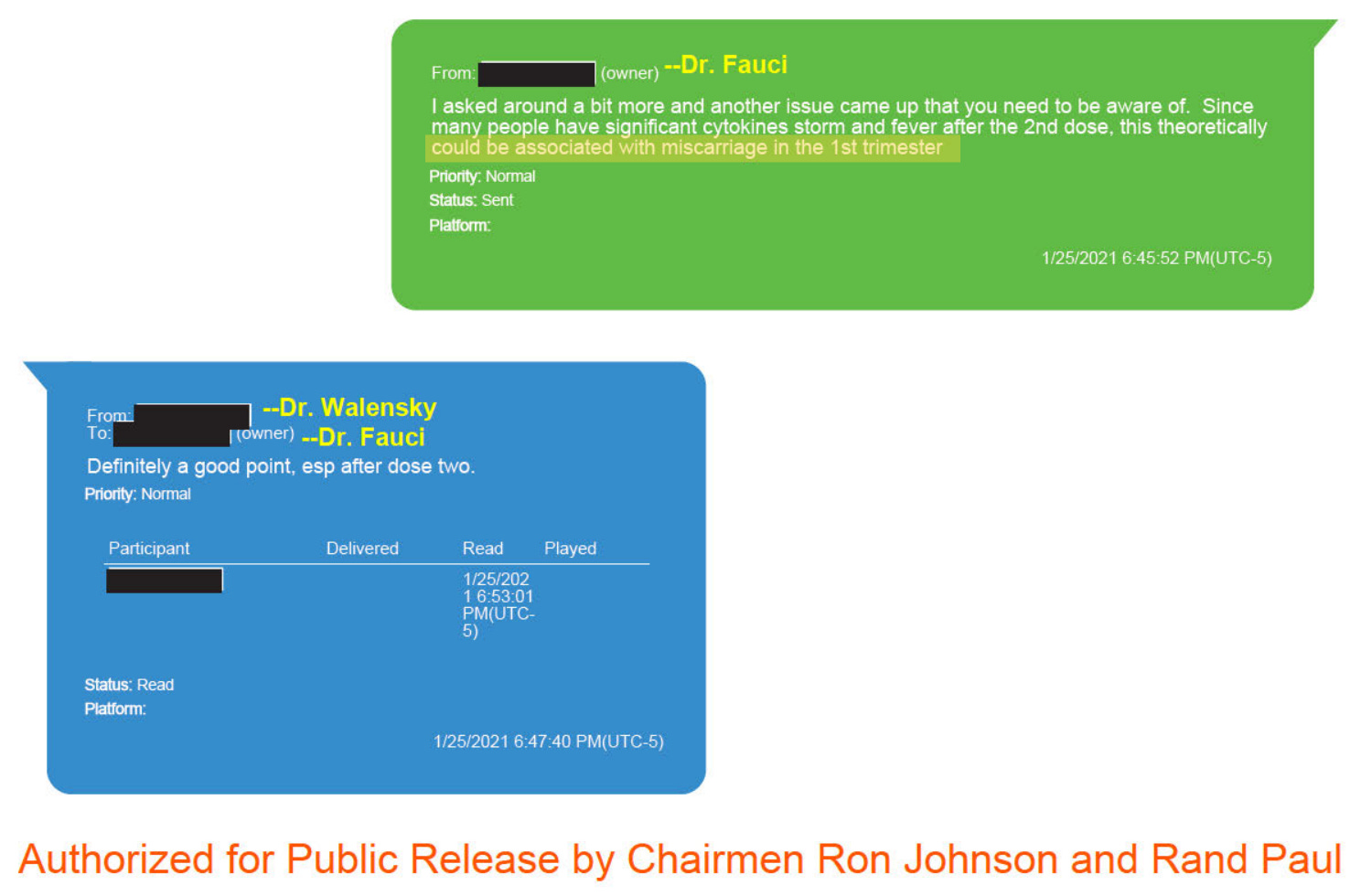
On Jan. 25, 2021, Fauci texted CDC Director Rochelle Walensky and Vivek Murthy, President Biden's pick for surgeon general, from his government iPhone:
"Since many people have significant cytokines storm and fever after the 2nd dose, this theoretically could be associated with miscarriage in the 1st trimester."
The next day, in another text about the WHO's caution on the Moderna vaccine in pregnancy, he wrote that more than 10,000 pregnant women had been vaccinated:
"No issues have arisen... Animal tox studies did not raise any red flags."
To be fair, both can be honest statements. A theoretical risk is not a known one. But one of them was a private concern shared among the country's top health officials, and members can now read the whole exchange and decide for themselves what the public deserved to hear.
4. The press conference problem.
In March 2021, Fauci learned that Drew Weissman, one of the scientists behind the mRNA vaccines, was planning a press conference about a mouse study. It found an immune response in the amniotic fluid of the pups after an mRNA shot. Fauci's diary:
"Even if the Weissman studies prove to be invalid, the fact that they are holding a press conference is going to create a huge mess. Hopefully, we can get this sorted out and have a repeat of studies to counter this finding."
The next day he wrote that he "took the le[a]d" in pushing the FDA and CDC to make sure "all their ducks were in order." The FDA reported that both Pfizer and Moderna had clean animal studies on file. That's in the database too. But notice the order of his worries. The first one was the press conference.
5. "Even when it does not contain actionable misinformation."
The Fifth Circuit's 2023 opinion in Missouri v. Biden is one of the most detailed official accounts of how the government leaned on social media. After meeting with federal officials, one platform sent a list of "commitments." One of them was a policy change "focused on reducing the virality" of anti-vaccine content even when it "does not contain actionable misinformation."

Not misinformation, even by the platform's own standard. Turned down on purpose.
A White House official told another platform its concern was "shared at the highest (and I mean highest) levels" of the White House. When the platform sent a moderation report, the official flagged a user's account. The platform removed it "entirely."
6. Before COVID, there was Ebola.
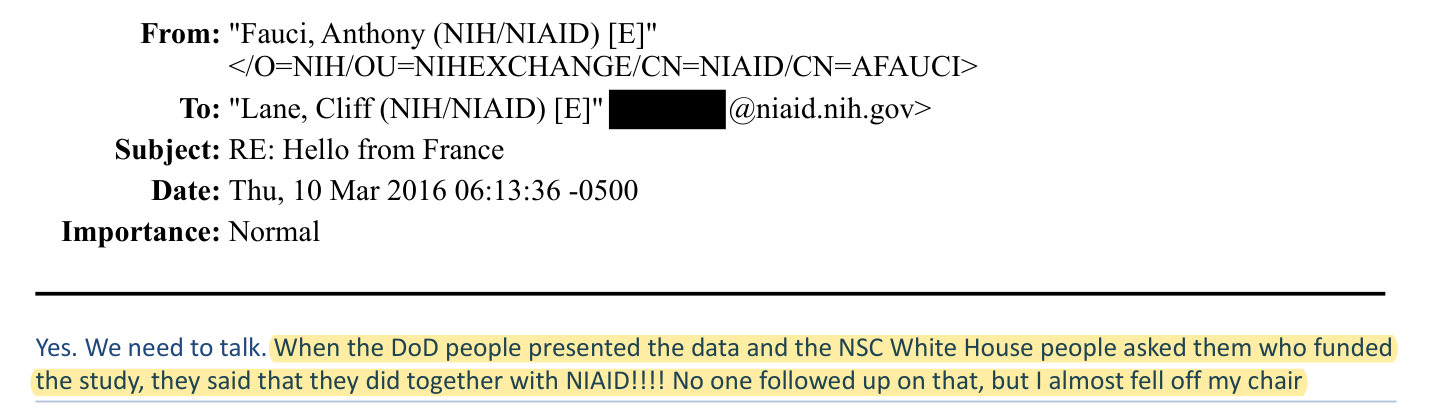
In 2015, NIAID helped fund an Army experiment that exposed vaccinated monkeys to aerosolized Ebola. In March 2016, Fauci found out at a White House meeting that his own agency had helped pay for it:
"When the DoD people presented the data and the NSC White House people asked them who funded the study, they said that they did together with NIAID!!!! No one followed up on that, but I almost fell off my chair."
The same day:
"The DoD folks said that they wanted to publish the data. I said that I thought that it should be classified and the NSC people blew them out of the water and said that they agreed with me."
Four years before COVID, the reflex was already there: when risky research produced bad news, manage who gets to see it.
And one quick hit, for everyone who spent 2020 standing on floor stickers. Asked by congressional investigators in 2023 where the six-foot rule came from, Fauci said: "It sort of just appeared." Asked if he'd seen studies supporting it: "I was not aware of studies."
How we keep it honest
Every finding is rated for what the document itself proves:
★★★ The document says it outright, and the exact line is quoted.
★★ The document supports it, alongside other evidence.
★ It's context, or its meaning is disputed.
The database also keeps 32 findings that cut against popular claims, logged at face value. The 2021 intelligence assessment judged the virus "was not developed as a biological weapon." NIH ethics officials reviewed one of Fauci's foreign prizes and cleared it. Inside the Proximal Origin Slack, Eddie Holmes pushed back hard on the idea that anyone had engineered the virus. Those are all in there. A database with only the damning documents is an op-ed. One with the inconvenient ones too is a record.
And we're holding our own sources to the same rule. The House Select Subcommittee's final report supplies 149 findings. Where the report quotes an actual email or transcript, the finding keeps three stars. Where it's the committee's own conclusion, we're re-rating it to two stars and labeling it "Committee conclusion." A committee's opinion isn't a primary document, even when I agree with it.
What's coming next
A link and a copy-ready citation for every finding, pointing at the exact document and page. If you write, post or argue about this stuff, you'll be able to cite it in one click.
A timeline, so you can watch what officials knew line up against what they said.
A page for every person and every document.
New batches on what you ask me about most: vaccines, lockdowns, masks, schools and testing.
How to get in
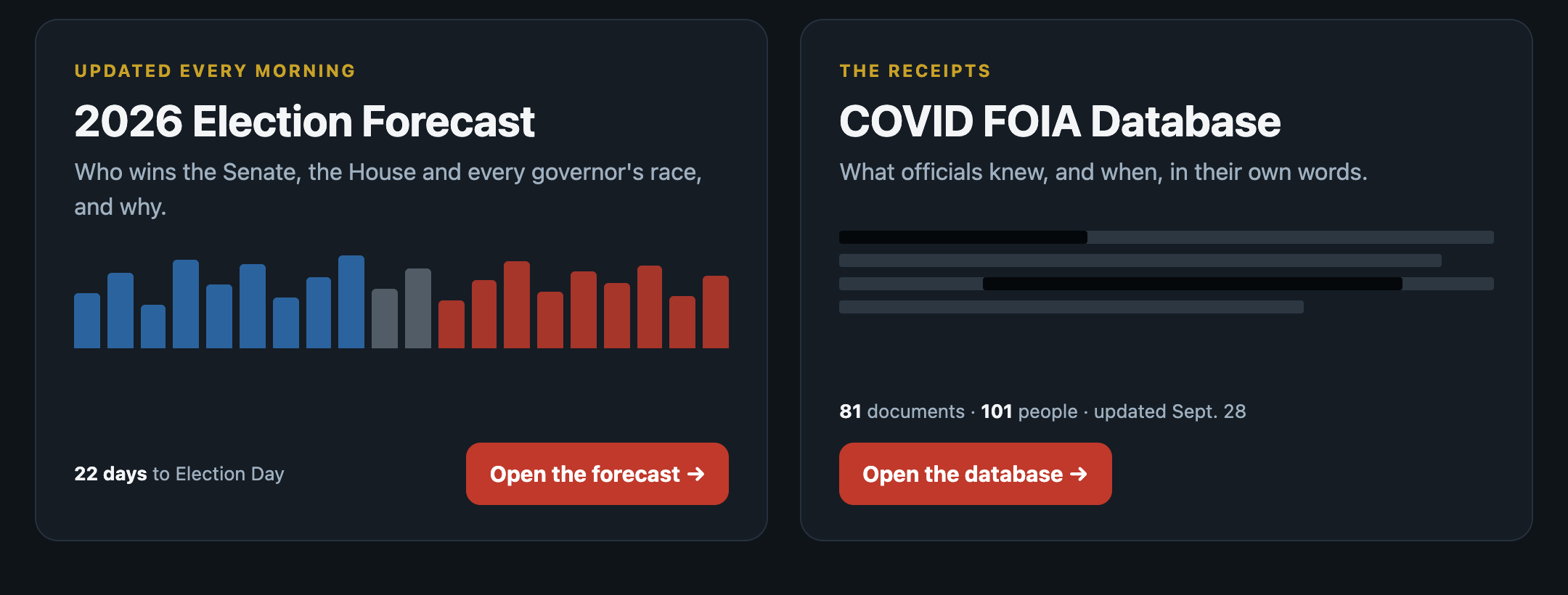
Everything lives at members.rationalground.com. There are two doors: the 2026 Election Forecast, updated every morning, and the COVID FOIA Database.
Paid subscribers: you already have the key. It's the same password that opens the Election Forecast. If you can't find it, just reply to this email.
Not a member yet? Right now it's $56 for the first year instead of $70, through Nov. 4, and it gets you both.
Become a member → $56 for your first year
They wrote it all down: in diaries, in texts, in emails they assumed nobody would ever read.
We're reading them. All of them. Line by line.
— Justin